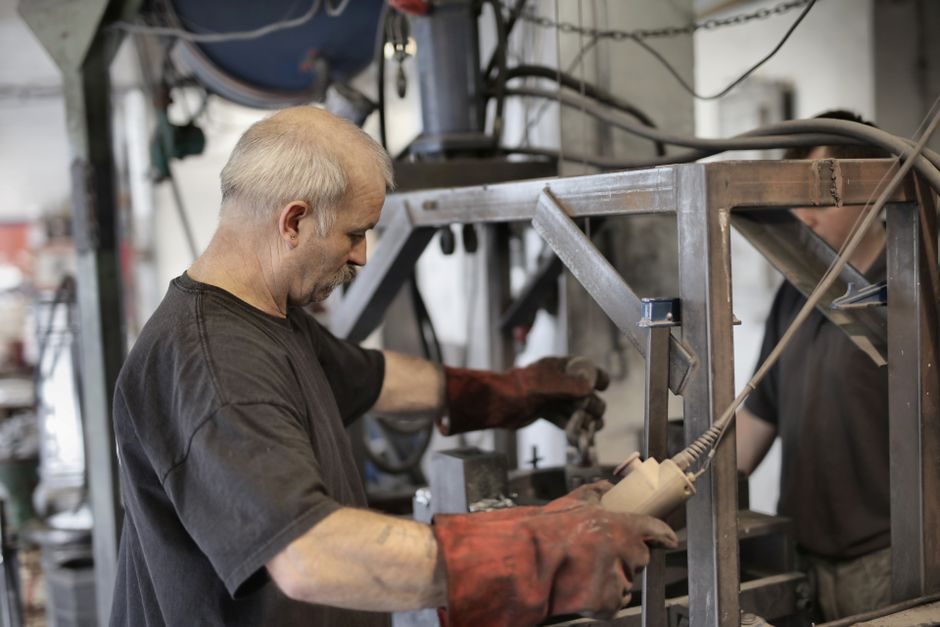
A PLC + touchscreen-controlled gravity die casting machine with imported hydraulics, manual/automatic modes and per-mold cooling-time adjustment is the de facto configuration for brass and zinc gravity work, with MOQ 1 Set and price band US$6,000–35,000 listed on Chinese B2B catalogs [S1][S2].
The same machine class covers faucet brass bodies, aluminium door handles and copper molten-iron water-tap castings, and is commonly quoted as a turnkey line with an integrated metal-casting induction furnace [S3]. On made-in-china the same gravity-die-casting part can land at US$2.10–2.50/kg for aluminium agricultural castings, illustrating the gap between machine CAPEX and per-kg casting cost [S5].
Why gravity die casting, and how the machine class differs from high-pressure die casting
Gravity die casting (GDC) fills a metallic mould under gravity alone, with no injection plunger; on foundry-planet.com it is grouped with low-pressure die casting as the family for permanent-mould work where melt flow is driven by metal head or low-pressure gas, not by hydraulic shot [S6]. For background on the broader machine taxonomy see the die casting machine encyclopedia entry and the gravity die casting machine page.
The practical consequence: GDC machines are not specified by clamp tonnage (as a high-pressure HPDC aluminium die casting machine is), because there is no injection force to resist. Instead, the four hard sizing gates are: (1) max shot weight, set by ladle volume and tilt-pour capacity; (2) platen / mould-table dimensions, set by the largest projected area of the part; (3) alloy and melt temperature, set by the furnace matched to the machine; (4) control stack — PLC, touchscreen HMI, hydraulic valves and safety interlocks [S1][S6].
The four sizing gates and how each one constrains the build
Shot weight: a typical Chinese-built 1-Set gravity casting line for brass water taps is paired with a metal-casting induction furnace and quoted in the US$6,000–35,000 band; the upper end of that band is normally a tilt-pour machine with larger ladle and a longer cooling-timer range [S2][S3].
Platen and mould table: mould-fit, not clamp force, is the gating constraint. The spec must cover both the open and closed mould heights, the ejector stroke, and the bolt-pattern for fixing the mould halves; ease of disassembly/assembly and cleaning is called out explicitly as a design point in the PLC-controlled product sheet [S1].
Alloy and melt: gravity machines are built for non-ferrous work — brass, zinc and aluminium are the three named in the source catalogs; copper/iron molten-metal variants are quoted but use a higher-temperature induction furnace paired to the machine [S3]. For zinc-only high-volume work a zinc die casting machine is sometimes substituted, and where porosity is the killer defect a vacuum die casting machine is the right next step. For magnesium programmes, see the magnesium die casting machine page — note that a standard gravity machine is NOT a magnesium machine without an SF6-cover gas envelope.
Control stack: PLC + touchscreen, imported hydraulic components, manual and automatic circulation, preset shot counter and individually adjustable cooling time per mould are the four named features in the product sheet, and are the lowest acceptable baseline for a 2026 build [S1].
Gravity vs low-pressure vs squeeze: where each one wins
Foundry-planet groups gravity and low-pressure die casting (LPDC) together as the permanent-mould family distinct from HPDC, because in both cases metal flow is gentle and the mould does the geometry work [S6]. LPDC adds 0.3–1.0 bar pressurised air above the melt to push metal up a riser tube, which buys you thinner walls and better feeding on aluminium cylinder heads; gravity stays the right pick when the part is brass or zinc, the wall is forgiving, and the buyer does not want a pressurised-vessel code stamp on the machine. Where mechanical properties need to beat LPDC — closer to forging — a squeeze casting machine is the next rung up; a 2026 cluster and spec-band survey of squeeze-casting suppliers is published at squeeze casting machine suppliers 2026, and a complementary LPDC sizing guide is at low pressure die casting machine sizing.
For semiconductor-tooling and heat-spreader castings, where thermal conductivity and vacuum-assisted fill dominate the spec, a dedicated picks list is at gravity die casting machine picks for semiconductor tooling. A broader force/platen/melt/control spec walkthrough is at spec a gravity die casting machine.
Spec comparison: what each machine type actually delivers on the four gates
Lining the three options up against the four sizing gates, with the gravity figures grounded in the source catalogs [S1][S2][S3]:
Shot weight — Gravity: 1–50 kg typical per ladle, set by ladle size and tilt-pour geometry; LPDC: similar envelope, but feeding pressure adds usable fill on long thin walls; Squeeze: small to medium shots (kg range), high specific pressure.
Platen / mould size — Gravity: open frame, mould-fit drives size; LPDC: same geometry with a sealed pressurised furnace above; Squeeze: heavy bolster, high-tonnage lower platen.
Alloy — Gravity: brass, zinc, aluminium, copper-iron at higher temperature; LPDC: predominantly aluminium; Squeeze: aluminium and magnesium primarily.
Control — Gravity: PLC + touchscreen + per-mould cooling timer baseline is sufficient [S1]; LPDC: adds pressurised-gas loop and leak-tight furnace; Squeeze: adds high-tonnage hydraulic clamp and shot-velocity profiling.
Supplier and sourcing reality in 2026
On the buyer side, Alibaba lists 1,246 hot-chamber die casting machine suppliers, with the top three export markets being Africa (13%), Eastern Asia (10%) and South America (10%), and a 91.6% response rate tag on the lead supplier [S4]. The same Alibaba ecology hosts most of the gravity-die-casting line exporters, although made-in-china carries the gravity-specific factory listings and the per-kg casting price points (US$2.10–2.50/kg for aluminium agricultural castings) that anchor landed-cost math [S5].
On the OEM side, foundry-planet's 2026 reporting flags Brückner's investment in a Kurtz tilt casting machine AK01 and Haitian's die-casting operations out of Brescia as two of the named European/China-Italy gravity-line moves in the past six months [S6]. For an engineering reader, the trackable signals to watch into the second half of 2026 are: (a) any tightening of CE/pressurised-vessel code on the LPDC sub-family, and (b) the spread between the US$6,000 entry-level and the US$35,000 turnkey-line quotes for brass water-tap machines, which is currently the tightest range visible on the Chinese B2B catalogs [S2][S3].