
Aluminum ladders are not banned on UK construction sites under the Work at Height Regulations 2005, but they are restricted to low-risk, short-duration work where a risk assessment shows that more suitable equipment is impractical [S2]. On demolition projects, that typically confines aluminum to inspection trips, low-level strip-out tasks, and one-person access to floor openings, never to structural dismantling where the substrate is unknown or live services may be hidden in the fabric.
Three selection gates govern any demolition ladder spec: the ANSI/ASSE A14 duty rating matched to the heaviest worker plus tool load, the rail material matched to the electrical and thermal exposure on site, and the maximum vertical reach before a rest platform or alternate access equipment becomes mandatory. Across the United States market, Type IAA aluminum and fiberglass extension ladders are commonly stocked at 28 ft overall length with a 375 lb load rating, the format that dominates online retail SKUs in mid-2026 [S4].
Why Aluminum and Fiberglass Compete for the Same Demolition Slot
Aluminum rails weigh roughly 40% less than equivalent fiberglass rails, which is why single-person carry and rapid repositioning both favor aluminum on a strip-out or soft-strip phase [S4]. Fiberglass rails, by contrast, are non-conductive and tolerate weld spatter and grinder sparks without rail deformation, the two failure modes that show up repeatedly on hot-work demolition of process pipe and steel decking. For a 28 ft extension ladder specified to ANSI Type IAA, the load capacity is 375 lbs regardless of rail material, so the weight difference is the deciding factor when the same duty class is otherwise met [S4].
For deeper context on how aluminum rail extrusions compare with fiberglass stiles across site conditions, the Aluminum Ladder Spec Map for Steel Construction Sites walks through the steel-erection case. A more general baseline on rail material, rung geometry, and slip resistance is captured in the aluminum ladder reference page, which sets out the alloy grades and connector-plate details common to A14-compliant products.
Duty Rating, Reach, and the 9 Metre Rest-Platform Trigger
ANSI A14.2-2017 (the current US consensus standard for portable metal ladders) ranks duty by load: Type III (200 lb), Type II (225 lb), Type I (250 lb), Type IA (300 lb), and Type IAA (375 lb). On a demolition site the worker is rarely the only load, a cordless impact wrench, a recip saw, a vacuum, and PPE routinely add 15-25 lb, which is why Type IA or Type IAA is the practical floor for any ladder that will see repeated tool carry [S4].
In the UK the Work at Height Regulations 2005 do not impose a hard maximum ladder height, but HSE guidance states that where a ladder rises 9 metres or more above its base, landing areas or rest platforms should be provided [S2]. Translated to a 28 ft (about 8.5 m) extension ladder, the unit itself is just under the 9 m line, so a 32 ft or 36 ft extension pushes the user into mandatory rest-platform territory. Scaffolding or a mobile elevating work platform becomes the lower-risk substitute above that threshold, and the risk assessment on demolition work should record that substitution explicitly.
Hidden Hazards That Should Push the Spec Off Aluminum
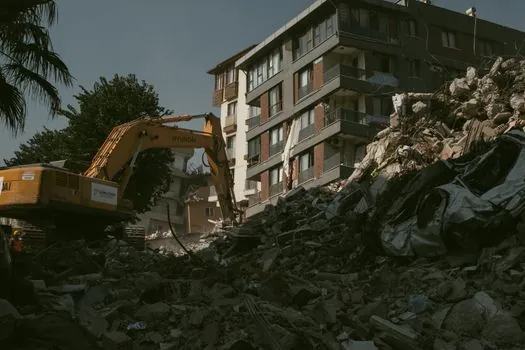
Weekly Safety's demolition briefing notes that demolition may introduce additional hazards, including materials hidden within structural members like lead, asbestos, silica, chemicals, or heavy metals, and unknown strengths or weaknesses of damaged materials [S1]. Two of those unknowns are decisive for ladder rail selection. First, stray conductors inside walls, conduit that was rerouted decades ago, a live MCC feeder passing through the demolition zone, turn aluminum into a serious shock hazard on contact. Second, hot work from cutting torches or plasma units can locally anneal 6000-series aluminum alloy rails, reducing the yield strength of the section at the burn point; the aluminum alloy reference covers the temper designations typically used for rail stock (mostly 6061-T6).
The remediation is straightforward: substitute a fiberglass-rail ANSI Type IAA ladder of equivalent length, or move the task to a non-conductive boom lift where the work envelope allows. For interior strip-out, an A-frame fiberglass stepladder with non-marring rail end caps is the format most commonly rented for that reason [S4].
Debris Handling, Floor Openings, and Chute Rules Around the Ladder Base
OSHA 29 CFR 1926.852(a) prohibits dropping material outside the exterior walls unless the drop zone is effectively protected, and 1926.252(a) requires an enclosed chute whenever material is dropped more than 20 ft to any exterior point of a building [S1]. Where a ladder is set inside a structure, the base must be kept clear of the debris drop zone, with barricades at least 42 inches high and at least 6 ft back from the projected edges of any floor opening above [S1]. A ladder leaning against a wall that is also being demolished is a different hazard class: the wall must be shored or the ladder relocated, because unknown strengths in the existing fabric are the very condition OSHA calls out for demolition [S1].
Floor openings used for material disposal must not exceed 25% of the total floor area, and lower-level material removal is not permitted until all demolition operations and debris handling above have stopped [S1]. In practice that means a ladder positioned at a debris-chute opening is a transient access, used only during the lull between upper-floor teardown and lower-floor cleanup, never as a permanent access during active drop sequences.
Comparison: Aluminum vs Fiberglass Rail for Demolition Access
Across four decision criteria, the trade looks like this. (1) Weight: aluminum wins, single-person carry over a 28 ft length is the deciding factor for strip-out crews. (2) Electrical safety: fiberglass wins unconditionally, any work envelope with unidentified live conductors or welding returns should default to fiberglass. (3) Heat resistance: fiberglass wins, aluminum softens at temperatures well below welding spatter, so any hot-work adjacent access should be fiberglass or a powered aerial work platform. (4) Cost and availability: aluminum wins on retail price, the 28 ft Type IAA fiberglass extension ladder currently lists higher than its aluminum counterpart in US retail channels [S4]. The decision tree therefore reads: aluminum for light strip-out at heights below 9 m, fiberglass wherever conductors, hot work, or chemical exposure is foreseeable.
Inspection, Access Planks, and the 10 ft Rule
OSHA 1926.852 also requires that floor openings within 10 ft of any wall being demolished be planked solid, except when workers are kept out of the area below [S1]. The rule is written for debris openings, but it is a useful proxy for ladder placement: an extension ladder footed within 10 ft of an active wall demolition needs a clear exclusion zone, plank cover over any adjacent opening, and a top tie-off to prevent the rail from slipping as the wall sheds material. The ladder itself must be inspected before each shift, with attention to rail dents, rung connector plates, and the rope/pulley on extension models, exactly the components the 28 ft Louisville SKU lists as standard inspection points: outside slide guides, aluminum rung connector plates, D-shaped rungs fully serrated, and non-marring rail end caps [S4].
For a more specific comparison of aluminum stepladders and A-frames in finish-phase access, the Aluminum Ladder Picks for Interior Finishing: Spec Map article goes one level deeper on rail profile and rung geometry. Across the wider demolition plant list, a related reference on powered access is the spec path for rough-terrain forklifts on 3-10 t class machines, which often pair with ladders for material movement at height.
When an Aluminum Ladder Is the Wrong Tool

Three situations should remove aluminum from the spec sheet entirely. First, any work envelope where the substrate contains unidentified utilities, conduit, or bonded rebar that could be live. Second, any task adjacent to torch cutting, plasma cutting, or sustained grinder use, where rail annealing is a realistic failure mode. Third, any access above 9 m without a rest platform, which is the HSE threshold for adding landings or rest platforms to a vertical ladder run [S2]. In all three cases a fiberglass rail of the same duty class, or a powered MEWP, is the lower-risk option and should be the documented choice on the risk assessment.
The job also has to be short-duration and low-risk, the two preconditions HSE attaches to ladder use generally [S2]. Strip-out of a single non-load-bearing partition over a one-hour shift is a defensible ladder task. Sequential dismantling of masonry panels over multiple days is not; that is a scaffold or a boom-supported platform job, and the ladder should be removed from the method statement.
Specifiers tracking the next revision should watch the ANSI A14 committee for any tightening of the rail-material rules for hot-work adjacent access, and the HSE Work at Height review for any change to the 9 m rest-platform trigger. Both have appeared in public consultations during 2025-2026, and any movement on either will shift the aluminum-vs-fiberglass balance for demolition work in the second half of 2026 [S2]. On the ground, the next signal to track is the 2026 release of updated OSHA 1926 Subpart T guidance, which has been the moving target for demolition fall protection since 2024.