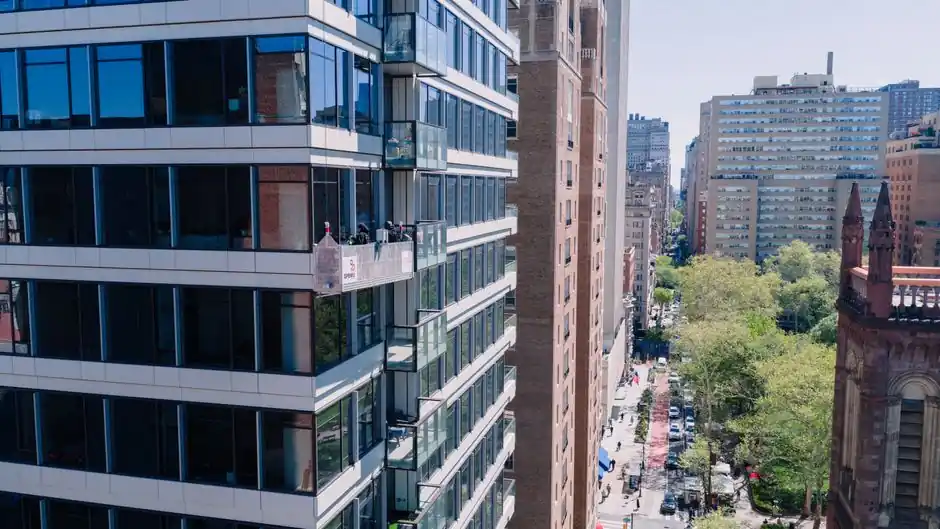
Landscaping projects differ from pure facade work because the load is often live (soil bags, potted plants, water hoses, pruning debris) rather than tools, and the working geometry is irregular: curved atria, stepped terraces, pergolas, and slope-side retaining walls. That drives selection toward modular platforms from 2 m to 10 m, a minimum working width of 675 mm with 450 mm of unobstructed access, and a working wire rope of 8.3–9.1 mm paired with an independent safety rope [S1][S3].
Platform class and load capacity for vegetation work
ZLP500, ZLP630, ZLP800 and ZLP1000 platforms cover 500 kg, 630 kg, 800 kg and 1000 kg rated loads respectively, and the correct unit is set by personnel plus wet materials rather than by dry tools [S4].
Two groundsmen with pruning shears, a 50 kg tool bag, four 25 kg planter bags and a 150 kg platform self-weight land at roughly 280 kg, which sits inside a ZLP500 envelope; add a 100 kg roll of coir matting and the same crew needs a ZLP630, the size most Chinese OEMs treat as the landscaping default [S2][S4]. Green-wall installations with mature climbing plant trays routinely push past 500 kg and should be specified at ZLP800 to keep the design safety factor of 2.0 intact, since the standard load equation treats personnel, tools, materials and self-weight as additive [S2][S3]. For softscape work on a hotel podium or shopping-mall atrium, an aerial work platform comparison often comes up, but where the access face is vertical and a roof beam can carry counterweights, a suspended cradle remains the lower-cost path.
Working height, hoist class and VFD control
ZLP630 hoists such as the LTD6.3 and LTD8.0 deliver 6.6–13.2 kW total at 7–10 m/min and climb up to 200 m on a single rope, but above 100 m a variable frequency drive (VFD) becomes the right call because starting current drops to roughly one-seventh of direct-on-line starting [S3][S5].
Landscaping rarely goes above 50 m, which keeps the wire-rope self-weight penalty modest (a 6 mm steel rope weighs 0.14 kg/m, so two ropes add only 14 kg at 50 m), but rooftop tree surgery on 30-storey towers and tall chimney ivy clearance do cross the 100 m threshold where elastic creep and elastic elongation in the rope become a real concern [S2]. Below 50 m, manual winch models cut initial procurement cost by 40–50% and are common on short atrium jobs; above 100 m, the VFD spec also gives smoother inching, which matters when a worker is cutting branches directly above a glass canopy [S2]. Comparing the three sizes for landscaping on three criteria: ZLP500 wins on cost and weight but loses on materials headroom; ZLP630 is the balanced pick; ZLP800 wins on live load and platform length up to 10 m but adds counterweight that some roof slabs cannot carry without a spreader beam [S3][S4].
Corrosion, wind and outdoor environment
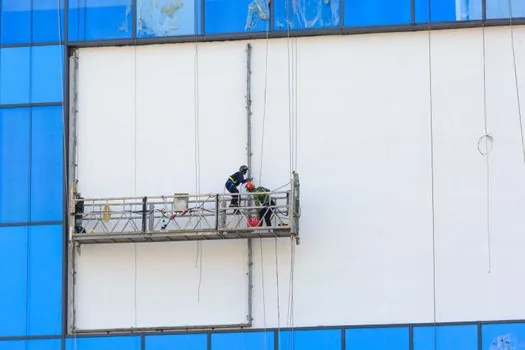
Type 316 stainless wire rope is the right answer for coastal, tropical or chlorinated-pool landscaping work because ordinary galvanized rope lasts only 6–12 months in salt spray versus 3–5 years for 316-grade, while a swing-arm safety lock with a 3°–8° tilt trigger and 20–30 kN permissible impact force handles the gusts common around open podiums and waterfront sites [S2][S3].
Wind is the most common cause of landscaping-job stoppages on suspended cradles. At 12.5 m/s the unit wind pressure is roughly 98 Pa with a 0.4 dynamic coefficient per EN1808, and every 1 m of platform width adds 35–40% more wind load, which forces 50–80 kg of extra counterweight per metre [S2]. Practical rule used in the field: stop work above 10 m/s wind speed, mandatory stop above 15 m/s (Beaufort 7), and integrate an anemometer with the building BMS where the client is a hotel or commercial landlord that wants auditable records [S2]. For indoor atrium landscaping the wind question largely disappears, but a separate suspended ceiling interface still dictates where counterweight beams can sit, and on a softscape site with no parapet, parapet clamps or engineered outriggers must replace a standard roof beam [S4].
Geometry, modular length and roof conditions
Modular platform sections from 1 m to 10 m let a ZLP630 or ZLP800 be reconfigured to match a curved green wall or a stepped terrace, and the roof suspension mechanism must be specified with front beam extension of 1.3–1.7 m and adjustable support height from 1.1 m to 2.14 m so the same cradle clears parapets, pergolas and tree canopies [S3][S4].
Rectangular facades suit a standard two-point suspension with wire ropes at each end, the configuration that dominates construction and maintenance work, while circular atria and free-form green walls need multi-point suspension with three or more ropes or a custom non-standard cradle [S2][S8]. One of the most often-overlooked steps on landscaping jobs is the roof survey: photographs, parapet height, facade width and working height should be sent to the supplier before quotation, because a flat roof that is rated for the live load of a saturated soil pallet is not automatically rated for the point load of a counterweight stack [S4]. For a procurement view that also covers access on bridges and embankments, the suspended platform selection for road maintenance spec path lays out a parallel load and rope workflow, while a suspended working platform selection for interior finishing piece covers the indoor atrium case where wind and corrosion drop out of the decision.
Buy versus rent and total cost of ownership

Standard electric suspended platforms list at $8,000–15,000 USD, wide models at $12,000–20,000 and extra-wide units at $20,000–35,000, while EU and US rental rates sit at $400–800 per day, so a six-month project at $36,000–72,000 in rental approaches outright purchase and pushes the math toward ownership [S2].
Annual inspection and maintenance on a purchased unit runs 8–12% of procurement price, which is a real line item that landscaping contractors under-budget on seasonal fleets; the ZLP series is built around modular 1 m sections that simplify spares stocking, and the control box, hoist and safety lock are the three components that fail first in field service records [S2][S3]. For a hotel group or property manager running repeated seasonal plantings, ownership pays back inside three to four cycles; for a one-off corporate-tower green-wall install, rental is the rational call. Either way, platform scale selection, rope certification and operator training are non-negotiable line items rather than optional extras.
Standards, certification and operator requirements
EU-bound cradles need CE marking with the EN1808 wind and safety framework, US-bound units need OSHA suspended-scaffold compliance, and Chinese-built ZLP platforms carry GB19155-2003 as the domestic baseline, while all units share the same core safety stack: electromagnetic brake motor, centrifugal speed limiter, swing-arm safety lock, separate safety rope, IP54 control box and emergency stop [S2][S3][S4].
For a landscaping project, the operator must be trained on the specific model, the pre-shift inspection must cover roof supports, counterweights, platform joints, hoist brakes, safety locks, wire ropes, electric cables, emergency stop and limit switches, and damaged ropes or cables must be removed from service rather than repaired in the field [S4]. Two further points that come up on every landscaping audit: a rescue plan must be written before the first lift, because a stalled cradle over a planted terrace is harder to evacuate than one over bare concrete; and personal fall arrest equipment is layered on top of the cradle's own safety lock, not in place of it. For readers comparing this against non-suspended access options such as scissor lifts on soft ground, the suspended platform reference page gives the geometry and load envelope, and the platform trolley page covers the roof-side rigging hardware that landscaping contractors often forget to budget.
Trackable signals for the next planning cycle: (1) whether project specifications continue to migrate from ZLP500 to ZLP630 as standard for two-person landscaping crews, and (2) whether EN1808 wind-speed triggers (10 m/s advisory, 15 m/s mandatory stop) get written into landscaping contracts the way they already are on Middle East high-rise facade work [S2].