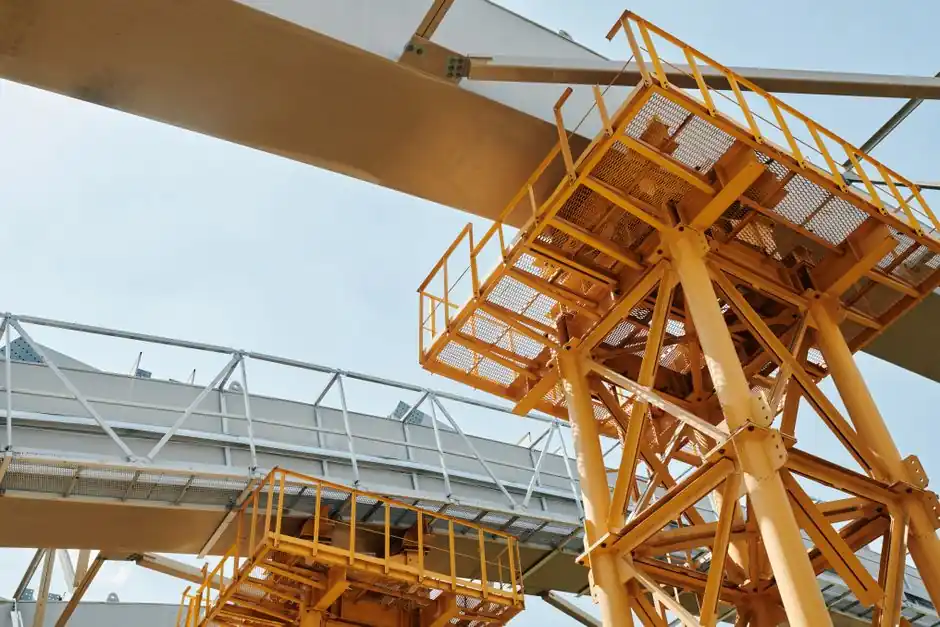
Plumbing risers, soil stacks, and external rainwater downpipes on mid- and high-rise buildings sit where scaffold access costs more than the pipework itself; an electric ZLP-class two-point suspended platform (gondola) sized to a 2.0 safety factor on personnel plus tools plus pipe mass is the default access choice, per current manufacturer and selection guidance [S2][S3].
Plumbing work is wet, tool-heavy, and frequently performed alongside other trades on a single facade, so the platform must carry 2-3 fitters with brazing rigs, solvent cement, pipe bundles, and a small jenny, typically 380-500kg live load at the deck [S3][S4]. The four engineering groups to verify before procurement are deck capacity, hoist traction class, wire-rope diameter and material, and the safety lock plus overspeed governor per EN 1808 / OSHA 1926.451 / GB 19155 [S2].
Load Sizing for a Plumbing Crew
For a 2-3 person plumbing team, rated load must be calculated as Personnel + Tools + Materials + Platform self-weight with a 2.0 safety factor; a 3-person crew with brazing gear and a 50kg pipe bundle lands near 440kg, which rules out a 400kg standard deck and forces a 500-630kg wide deck [S3].
Occupant mass is conventionally counted at 80-100kg per person, so a 630kg rated platform typically allows 3 workers plus 200-220kg of tools and pipe stock, while a 250kg standard unit is single-occupant only and unsuitable for plumbing teams [S2][S3]. Deck length is built from 1m, 2m, and 3m modular sections into working lengths of 2-7.5m, and the longer the deck the more pipework can be staged without re-rigging the hoist position [S2].
Hoist Class, Rope Diameter, and Working Height
Above 50m working height, wire-rope self-weight and elastic elongation start to govern rope diameter; a 6mm steel rope weighs roughly 0.14kg/m, so a single 200m hoist rope already consumes 28kg of capacity and two ropes consume 56kg, which is significant on low-tonnage decks [S3].
For plumbing stacks on towers above 100m, manufacturer guidance is to step up to a variable frequency drive (VFD) hoist; VFD starting current is about 1/7th of direct-on-line starting, which limits voltage drop on long SOOW trailing cables, and a 220V hoist that drops to 190V on a 400-foot run will overheat and fail prematurely per field guidance [S3][S8]. Voltage at the platform under load is a mandatory daily check on tall plumbing riser work [S8].
Suspended Platform Type vs Plumbing Task
Standard 1.0-1.2m wide, 250-400kg ZLP platforms suit single-trade pipework on simple facades, while 1.5-2.0m wide 400-600kg decks are the practical minimum for plumbing crews sharing the elevation with electricians or fire-protection fitters, and 2.5-3.0m 600-1000kg extra-wide decks are reserved for plant-room exteriors and tank-wrap piping [S3].
Two-point swing stages cover most plumbing work, but circular or irregular building footprints (common on water-treatment tanks and curved hotel towers) need custom non-standard suspension geometry, and a multi-point (3+ rope) configuration is the correct choice for very long decks or where pipe pre-assembly is staged at the deck [S3][S7]. Manual rope platforms are limited to low-rise 10-50m plumbing work and reduce initial procurement cost by 40-50%, but electric hoists are standard for any plumbing task above 50m [S3][S5].
Wind, Water, and Corrosion Constraints on Plumbing Sites
For plumbing work on coastal towers or near cooling-tower plume, Type 304 stainless wire rope suits general marine exposure while Type 316 is required for tropical-coast or high-salt-spray sites; ordinary galvanised rope lasts 6-12 months in those conditions versus 3-5 years for stainless [S3].
Wind load scales with deck frontal area, so each 1m increase in platform width adds 35-40% more wind load and requires 50-80kg of extra counterweight; per EN 1808 with a 0.4 dynamic coefficient, at 12.5m/s wind speed unit pressure is roughly 98Pa, and work should be stopped above 10m/s and is mandatory above 15m/s (Beaufort 7) [S3]. A wind-speed interlock tied to the hoist control circuit is now standard specification on Middle East projects, and on plumbing sites the same interlock also protects against gusts during brazing or solvent welding where open flame or fume ignition is a real risk [S3].
Safety Lock, Governor, and Mandatory Redundancies
Every stirrup must carry an independent safety wire rope and a fall-arrest lock calibrated to the working rope, with a tilting-cable locking angle of 3-8 degrees and an allowable safety-lock impact force near 30kN on ZLP-series builds [S4]. Two-rope platforms are a paired system, so a single-rope failure must arrest without uncontrolled descent, and that is why the safety rope and lock are a separate mechanical train from the traction hoist [S2][S4].
Limit switches, overspeed governors, phase selectors, and a platform-level voltage check are the non-negotiable daily-test items, and on plumbing sites the additional live checks are rope lubrication (water splash carries grit back to the hoist sheave), guardrail integrity after crew changeover, and confirmation that no temporary pipe clamp has been attached to the platform guardrail as an anchor point [S8]. If a safety lock has arrested a fall, the unit is taken out of service; locks are not field-reset, they are replaced and the rope is inspected end-to-end before return to duty.
Certification, Codes, and Rental vs Purchase Economics
EN 1808 governs suspended access equipment in Europe, OSHA 29 CFR 1926.451 and 1926.452 in the United States, and GB 19155-2003 in China; CE-marked product accounts for the majority of EU demand and OSHA compliance is the US baseline, so a single platform is rarely legal across all three jurisdictions without re-examination [S2][S3][S4].
Standard electric ZLP platforms run $8,000-15,000, wide models $12,000-20,000, and extra-wide units $20,000-35,000, with wire ropes and counterweight systems priced separately; rental in EU/US markets runs $400-800 per day, so a 1-3 month plumbing retrofit breaks even on rental, while a 6-month new-build riser installation at $36,000-72,000 rental spend approaches outright purchase and tips toward ownership, with annual inspection and rope replacement budgeted at 8-12% of procurement price [S3].
Track next: the ZLP steel-construction spec path and the demolition variant spec path both share hoist, lock, and rope figures with plumbing work and are useful cross-references for procurement engineers sizing the same platform for multiple trades; monitor EN 1808 revision activity and any local wind-speed threshold changes above 15m/s that would shift the mandatory stop level for brazing operations.
Detailed specification references: suspended platform, suspended ceiling, and platform scale.
Related analysis: Shakeout Machine Selection for Telecom Enclosures: 2026 Spec Path.