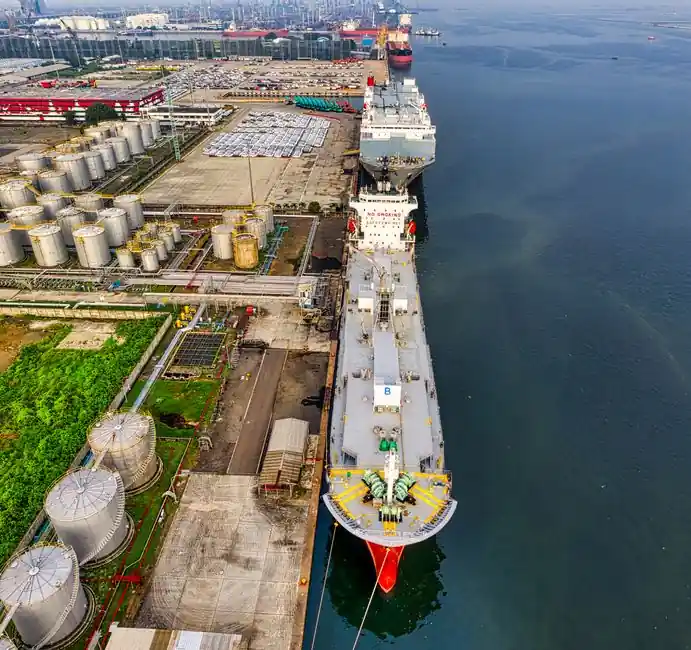
From 1 July 2026, anhydrous ammonia carried as cargo on gas carriers can be used as fuel on board under amendments to the IGC Code agreed by the IMO Maritime Safety Committee, the first time a non-LPG gas carrier trades ammonia and burns it in the same voyage [S2][S8].
The 2024 orderbook already showed the direction: 274 ammonia carriers moved cargo from 38 terminals, and roughly half of the gas-carrier newbuild orders placed that year were ammonia-capable [S1]. Engine makers MAN Energy, Win GD and Wärtsilä all advanced ammonia-fuel programmes through 2024 [S2], and a 2026 industry review (Cited by 3) projects 60% ammonia penetration of marine fuel demand by 2050 in a combined levy-and-fuel-standard scenario [S4].
Regulatory gate opens 1 July 2026: IGC Code amendment and IGF interim guidelines
The IGC Code amendment permitting ammonia cargo as fuel enters into force on 1 July 2026, the operational trigger that lets a gas carrier legally use its own cargo to power the ship [S2][S8]. Separately, the IMO Maritime Safety Committee in May 2026 approved two interim guidelines: one for ships using ammonia as fuel, and one for seafarer training on ammonia-fuelled vessels [S3]. The interim guidelines cover hazardous-space restriction, ammonia release minimisation, mitigation systems, fuel-tank ventilation, and on-board safe havens; the IMO has flagged a review in 2026 or 2027, and the text remains non-mandatory [S2].
For shipowners, this creates a two-tier rule set: the IGC Code amendment is binding for the cargo-as-fuel use case, while the broader ammonia-as-fuel interim guidelines are advisory until incorporated into the IGF Code. Bunkering operations will need leak detection, vapour return and double-walled transfer lines, which is why related articles on Ex d vs Ex e flameproof enclosures are surfacing in 2026 ammonia-bunker specification work.
Fuel pathways: green, blue and brown ammonia on a well-to-wake basis
Ammonia is sulphur-free and carbon-free at the combustion point, but produces NOx and N2O, the latter carrying a global warming potential around 265-298 times that of CO2 over 100 years, which is why the EU ETS extension to maritime covers N2O from 2026 and FuelEU Maritime factors it into the well-to-wake GHG intensity calculation [S2].
Production pathway drives the lifecycle number: green ammonia from renewable electrolysis, blue ammonia from natural gas with carbon capture, and conventional brown ammonia from steam methane reforming each carry different well-to-wake intensities, and FuelEU rewards the lower end [S2][S4]. The 2026 GET-model study finds that a goal-based marine fuel standard combined with a GHG pricing mechanism is the policy mix that pulls ammonia penetration toward the 60% modelled ceiling, because neither instrument alone closes the bunker-fuel cost gap [S4].
Engine technology: where 2-stroke and 4-stroke programmes actually stand

MAN Energy, Win GD and Wärtsilä all progressed ammonia engine announcements in 2024, targeting both newbuilds and retrofits for deep-sea segments where methanol and LNG are the main competing pathways [S2][S7]. The 2026 ammonia-engine technology review (Patsnap Eureka, 2026-04-23) frames ammonia as the leading zero-carbon candidate for newbuilds after methanol, with the IGC amendment of 1 July 2026 cited as the first commercial open [S6].
Two practical constraints dominate engine design. First, ammonia's flame speed is roughly one-fifth that of methane, so direct-injection compression-ignition concepts need pilot fuel or high-energy ignition assist, which complicates Tier III NOx compliance. Second, the gas supply train must stay above atmospheric pressure, which is why marine valves on the ammonia fuel block are typically dual-block-and-bleed cryogenic patterns with welded bonnet and NACE MR0175 trim for sour-service fallback. Auxiliary systems such as marine HVAC ventilation for the engine room and fuel preparation space have to handle ammonia leak detection at 5-10 ppm thresholds with redundant sensors.
Supply, bunkering and the carrier-led ramp
Ammonia carriers are the first movers because they already carry the cargo and the same IGC amendment now lets them burn it. The 2024 fleet of 274 carriers operating from 38 terminals gives an existing network of import/export terminals, reliquefaction plants and trained crews, a real head-start over methanol or hydrogen carriers [S1]. Greenfield bunker barges and shore-side ammonia storage are still limited; the policy briefing from MarINH3 (2026-04-30) flags this as the binding constraint on a non-carrier ammonia-fuelled newbuild orderbook [S9].
The Mærsk-led orderbook for ammonia-capable container ships, plus NYK Line, Berge Bulk and Viking Supply Ships ammonia vessel projects, all rely on the same handful of ammonia-export terminals (Sabine Pass, Al-Jubail, Donaldsonville, and Yara's Porsgrunn/Heymarket complex), which is why flow meters on ammonia bunker lines are mostly Coriolis, with helical twin-tube designs for the high-viscosity sub-zero transfer case. The systematic review (Cited by 1, 2026) emphasises that large-scale adoption stays constrained by feedstock supply, terminal capacity, and crew training, not engine hardware [S5].
Comparison: ammonia vs methanol vs LNG on the 2026 decision criteria
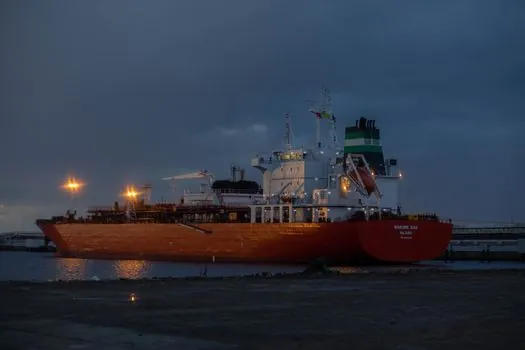
For a deep-sea newbuild in 2026, the four selection criteria most often invoked by owners are: (1) regulatory certainty, (2) fuel cost premium, (3) energy density / cargo space penalty, and (4) safety case maturity. On criterion 1, ammonia and methanol both have IMO interim guidelines approved, with ammonia gaining a binding IGC clause on 1 July 2026 for gas carriers, while LNG sits inside the mature IGF framework. On criterion 2, conventional ammonia trades at a discount to green ammonia but a premium to HFO on an energy-equivalent basis; methanol is closer to LNG on lifecycle cost in 2026. On criterion 3, ammonia's volumetric energy density sits around 12.7 MJ/L at -33C, well below LNG's 22.2 MJ/L and methanol's 15.8 MJ/L, so ammonia tank volume roughly doubles for equal range. On criterion 4, ammonia's toxicity, with an IDLH of 300 ppm, is the open safety case; LNG's flammability, and methanol's lower-energy-density plus flammability, are the analogous open items for the other two [S2][S5][S7].
The systematic-review conclusion (Cited by 1, 2026) is that no single fuel clears all four criteria, which is why most 2026 newbuild orderbooks are dual-fuel rather than single-fuel [S5]. Owners typically lock in LNG or methanol for the first 5-7 years of asset life and carry ammonia-ready engine foundations, fuel-storage space, and bunkering line interfaces for the post-2030 fuel switch.
Limitations, failure modes and the N2O blind spot
Ammonia's biggest non-obvious risk is N2O slip. Unburnt ammonia in the exhaust can oxidise to N2O over the SCR catalyst, and FuelEU plus EU ETS both count N2O from 2026, so a poorly tuned ammonia engine can be penalised on the very regulation meant to reward it [S2].
Crew training is the second open item. The Maritime Just Transition Task Force (IMO-backed) published interim training frameworks for seafarers on ammonia, methanol and hydrogen-fuelled vessels in 2025, but harmonised IMO standards are still in development, which means owners cannot yet rely on a single STCW certificate for ammonia [S3]. Storage and handling also require double-wall piping throughout, gas-detector coverage of every void space, and crew-safe-haven spaces with independent ventilation; mis-specifying any of these is what an industrial valve failure on the ammonia block typically traces back to in incident reports.
Trackable signals for the next 12 months
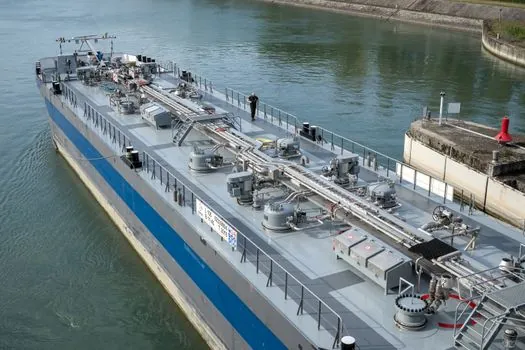
Three concrete signals will mark whether the 1 July 2026 IGC amendment is delivering a real commercial ramp or just a paper one: (1) the first commercial voyage of an ammonia gas carrier burning its own cargo, expected in Q4 2026 on a US Gulf to Northwest Europe route, (2) MEPC adoption of the Net Zero Framework at the late-2026 IMO decision point, which would lock in the levy-plus-standard policy mix the GET model uses to reach 60% ammonia penetration, and (3) the first Lloyd's or DNV type approval of a pressure transmitter for ammonia service at -33C, with HART 7 over a 4-20 mA loop and IEC 60079-0/1 hazardous-area certification, since instrument approvals tend to lag engine approvals by 6-9 months on new fuels [S3][S4]. The IMO's own modelling, which puts widespread commercial adoption at 2037 and ammonia as the dominant newbuild fuel by 2042, sets the long-horizon reference, but the 1 July 2026 amendment is what 2026 shipowners will actually feel first [S3].