
The 2026 market for autonomous mobile robots spans USD 5.5B (AMR-only base, Grand View Research) to USD 8.62B (mobile industrial robots inclusive of AGVs, Fact.MR), with warehouse robotics as a broader category reaching USD 11.63B (Market Research Future) [S2][S3][S5].
Manufacturing-floor demand is the structural accelerant: Fact.MR's June 2026 update puts AMR share of the mobile industrial robot product mix at 34.8%, while wheeled sensor-based units (the configuration that dominates both pick-and-pack aisles and line-side delivery) hold 41.2% of mobility architecture and 39.5% of navigation intelligence [S2]. For engineers sizing a fleet, the AMR robot reference is the starting point for the navigation and payload taxonomy that those percentages describe.
2026 market sizing: where the headroom sits
Three credible 2026 figures define the envelope. Grand View Research (Aug 2026) sizes the AMR segment alone at USD 5.5B in 2026, rising to USD 14.0B by 2033 at 14.4% CAGR [S3]. Market Reports World (Aug 2026) pegs the AMR market at USD 6,472.85M in 2026 [S7]. Fact.MR (Jun 2026) widens the lens to mobile industrial robots (AMR + AGV + autonomous mobile manipulators) at USD 8.62B, with a 10.5% CAGR to USD 23.39B by 2036 [S2]. One level broader, LogisticsIQ cites a USD 13.2B 2026 figure for all mobile robots via Pudu Robotics' March 2026 piece [S1], and Market Research Future's September 2026 update puts the full warehouse robotics market at USD 11.63B growing to USD 44.58B by 2035 at 16.1% CAGR [S5].
Where the three differ is scope, not direction: AMR-only sits at the conservative end, mobile industrial robots at the middle, and warehouse robotics (which adds AS/RS, picking arms, and software) at the top. SNS Insider's July 2026 warehouse robotics report corroborates the steep growth curve at 21.35% CAGR to USD 87.07B by 2032 [S8]. Robotics Center (Apr 2026) frames the wider warehouse automation and robotics pool at USD 12.4B in 2026, expanding 28% year-over-year [S6]. For a fleet manager, the practical reading is that AMR hardware alone is roughly 40 to 60% of the warehouse robotics line item, with the balance going to arms, AS/RS, and orchestration software.
Warehouse vs manufacturing floor: who buys what
Warehousing still owns unit volume. Storage itself accounted for 41.0% of 2025 warehouse robotics revenue, anchored by AS/RS, while mobile robots are projected to outpace every other category at 19.4% CAGR through 2035 [S5]. Automate-X's 2026 guide notes AMR order-picking error reductions of up to 99% in some deployments and integrates with WMS or WES for real-time inventory visibility [S4].
Manufacturing floor demand runs on different drivers. Per Fact.MR's June 2026 analysis, line-side delivery, work-in-process transport, and cross-floor material handoff are pulling AMRs into the same plants that already run collaborative arms and CNC cells, with payback periods compressing to 12 to 24 months as sensor-fusion navigation software matures [S2]. MRFR's regional data underlines the production-line pull: Asia-Pacific holds over 42.5% of the warehouse robotics market with China logging a 44% jump in new installations in 2024, while North America (about 26% share) and Europe (about 22%) are pushed by OEM and third-party logistics investment plus German, UK, and Nordic labor shortages [S5]. The use case overlap is meaningful enough that the industrial valve and flow meter reference pages sit comfortably next to AMR guides in most engineering documentation portals, since line-side AMRs feed the same process nodes those instruments monitor.
Decision matrix: AMR vs AGV vs mobile manipulator on the 2026 floor
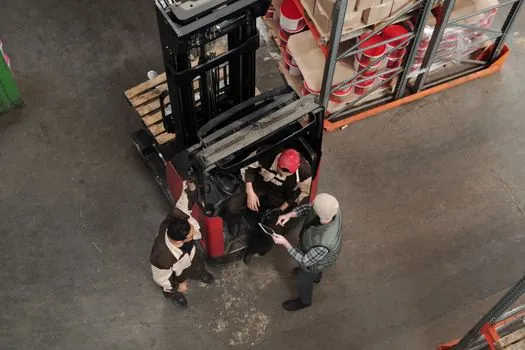
Three product classes compete for the same line item. On a like-for-like 2026 comparison, AMRs hold 34.8% of the mobile industrial robot product segment by Fact.MR's June 2026 reading, with AGVs and autonomous mobile manipulators splitting the balance [S2]. AMRs win on infrastructure-free navigation and redeployment speed, AGVs win on unit cost for repetitive point-to-point pallet runs in greenfield DCs, and mobile manipulators add a robotic arm to handle tote induction or machine tending without a fixed cell.
Cost and integration effort diverge sharply. Sensor-based navigation (39.5% of the 2026 navigation intelligence segment) lowers commissioning time versus magnetic-tape or QR-code AGVs, but multi-vendor fleet orchestration still costs integration hours in WMS or WES APIs [S2]. Mobile manipulators carry the highest unit price but consolidate two workstations (transport plus pick) into one footprint. By operational model, Fact.MR's segmentation groups demand into goods movement automation, production line supply, warehouse sorting, and collaborative transport, with production line supply the manufacturing-floor wedge and goods movement the warehouse wedge [S2]. For buyers cross-shopping factory-floor cells, this AMR decision matrix mirrors the kind of head-to-head frameworks used in adjacent process-equipment guides like the contact vs gap CD stud welding comparison: match the duty cycle first, then the integration cost.
Selection criteria for a 2026 fleet spec
Four specifications decide the build. Navigation stack: sensor-based fusion (LiDAR + camera + ultrasonic) is the 2026 default, taking 39.5% of the navigation intelligence segment and removing the floor-marking dependency that AGVs still carry [S2]. Drive architecture: wheeled systems at 41.2% of mobility architecture dominate both aisles and factory floors; legged and humanoid-class units remain pre-scale in 2026 [S2]. Payload class: tote and box AMRs target the under-50 kg bin-handling use case that defines e-commerce picking, while pallet-moving units cover the 500 to 1500 kg range that drives manufacturing line-side and end-of-line pallet handoff. Fleet management: WMS or WES integration plus dynamic traffic and task allocation is now table-stakes, and Robotics-as-a-Service remains the mid-market entry point that MRFR's September 2026 report flags as a primary growth lever [S4][S5].
What an AMR is NOT for in 2026: high-mix small-batch environments with constantly changing SKU geometries still run better with fixed automation or human pickers, and any deployment over 1500 kg per move is still AGV or autonomous forklift territory. Cold-chain warehouses below 0 deg C need IP-rated, heated-battery variants that carry a cost premium, and mixed-traffic sites without curated aisles will see AMR throughput drop until pedestrian paths are physically separated. The floor grinder reference page sits in the same industrial-encyclopedia cluster for a reason: surface flatness and joint quality are the silent prerequisites for any wheeled mobile robot, AMR or AGV.
Standards, sourcing, and trackable signals
Safety and interoperability standards shape the 2026 spec sheet. ISO 3691-4 governs driverless industrial truck safety (the AMR and AGV baseline in EU plants), while ANSI/RIA R15.08-1 covers the equivalent US mobile robot safety requirements. Functional safety typically lands at PL=d Cat. 3 under ISO 13849-1 for the safety-rated stop and obstacle-avoidance functions. For hazardous-area plants, ATEX or IECEx-rated AMRs are available from multiple vendors but remain a minority of 2026 shipments, with deployment concentrated in chemical and pharmaceutical line-side work. For engineers cross-referencing process instrumentation alongside robotics, the pressure transmitter and additive manufacturing material entries round out the same industrial-equipment taxonomy used to spec the rest of a smart factory line. [S1]
Trackable signals for the next data node: Fact.MR's next mobile industrial robot update is the natural cycle to watch for a 2027 base revision; MRFR's warehouse robotics model will refresh again ahead of MRFR's 2026-2035 forecast close; and the 2025-12 Zebra acquisition of Photoneo for USD 350M (3-D machine vision) flagged by MRFR's September 2026 update is the kind of M&A signal that reshapes picking-arm and AMR vision-stack pricing through 2026 and 2027 [S5]. The next verifiable trigger is the Q4 2026 AMR shipment data from the major US and EU logistics integrators, which will set the 2027 base case for both warehouse and manufacturing-floor demand.