
Handheld angle grinders accept 4½", 5", 6", 7" and 9" discs and run on electric, compressed-air or petrol drive, making them one of the most versatile portable abrasive tools on a fabrication or construction site [S1].
For procurement, the practical decision narrows to four spec gates — disc diameter, motor amperage, no-load RPM, and weight/grip geometry — each of which directly maps to a use-case band from home DIY to structural steel cutting [S1].
Disc Diameter, Power and Speed Envelopes
Common disc sizes are 4½", 5", 6", 7" and 9", with smaller discs specified for general-purpose cutting and finishing and larger discs chosen when deeper cut depth or faster stock removal is required [S1]. Smaller angle grinders are typically lighter and more maneuverable, while larger 7" and 9" units are reserved for heavy industrial work where the added mass and torque are an asset rather than a burden [S1].
Motor amperage scales with disc size: low-amp motors suit household grinding and polishing, while higher-amp motors are needed for sustained heavy material removal on professional job sites [S1]. No-load disc RPM is a separate lever — slower-running discs generate less heat and less noise during operation, which matters when working on heat-sensitive alloys or in occupied spaces, while higher RPM is preferred for clean abrasive cutting [S1].
Operator Advantages in Real Workshop Use
The primary advantage of an angle grinder is functional versatility: a single tool body, with the disc swapped, handles rust removal, paint stripping, metal and masonry cutting, concrete scoring, brick shaping and surface sanding — work that would otherwise require several dedicated machines [S1].
A second advantage is portability versus bench equipment: a handheld grinder goes to the workpiece rather than the workpiece coming to a fixed abrasive saw, which is decisive on structural-steel erection, ship repair and on-site demolition where moving the part is not an option [S1]. Compared with a fettling grinder, which is tuned for foundry clean-up, a standard angle grinder offers broader disc compatibility and lower cost; compared with a floor grinder, it is cheaper and far more agile but lacks the down-pressure and surface area needed for large concrete slab finishing.
Safety Hazards and Operating Disadvantages
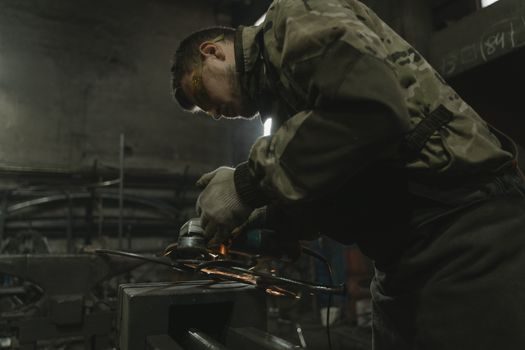
The same disc speed and exposed abrasive that make the tool productive also drive its main disadvantages: kickback from a pinched disc, disc shatter from overload, eye and skin impact from ejected debris, and prolonged vibration exposure that pushes the tool into HAV (hand-arm vibration) risk bands on continuous shift work. Slower-RPM discs reduce heat and noise but do not eliminate kickback, which is why an adjustable disc guard — fitted and rotated to the working side — is treated as a non-optional accessory rather than a comfort item [S1].
A secondary disadvantage is the learning curve: an inexperienced operator can burn workpieces, gouge thin-wall tube, lose a finger, or set up a grinding-induced fire when grinding magnesium or aluminium without the correct spark-control discipline. The tool's high noise output also demands hearing protection above roughly 85 dB(A) operating thresholds typical of abrasive cutting, which in turn adds PPE cost and fatigue on long shifts.
Application Fit and Selection Criteria
Use this side-by-side to match tool size to job band before procurement: a 4½" / 5" grinder covers light fabrication, plumbing and auto-body work; a 6" grinder is the generalist for steel erection and concrete scoring; a 7" / 9" grinder is justified only for heavy stock removal, pipe cutting and demolition where the larger cut depth offsets the added weight [S1]. On all three bands, lower no-load RPM is favoured for stainless and aluminium to limit heat tint, and higher motor amperage is favoured when the disc spends more time loaded than free-spinning.
For procurement-side trade-off logic similar to the alloy-versus-machine gates used in zinc die casting selection, an angle-grinder spec sheet should be read as a stack of independent criteria (disc size, amp rating, RPM, weight, guard type, spindle thread) — accepting a smaller disc to gain a lighter body is the same engineering trade as accepting a thinner aluminium sheet to gain formability. The wrong combination is not "bad tool" but "wrong tool for the cut", and the failure mode is the same: scrapped workpiece, disc shatter, or operator injury.
Standards, Compliance and Sourcing Constraints
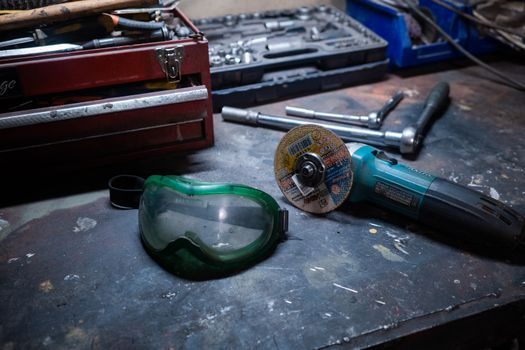
Industrial buyers in the EU and UK typically require CE marking under the Machinery Directive, ATEX-rated motors for use in zoned areas, and disc compliance to EN 12413 (bonded abrasive products) — confirm these on the data sheet before order rather than after a disc shatter incident on site [S1]. For abrasive cut-off wheels and grinding discs, the maximum operating speed marked on the disc must exceed the grinder's no-load RPM; mismatched discs are the most common root cause of catastrophic wheel failure recorded in shop-floor incident logs.
Supply-side, 4½" and 5" corded grinders are the highest-volume SKUs globally, which keeps lead time short; 7" and 9" industrial units, brushless cordless platforms above 54 V, and pneumatic grinders for ATEX zones are tighter in stock and should be ordered against confirmed delivery dates rather than spot-buy. Verify brush and bearing serviceability — a grinder with a replaceable motor brush and a vendor-stated brush life avoids the throwaway cost pattern that pushes the lifetime spend on heavy-use tools in the same direction as the rotary hammer TCO curve.
Who Should and Should Not Specify an Angle Grinder
Specify an angle grinder for: metal fabrication shops, steel erectors, shipyards, auto-body repair, plumbing and HVAC installers, concrete and masonry contractors, and general maintenance crews that need a single portable abrasive tool across mixed materials. Do not specify a standard angle grinder for: large-area concrete polishing (use a floor grinder instead), high-volume foundry fettling (use a fettling grinder), work inside an Ex zone without a confirmed ATEX-rated pneumatic or low-voltage unit, or any cutting application where a fixed abrasive saw would give a straighter, safer cut. [S1]
Trackable signals for the next planning cycle: vendor moves on brushless 18 V / 54 V cordless platforms that close the torque gap with corded 4½" units; revisions to EN 12413 affecting maximum permissible free speed markings on bonded discs; and the spread of quick-change nut systems that reduce disc swap time in production environments. Monitor these three alongside your internal disc-consumption rate per operator-hour to detect when a fleet-wide re-spec is cheaper than another year of consumables spend.