
For 2026 procurement, the decision that drives everything else is disc diameter: 115 mm and 125 mm cover 80–90% of fabrication and site work, 150 mm and 180 mm handle heavy stock removal, and 230 mm is reserved for masonry and rebar work [S3].
Each step up in disc size roughly doubles the cutting depth, adds 0.5–1.0 kg of mass, and pushes continuous-load input power into the 2000–2600 W band — so oversizing the tool burns wrist, battery, and budget on jobs a 125 mm machine already handles [S3].
Disc Diameter vs Application: The Core Decision
Disc diameter sets the cutting depth, the safe clearance around the workpiece, and the gear-head geometry you can actually fit into a corner. A 115 mm wheel cuts to roughly 25–30 mm depth, a 125 mm wheel reaches about 32–38 mm, a 150 mm wheel extends to ~40–45 mm, a 180 mm wheel cuts ~50–55 mm, and a 230 mm wheel reaches ~60–70 mm in one pass [S3]. The same 230 mm class, marketed on Alibaba listings in May 2026 as a 9-inch high-performance electric grinder, is the standard for masonry cutting and rebar dressing on site.
For bench-and-bracket metalwork, a 125 mm tool is the workhorse: light enough for one-handed overhead use, deep enough for standard 25 mm tube, and compatible with the widest accessory range. The angle grinder encyclopedia entry confirms that 125 mm remains the highest-volume SKU globally for general fabrication.
Motor Power, Speed and Voltage Class
Corded models in the 115–125 mm class run 600–1100 W input with a no-load speed near 11 000 min⁻¹; 150–180 mm machines sit in the 1400–2200 W band at ~8500–9000 min⁻¹; 230 mm industrial corded units run 2000–2600 W at ~6500 min⁻¹ [S3]. Brushless 18 V cordless platforms have closed the gap on light work — a modern 125 mm brushless 18 V tool delivers roughly 800–900 W of mechanical output and cuts 10 mm rebar in under 6 seconds per pass on a fresh 5.0 Ah cell.
Use these thresholds as your gate: anything below 700 W input on a corded 125 mm will stall on 6 mm plate under load, while 18 V cordless is only economic for intermittent cutting below 4 mm steel — for production fab work, stick with corded 1100 W+ machines. Speed matters as much as wattage: 11 000 min⁻¹ is fine for cutting discs, but flap and finishing discs perform better at 7000–8500 min⁻¹, so a variable-speed dial pays for itself on finishing work [S3].
Switch Type, Spindle and Safety Architecture
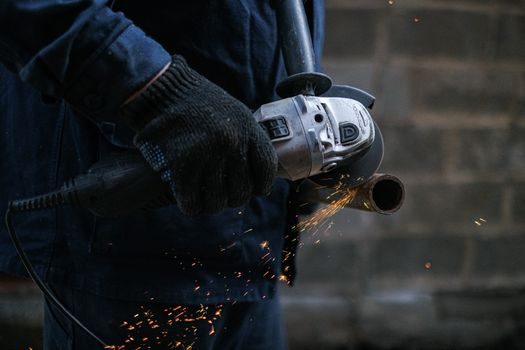
Three switch architectures dominate the 2026 market: deadman (no-volt-release, paddle) switches for site and construction, slide switches for production grinding where the operator wants constant-on, and trigger switches for one-handed overhead work [S3]. Deadman switches are mandatory on most EU and UK construction sites because they default to off on power loss — if your crew is on a site with a permit-to-work system, do not buy anything else.
Spindle thread is the second spec people get wrong. 115/125 mm models use an M14 spindle globally; North American 7-inch and 9-inch models historically use 5/8-inch-11 UNC, and mixing them means the accessory simply will not mount. Soft-start electronics, electronic brake, and a re-start guard (cuts power if the disc stalls and the switch is still held) are now standard on every machine priced above the entry tier — verify on the nameplate, not the brochure [S3].
Comparing the Main Options Side by Side
Disc diameter, input power, no-load speed, spindle thread, and typical weight form a clean four-criteria matrix that maps directly to the job: [S1]
- 115 mm corded: ~700–900 W, 11 000 min⁻¹, M14, 1.4–1.8 kg — one-handed detail work, sheet metal, plumber cuts.<br/>- 125 mm corded: ~900–1100 W, 11 000 min⁻¹, M14, 1.7–2.2 kg — general fab, the default workshop SKU.<br/>- 150 mm corded: ~1400–1800 W, 9000 min⁻¹, M14, 2.5–3.0 kg — heavy stock removal, weld blending on thick plate.<br/>- 180 mm corded: ~1800–2200 W, 8500 min⁻¹, M14, 3.2–3.8 kg — pipe and tank work.<br/>- 230 mm corded: ~2000–2600 W, 6500 min⁻¹, M14 or 5/8-11 UNC, 4.0–5.5 kg — masonry, rebar, floor-edge concrete [S3].
For a smaller sibling tool, the fettling grinder encyclopedia page explains the 150–180 mm niche used in foundry and weld-prep cells, while the floor grinder entry covers the 230–450 mm walk-behind class for surface-prep contractors.
Who an Angle Grinder Is For — and Who Should Buy Something Else
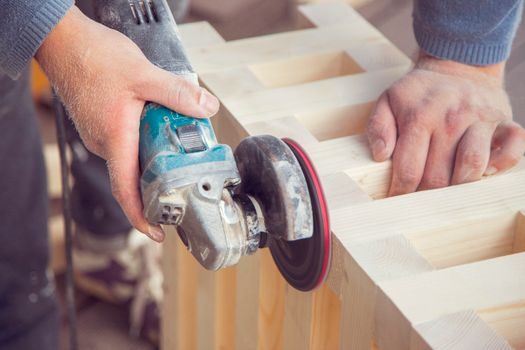
Angle grinders are for cutting, grinding, beveling and brushing steel, stainless, stone, masonry, and tile — i.e. work that needs a thin abrasive wheel turning at high peripheral speed. They are not for precision grinding (use a bench grinder for that, which is a [bench grinder reference topic outside this guide's scope but worth flagging]) and not for fine surface finishing on visible stainless (a 125 mm variable-speed polisher with a lamb-wool pad is the correct tool) [S3].
If the job is a one-off small-diameter cut in tile, a marble cutter is the safer, cheaper, and faster answer — the article on rotary hammer vs marble cutter mechanism chuck and job fit is a useful read across that decision. Likewise, if you are drilling masonry repeatedly, a rotary hammer with an SDS-Plus chuck will outperform a grinder with a diamond core bit on every cycle — see the rotary hammer selection guide for the spec-gate logic.
Failure Modes, Guard Discipline and Accessory Reality
Three failure modes drive almost every angle-grinder injury report: disc shatter from over-speed or wrong-arbor mounting, kickback on a pinched cut, and guard removal by the operator to "see better". A wheel rated at 11 000 min⁻¹ maximum must never be run on a machine that exceeds that speed, and Type 41 (flat cutting) and Type 27 (depressed-centre grinding) discs are not interchangeable on every guard [S3].
The guard shipped with the tool is a Type 27 / 42A combination on most modern machines; do not swap it for a slimmer cut-only guard unless the job has been risk-assessed and the operator is wearing a face shield rated to EN 166 plus ear protection above 85 dB(A). Battery platforms also matter: an 18 V 5.0 Ah pack delivers about 12–15 minutes of continuous 125 mm cutting on 6 mm plate before the thermal cut-off trips — factor that into crew sizing or stay on corded.
Sourcing, Standards and What to Verify on the Nameplate
For European buyers the nameplate must show the CE mark, the EN 60745-2-3 compliance line for hand-held grinders, and on 230 V professional tools the EN 61000-3-2 harmonic-compliance reference; for North American sites, look for a UL 60745-2-3 or CSA listing. South African buyers in 2026 can source INGCO-branded entry-tier machines from wholesaler channels with a published sizes-specs-uses buying reference [S1].
On the receiving dock, verify three things before sign-off: disc diameter stamped on the nameplate, no-load speed, and spindle thread. Open the carton, fit a Type 27 grinding wheel, and run the tool for 60 seconds at no-load listening for bearing growl — that 60-second test catches more warranty returns than any spec sheet. For larger plant tooling adjacent to angle-grinder duty, the steel strand buying guide covers another high-volume consumable SKU with the same kind of nameplate-discipline logic.