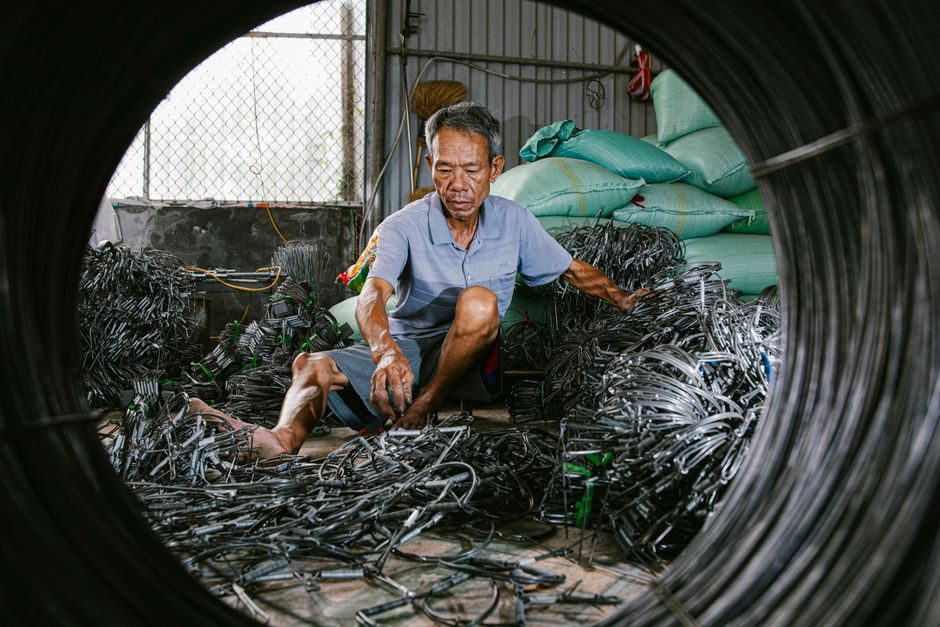
A 7-wire steel strand is a helically laid bundle of six cold-drawn outer wires around a larger straight king wire, drawn from high-carbon wire rod and stress-relieved for prestressed concrete (PC) use; the three production diameters a buyer will see quoted in 2026 are 9.53 mm (3/8"), 12.7 mm (1/2") and 15.24 mm (0.6"), all to GB/T 5224 or ASTM A416 tolerances depending on the destination market [S3].
Domestic Chinese mills including Tianjin Daqiang Steel list strand, PC strand and concrete steel strand as their primary product lines and actively post RFQs through B2B portals, meaning 2026 procurement is heavily online-discovered rather than broker-mediated [S3]. For comparison with other long-product categories, the alloy steel buying guide 2026 walks through the same mill-source and MTC discipline but for bar and billet rather than wire-rold-based strand.
Construction and Where the Strands Sit Inside It
A steel strand is not a single wire — it is a 1×6 (occasionally 1×7 for 18 mm and 21.6 mm post-tensioning) helical cable where each outer wire is roughly 4–5 mm in diameter for a 12.7 mm strand; the helical lay gives the cable its elastic elongation behaviour that plain rebar cannot match, and that is why prestressing strand is specified wherever a structural element must resist tension after the concrete has cured (pretensioned beams, post-tensioned slabs, ground anchors, pressure vessels). [S1]
In bridge girders, hollow-core floor slabs and LNG tank walls the strand carries 70–80% of the design tensile load, with the concrete carrying compression; undersizing the strand diameter by one step (12.7 → 11.11 mm) on a long-span girder typically forces rebar congestion at the anchor zone and re-design of the stressing pockets. The helical construction is what makes the same product flexible enough to coil on a 1.2 m-diameter reel yet stiff enough to hold its helical geometry under 80% UTS during stressing.
The Three Diameters You Will Be Quoted
9.53 mm (3/8") strand weighs roughly 0.432 kg/m and breaks at about 102 kN (1860 MPa grade); 12.7 mm (1/2") weighs about 0.774 kg/m with a 184 kN minimum breaking load; 15.24 mm (0.6") strand weighs 1.101 kg/m and breaks at about 260 kN, which is the size most commonly used in post-tensioned bridge girders and large floor slabs [S3]. Larger 17.8 mm and 21.6 mm sizes exist for heavy post-tensioning and ground anchors but are not the everyday buyer's stock items.
For 99% of cast-in-place and pretensioned work the 12.7 mm strand is the de-facto standard — coil weight is typically 2,000–3,000 kg, reel diameter 1.0–1.2 m, and a 40 ft high-cube container holds roughly 22–26 t net. Buyers who specify 15.24 mm for the wrong reason (e.g. hoping to reduce strand count) usually lose the savings on heavier anchorage, larger ducting and bigger stressing jacks.
Grade 1860 MPa vs 1960 MPa and What You Actually Gain
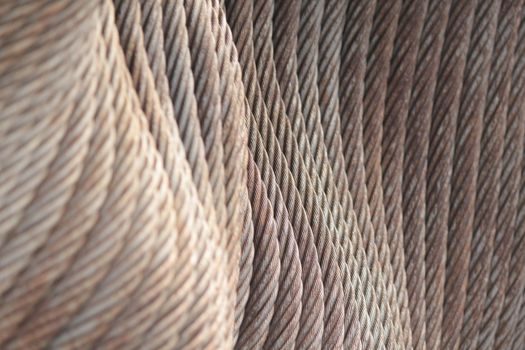
1960 MPa strand is more sensitive to relaxation loss at sustained load and to stress-corrosion cracking in chloride environments, so the relaxation class (see below) and the project's exposure condition matter more than the headline MPa. In a typical 2026 quote envelope from a Chinese mill, 1860 MPa 12.7 mm strand lands around 600–720 USD/t FOB Tianjin, with 1960 MPa carrying a 5–10% premium and indented (bonded) strand a further 3–5% premium for the surface deformation that improves bond with grout.
Relaxation Class: Low-Relaxation (Lo) vs Regular (R)
Low-relaxation (Lo) strand is the only kind to specify for any pretensioned or post-tensioned structural application in 2026; it is produced by stress-relief heat treatment at around 350–400 °C after the final cold draw, which stabilises the dislocation structure and drops the 1,000-hour relaxation loss from 8–10% (regular class) to below 2.5% under 70% UTS at 20 °C [S3]. Specifying "ASTM A416" without the relaxation class suffix is one of the most common buyer errors and silently locks in the cheaper, higher-loss product.
For ground anchors and rock bolts where the strand is tensioned once and held for decades, low-relaxation is mandatory; for temporary works or post-tensioned slabs with full grout protection, regular-relaxation strand still appears in some markets but is increasingly rejected by specifiers. Buyers should require the mill to stamp the relaxation class on each coil tag and on the MTC, not just on the invoice.
Standards That Show Up in 2026 RFQs

ASTM A416 / A416M covers 7-wire uncoated and epoxy-coated stress-relieved strand for prestressed concrete, including the grade suffixes "Grade 1860" and "Grade 1960" and the relaxation suffixes "R" (regular) and "L" (low). GB/T 5224 is the Chinese national standard and is technically equivalent for most cross-border shipments, with 1×7 15.20 mm and 17.80 mm sizes defined separately. BS 5896 covers British / Singapore / Hong Kong projects, prEN 10138 is the European standard, and JIS G 3536 covers Japanese shipments. All four use similar 1860 MPa low-relaxation as the workhorse grade [S3].
For bridges and post-tensioned civil structures in seismic zones, additional requirements typically apply: ASTM A882/A882M for epoxy-coated fill- or grit-coated strand, and project-specific bond-strength tests on the coated product. Epoxy-coated strand carries a 15–25% cost premium and longer lead time (4–6 weeks vs 2–3 weeks for bare strand from a Chinese mill in 2026).
MTC Discipline: What the Mill Test Certificate Must Show
Buyers should also ask for a third-party inspection slot (SGS / BV / TUV) for any shipment above 50 t or any new-mill first order.
The wire rod feeding the strander is itself made to alloy steel or high-carbon carbon steel rod specifications (typically SWRH82B / 82B-1 / 77B in Chinese nomenclature), and the rod's chemistry is the upstream variable that controls the strand's fatigue life; a cheap MTC that does not show the rod's heat number should be a red flag for re-rolled or remelted stock.
Surface Condition: Bright, Galvanised or Epoxy-Coated

Bright (black) strand is the default and is stored in grease-wrapped coils for temporary corrosion protection only — once unrolled on site it must be embedded in grout within days or it will flash-rust. Galvanised strand adds a zinc coating (~300 g/m²) for permanent corrosion protection in bridges and coastal structures and roughly doubles the unit cost relative to bright strand in 2026. Epoxy-coated (ASTM A882) is the third option and is bonded by grit-blasting the zinc before fusion-bonded epoxy application, with the grit giving mechanical bond to the grout. [S2]
A buyer who needs galvanised strand for a bridge pier in a marine splash zone should also specify the coating weight, the chromate treatment, and the strand's relaxation after galvanising (some mills re-stress-relax the strand post-coating, some do not, and the relaxation loss is then non-compliant with A416).
Who 7-Wire Strand Is For and Who Should Not Buy It
7-wire PC strand is the right answer for pretensioned beams, post-tensioned slabs, bridge girders, ground anchors, rock bolts, concrete pressure vessels, LNG tank roofs, and railway sleepers — anywhere high tensile load must be carried in a small cross-section. It is the wrong answer for welded mesh, stirrups, column ties, slab-on-grade reinforcement, or any application that requires the reinforcement to be bent on site: strand cannot be field-bent to the radius that rebar can, and attempts to do so will fracture the outer wires. [S3]
For those applications, linear guide is irrelevant (it is a motion-control product, not a construction product), but buyers searching for "steel wire" should be careful to distinguish between PC strand (stress-relieved, high-carbon, structural), galvanised wire rope (flexible, low-carbon, lifting), and welded wire mesh (cold-drawn, mild, not stress-relieved). Cross-substitution is a common RFQ error.
Comparison Table: Three Main Options for Prestressed Reinforcement
The plain rebar option (typical Grade 500B 16 mm) is cheaper per kg but provides no pretensioning capability and is not a substitute for any post-tensioned or pretensioned design. [S1]
On lead time, bright 12.7 mm strand in coils of 2.0–3.0 t is the shortest at 7–14 days FOB Tianjin for in-stock production; 15.24 mm extends to 14–21 days; galvanised adds another 10–15 days for the zinc pass; epoxy-coated 4–6 weeks because of the fusion-bonded line capacity. Buyers who need strand on a tight site schedule should not specify epoxy-coated unless the corrosion exposure forces it.
Failure Modes and How to Read Them in a Reject Note
The most common field reject on incoming 7-wire strand in 2026 is undersize diameter (out of round or below the lower A416 tolerance of −0.15 mm on 12.7 mm), followed by surface defects (scratches, scabs) that breach the 1% of surface area limit, then by missing or non-traceable MTCs, and finally by relaxation test failure when the mill's stress-relief furnace was under-temperature. A 1% area surface defect on a 12.7 mm strand is roughly a 12 mm × 12 mm patch — anything larger should be rejected before uncoiling. [S2]
A second class of failure is grease contamination of the strand's outer wires, which prevents grout bond and shows up as a post-tensioning pull-out failure at 30–60% of design load; the cure is to require the mill to wrap each coil in grease-proof paper plus hessian, and to reject coils where the wrap is torn on arrival.
RFQ Checklist and Trackable Signals
A 2026 RFQ that survives a technical review names: diameter (with tolerance class), grade (1860 or 1960 MPa), relaxation class (Lo or R), surface (bright / galvanised / epoxy), standard reference (ASTM A416 / GB/T 5224 / BS 5896), coil weight and reel type, MTC format (EN 10204 3.1 vs 3.2), third-party inspection, packaging, and delivery incoterm (FOB / CFR / DDP). A quote that omits any two of those items is a quote against an incomplete specification and will produce a price, but not a usable order [S3].
Two trackable signals for the rest of 2026: Chinese mill listing pages (e.g. Tianjin Daqiang Steel) continue to update product lines and "RFQ" call-to-action buttons in line with [S3]'s May 2026 snapshot, and online B2B platforms (Hashtagsteel) are pushing step-by-step onboarding tutorials and UPI / card / net-banking payment options that indicate the procurement funnel is shifting from email-PDF to portal-based order placement [S2]. Both signals point to 2026 being the year the small and mid-tier strand buyer migrates online, with the mill-side RFQ response time dropping from 3–5 days to under 24 hours for portal-registered buyers.