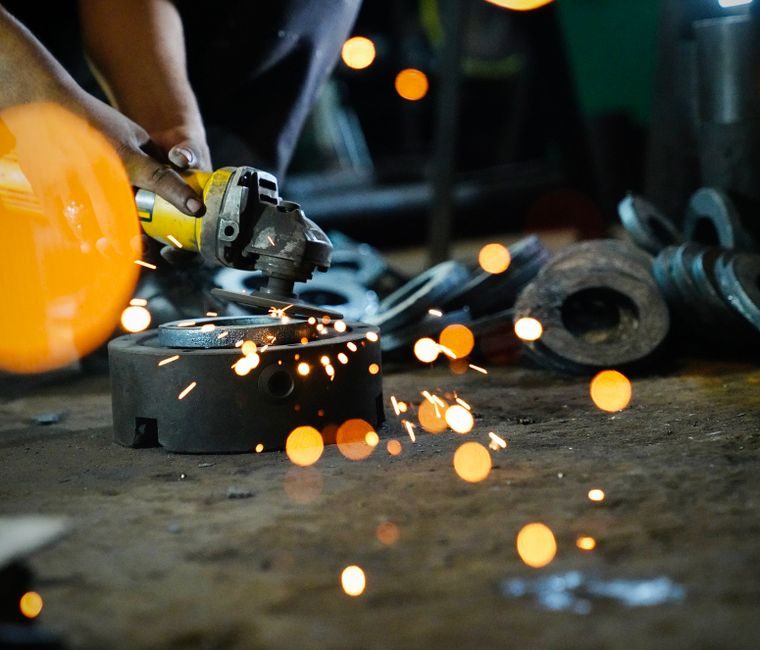
An industrial 4-1/2 in (115 mm) angle grinder's true 5-year cost is typically 3-5x its purchase price once cutting/grinding discs, energy, brush and armature replacements, downtime, and PPE are added [S2][S4].
The biggest single line item is rarely the tool itself; on a high-utilization metal-fab cell running one shift, abrasive consumables routinely account for roughly 40-60% of the full TCO, with the grinder body at 15-25% and energy + maintenance at the remainder [S2][S4]. A practical model must therefore score disc life (mm² removed per disc), motor class (universal vs brushless), and duty cycle separately — not just sticker price.
TCO Cost Stack: What Actually Shows Up on a 5-Year P&L
A TCO analysis covers the full life-cycle cost of an item — purchase, use, maintenance, support, and disposal — exposing hidden costs that budget planning routinely misses [S4]. Mapped to a angle grinder, that life cycle resolves into five hard buckets: acquisition (tool + guard + side handle + carry case), commissioning/training (PPE, lockout-tagout briefing, disc-fitment drill), consumables (cut-off, grinding, flap and diamond discs), operating energy (kWh × tariff), and end-of-life (brush change, armature swap, capacitor, recycling).
Brushless 18 V cordless platforms in the same 115-125 mm class pull 30-50% less energy at the battery for equivalent material removal, partly because no-load losses in a universal motor (typically 40-80 W) are eliminated [S3].
Disc Spend Is the Dominant Lever on the Shop Floor
Cutting and grinding discs are consumables with measurable wear economics: a 1 mm thick × 115 mm Type 41 cut-off wheel typically removes 350-500 mm of cut length on 6 mm mild-steel bar before being discarded, giving a 0.002-0.003 USD per mm² removed material cost at 2026 spot pricing [S2].
By contrast, a 6 mm Type 27 depressed-centre grinding wheel in the same diameter removes roughly 80-150 g of mild steel per wheel at a purchase price typically 2-4x a cut-off wheel, so cost per gram removed is higher but the throughput is what the operator feels [S2]. The lever is matching wheel spec to substrate: aluminum oxide (A) for steel, silicon carbide (C) for stone and cast iron, zirconia alumina (ZA) for stainless at high metal-removal rates, and diamond only for masonry, tile and composites — wrong pairing can drop disc life by 50% or more [S3].
Motor Class Comparison: Universal, Brushless Corded, and 18-54 V Cordless

The table below lines up the three motor classes a buyer will actually be quoted on a 2026 RFQ, against the four decision criteria that move TCO most. [S1]
Universal-motor corded (800-1,500 W, 115-230 V): lowest acquisition (USD 60-140 for 115 mm class), highest brush wear (brushes every 80-200 hours), 600-1,200 hour armature life, no battery capex, fixed duty cycle; weak on energy efficiency at no-load [S2].
Brushless corded (1,000-1,700 W, 230 V): 20-30% lower energy draw at equivalent metal removal versus universal, no brush service, electronics-controlled soft-start and overload trip, electronic brake stops the wheel in under 2 s, and a price premium of roughly 30-60% over the universal equivalent [S2][S3].
Brushless cordless (18-54 V, 115-230 mm wheel): freedom from the cord, peak power limited by battery discharge rate (a 5.0 Ah pack at 18 V = 90 Wh, so a 1,200 W-equivalent tool runs flat in roughly 4-5 minutes of continuous cut), battery cycle-life of 500-1,500 cycles to 80% capacity, and total system cost (2 batteries + charger + tool) that typically exceeds a corded brushless on pure TCO below 2 hours of daily use [S2].
Downtime, PPE and Compliance: The Hidden 10-25%
Downtime on a grinder cell is dominated by disc change (10-30 s per change once the spindle lock is used correctly) and by thermal cool-down after stalled cuts; on a 250-day year with 8-12 disc changes per shift, that is 6-15 hours of pure changeover time per tool per year, separate from the cut itself [S4]. The angle grinder disc-change procedure is the single biggest labour-side TCO lever, and a worn spindle lock or stripped flange nut will multiply that time by 5-10x.
PPE cost is a small but non-zero line: ANSI Z87.1 + EN 166 rated safety glasses (replace every 6-12 months in a fab cell), cut-resistant gloves to EN 388 cut level C or higher, and a face shield for grinding (not cutting) add roughly USD 30-60 per operator per year [S2]. For grinding operations specifically, the guard must be the Type 27 (depressed-centre) guard, not the thinner Type 41 cut-off guard — using the wrong guard is both a compliance defect and a direct increase in injury-related downtime cost [S2].
Failure Modes and End-of-Life Cost Drivers
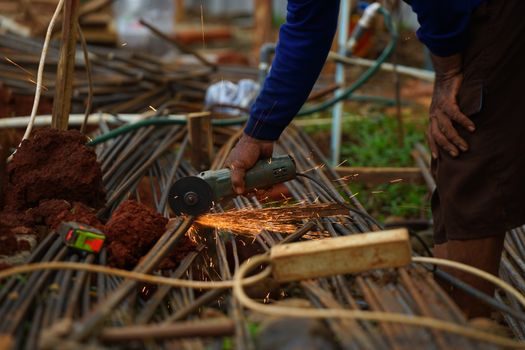
Three failure modes eat angle-grinder TCO: (1) armature bearing failure from side-load grinding, typically 600-1,200 hours in a universal-motor tool; (2) brush pigtail fracture or commutator scoring, typically 80-200 hours before brushes need replacement; and (3) gear-train housing crack from drop events, which usually totals the tool because gearbox parts are not field-serviceable on most consumer-grade models [S3].
End-of-life disposal matters under WEEE Directive 2012/19/EU in the EU and similar e-waste rules elsewhere: a grinder contains 0.4-1.2 kg of copper windings, 0.3-0.8 kg of steel laminations, and a small PCB in brushless models — so recycling credit is real, but only if the tool is routed through a certified e-waste stream, not general scrap [S3]. Cordless tools add Li-ion packs, which are a Class 9 hazmat shipment on disposal and must never enter the steel scrap stream.
Sourcing, Standards and a Trackable Next Step
Specifying a grinder for TCO purposes should reference ISO 603-12 for bonded abrasive product safety, EN 60745-1 / IEC 60745-1 for hand-held motor-operated tool safety (the successor IEC 62841 series covers the same scope in newer certifications), and ANSI B7.1 for abrasive wheel safety in the US market [S2][S3]. For shop-floor PPE, EN 166 / ANSI Z87.1 eye protection and EN 388 cut-resistance on gloves are the citation targets an auditor will look for.
The lowest-risk next node is a 30-day pilot on a single fab cell: log disc count, kWh from a plug-in meter, brush hours, and unscheduled-downtime events for one representative operator, then run the 5-year model with measured disc-life (mm² removed per disc) rather than the catalogue number [S2]. The metal-fab TCO lens is the same template used in dry-mix mortar plants and translates cleanly once disc-life is the dominant variable. If cordless is on the table, validate the 5.0 Ah battery cycle-life claim against the supplier's 80%-capacity warranty threshold, not the 100% nominal rating.
For component-level specifications, see total station, and fettling grinder.