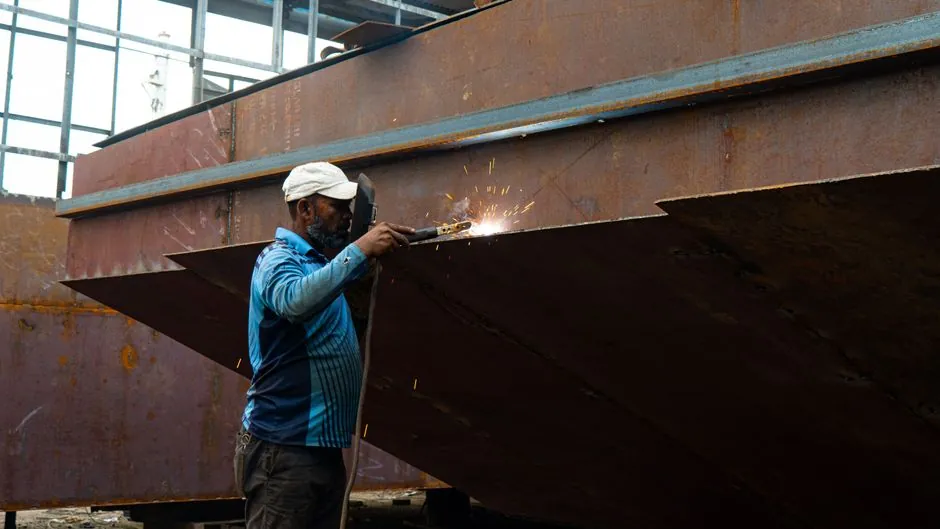
For 2026, anti-static equipment selection around welding is driven less by "static electricity" myths and more by combustible atmospheres, GMAW fume generation rates, and hot-tap procedures on live process piping [S1][S3].
Stainless GMAW processes in the US survey generated 0.2 mg fume per g electrode (pulsed-spray) versus 8 mg/g for shielded metal arc welding (SMAW), with hexavalent chromium emission rates spanning 50 to 7800 microgram/min across the eleven processes profiled [S1].
What anti-static equipment actually has to solve on a welding job
The risk envelope in welding-related static control is not the arc itself, which is a continuous low-voltage high-current source bonded to the workpiece, but the secondary electrostatic charging of non-conductive PPE, dry work clothing, flexible ducting on local exhaust, and any ungrounded conductive hardware within a combustible atmosphere [S3].
For hot taps on operating equipment, the practical guidance from a 40-year process engineer is to bond the weldolet, the valve body, the live pipe, and the welder's work clamp to a common verified ground before striking an arc, then to maintain that bond through fillet-welded attachment of a full-bore gate or ball valve to the nozzle [S3]. Conductive fluid in a running pump suction is mentioned in field threads as a low-probability hazard compared with the stored energy of the system; grounding integrity matters more than proximity [S3].
Equipment selection for fume and metal-fume control is in scope of the same review: pulsed-spray GMAW cut labour plus consumables to $3.15 per metre on 6.3 mm horizontal butt welds versus $7.40 for SMAW, and several GMAW variants reduced manganese emission rates below 50 microgram/g, which is meaningful when local exhaust is also being specified for [S1].
Selection criteria: classification, resistance band, and arc-process match
For 2026, an anti-static bill of materials for a welding cell should be qualified against four concrete criteria rather than a generic "ESD-safe" label: atmosphere group and zone (per the IEC 60079 series or NEC 500 equivalents), resistance-to-ground band, contact integrity on the workpiece, and compatibility with the selected arc process duty cycle [S2][S3].
Static-dissipative flooring and mat products for operator stations typically fall in the 1x10^6 to 1x10^9 ohm resistance-to-ground band; conductive (static-conductive) products sit below 1x10^6 ohm and are required where flammable vapours can reach the operator platform. Insulative products above 1x10^11 ohm are excluded from any cell that will draw an arc in the same room as a solvent line or hydrogen header [S3].
Welding equipment itself must be selected for the work to be performed, with the operator verifying that cable insulation, gun liner length, and power-pin seating match the process, per the general duty language in OSHA 29 CFR 1910.254 and the upstream inspection steps now standard in arc-welding preparation checklists [S2][S5]. A poorly trimmed MIG gun liner is a documented source of erratic arc, birdnesting, and burnback, and that same fault class on the work clamp side becomes a hidden resistance path that can mask a proper safety ground [S4].
Process pairing matters for fume-rate-driven decisions: nine GMAW variants and two flux-cored/SMAW processes were measured for fume generation per g of electrode, and the data show that the choice of waveform alone moves the emission rate by roughly 40x, which is the largest single lever a specifier has before touching extraction hardware [S1].
Comparison of main anti-static equipment options for a welding cell
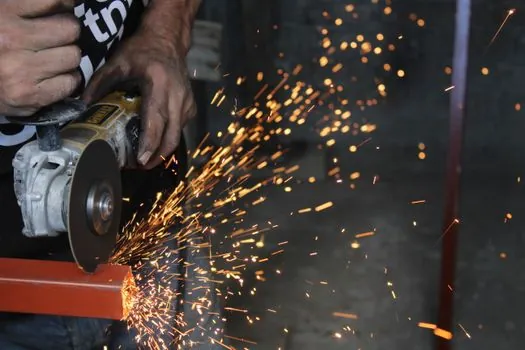
Four equipment families compete for the anti-static budget on a new welding cell, and the decision is best made against fixed criteria rather than brand. The table below uses values representative of the 2026 product class; exact resistance and current ratings should be re-verified against the manufacturer's datasheet and the applicable zone certificate before procurement. [S3]
Grounding clamps and bonding straps: the lowest-cost line item, typically copper or copper-alloy jaw with a duty cycle matched to the welding amperage (250 A class versus 400 A class). They are required on every arc strike and on every hot tap, and they fail safe by visible wear on the contact face. They are not a substitute for fixed installation grounding [S3].
Static-dissipative workbench mats and floor tiles: sized to the cell, resistance band 1x10^6 to 1x10^9 ohm, installed with a verified ground point at the mat edge. They control charge on the operator and on small parts, not on the welding circuit itself. Best fit for cells where solvents or powder coatings share the room [S3].
Conductive (static-conductive) floor coatings and footwear systems: resistance below 1x10^6 ohm, mandatory for Group IIC hydrogen atmospheres and any Zone 1 solvent handling. Higher cost and stricter cleaning regime, but they are the only option that reliably drains charge from a moving operator on a coating that may be contaminated with oil [S3].
Local exhaust hoods and flexible extraction arms with static-dissipative ducting: address fume and particulate, not surface charge on the part, but a non-conductive duct can itself accumulate charge and become an ignition source within the capture zone. Specifiers should request ducting rated to IEC 60079-32-1 guidance or equivalent and verify the resistance of the flexible arm at install [S1][S3].
Who this is for, and who it is not for
Anti-static equipment around welding is a hard requirement for any cell drawing an arc within a classified hazardous area (Zone 0/1/2 gas, Zone 20/21/22 dust), any hot-tap operation on a live flammable-service line, and any work using solvent-borne cleaners or coatings in the same room [S2][S3]. NADCAP-accredited suppliers treat welding as a special process and audit calibration, environmental controls, and consumable storage alongside equipment selection, which is the right governance model for aerospace and nuclear-adjacent work [S6].
It is not a substitute for process change. If the underlying arc process is SMAW with E308 rods on stainless, the 8 mg fume/g emission rate and the $7.40/m labour-plus-consumables cost dominate the safety and productivity case before any anti-static hardware is evaluated; switching to pulsed-spray GMAW moves both numbers by roughly an order of magnitude [S1]. For general fabrication on mild steel with no flammable atmosphere, the economic case for full ESD-grade matting is weak, and a verified work clamp plus a resistance-checked floor is usually sufficient [S2][S3].
Limits, failure modes, and what to verify on site
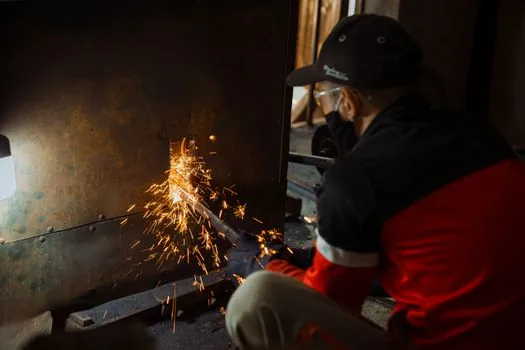
The most common failure mode is not absence of equipment but loss of the ground path: corroded clamp jaws, painted or oily workpiece surfaces, a cut-too-short MIG gun liner that lifts the contact tip out of concentric alignment, and a missing or daisy-chained mat ground [S4]. Each of these is observable in a 5-minute pre-shift check and each defeats the rest of the anti-static system [S2][S5].
The second failure mode is a specification that names the right standard but the wrong class. A Zone 1 hydrogen cell needs conductive (not dissipative) flooring, and a Class II dust cell needs a different cleaning regime on the same flooring. IEC 60079-32-1 is the reference engineers cite most often for electrostatic hazards in flammable atmospheres, but the specific resistance band and test method must match the zone and the group, and should be confirmed against the current revision of the standard at the time of purchase [S3].
For broader background on adjacent equipment categories that share grounding, fume, and hazardous-area logic, see the welding and cutting tool reference and the anti-static equipment entry; selection of extractors and fume arms often falls under the same procurement gate as construction machinery and equipment on site builds, where static-dissipative ducting is a sub-line of the same spec.
Procurement checklist and 2026 signal
Procurement language for a 2026 anti-static equipment pack should require: a resistance-to-ground value with the test method and the certificate reference, an atmosphere group and zone compatibility statement, a duty-cycle rating on the work clamp that exceeds the welding power source rating by at least 25 percent, and a documented joint between the gun liner spec and the consumable platform to avoid the trim-length failure mode described in field service notes [S4]. NADCAP audit scope and the 2025 update to arc-welding preparation guidance both push the same direction: equipment selection, environmental controls, and calibration evidence are reviewed as one system, not as separate line items [S5][S6].
For an applied spec-first example of how a related consumable category is being mapped this year, see the AM material selection for mold and die tooling brief, which uses the same resistance-and-class framework against a different process.