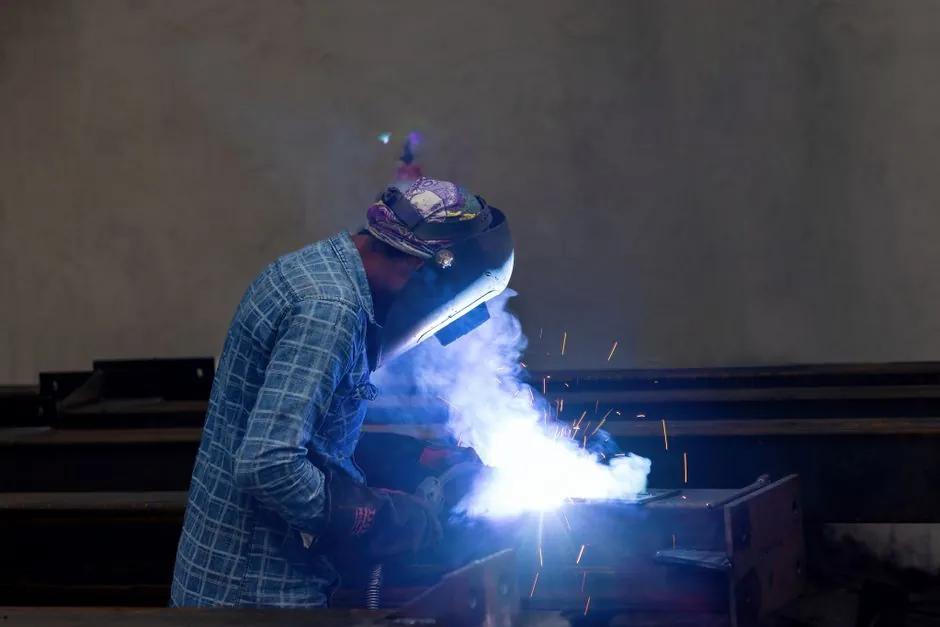
Arc force on a constant-current stick machine is a dynamic, short-duration current boost that fires only when arc voltage collapses toward a short-circuit threshold, with practitioner reports placing that trigger near 19 V on Miller-class inverter CC outputs [S1].
That single control decides whether a low-hydrogen E7018 bead lays down with a quiet hiss or throws a shower of spatter, and it is the same knob that lets a cellulose E6010 push a keyhole open on a downhill root pass without snuffing [S1][S4].
What the "dig" circuit actually does in the millisecond the arc collapses
Inside the welding arc, the typical open-circuit-to-arc voltage window for SMAW sits in the 19–40 V range, and the dig/arc-force loop is engineered to remain dormant whenever the arc is healthy above roughly 19 V [S1]. When the operator's hand dips and the gap closes, voltage drops below that threshold, the circuit reacts in microseconds, and the power source injects a temporary current surge to rupture the molten bridge before it freezes [S1].
The surge is not a continuous increase in machine output; it is a transient that returns to the preset amperage the instant a normal arc length is restored, so heat input calculated as volts × amps × time over the weld still tracks the original schedule plus a small correction [S1][S3]. On a CC/CV machine the same knob behaves differently, becoming an inductance control when the source is switched to CV (MIG) mode, which is why a single panel label is not a single physics [S1].
E7018 versus E6010: same knob, opposite spatter response
Cellulosic E6010 and similar XX10 rods transfer in a spray that allows the electrode to be driven straight into a root gap to form a keyhole, and high dig settings are typically chosen so the surge keeps that keyhole alive and pushes the bead into the open root [S1]. Low-hydrogen E7018 transfers in large globular droplets that hang off the rod tip; when a glob touches the plate the arc voltage sags, the dig fires, and a large short-clearing current blasts the glob apart, throwing spatter [S1].
The practical rule from experienced operators: keep dig low (often 0–3 on a 0–10 scale) for E7018 to limit the magnitude of the current step, and only raise it when running extra-low current for that rod diameter and the electrode starts sticking [S1]. On the same machine class, running 5/32" E7018 at 180 A with dig turned up to roughly 3/4 produced undercut and visible spatter, while dropping amperage to 145 A, going to a very short arc, and pushing arc force to maximum eliminated the undercut and spatter almost entirely [S5].
Electrode sticking, root blow-out, and the puddle signal that tells you the setting is wrong
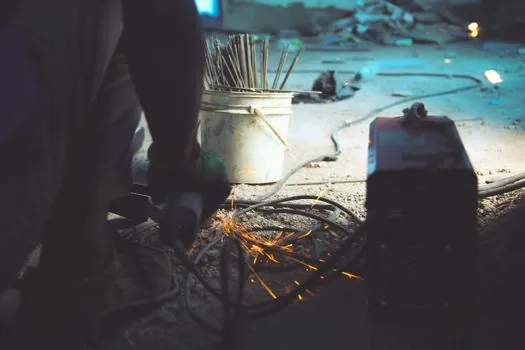
When arc force is set too low the most common failure mode is the electrode freezing to the workpiece, the arc snuffing out, and the welder having to crack the holder free, a problem Hot Start and Anti-Stick are designed to mitigate at strike and during the brief stall [S3][S4]. The most common failure mode at the opposite extreme is puddle blow-out: the surge that was meant to clear a short instead ejects molten metal from the pool, producing excess spatter and a rough, high-crown bead [S2].
Symptom-mapping is the fastest field diagnostic: arc sputtering or going out on tight root passes, an unusually violent or harsh arc sound, and a blown-out puddle are all signs arc force is set above the level the electrode and joint can absorb [S2]. Once that pattern appears the corrective sequence recommended across sources is to drop the dig one increment, re-establish the arc at the same amperage, and repeat until the bead lays quietly, rather than fighting the symptom with more current [S1].
Setting procedure: zero dig, dial the pool, then add the boost
The widely repeated field procedure is to set the dig/arc-force control to zero, set the welding amperage to the level that produces the preferred weld pool and arc length, and then raise dig only until the arc behaves the way the welder wants [S1]. On a Miller-class CC inverter, a 0–3 setting is the usual band for E7018, and settings in the upper half of the dial are reserved for E6010 and other XX10 rods on open roots [S1].
Because dig interacts with arc length, not just electrode type, the same numeric setting produces different results on a stringer bead at long arc versus a weave at short arc; the short arc and the high-dig setting together amplify the short-clearing surge, which is why a 145 A short-arc E7018 weld at maximum dig can still run clean while a longer-arc bead at lower dig spits [S1][S5]. This interaction is also why arc force is not a stand-in for amperage: changing dig does change instantaneous current during shorts, but the long-arc steady-state current is set by the amperage knob, not by dig [S3].
Arc force on inverter welders: Hot Start, Anti-Stick, and the dynamic I/V characteristic
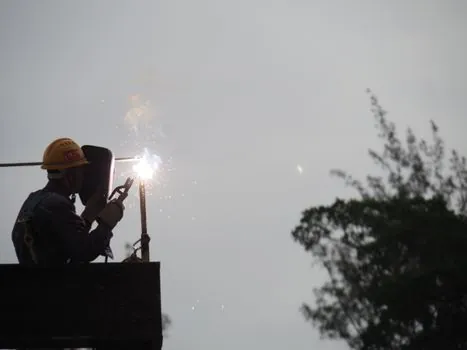
Modern inverter stick machines package three related dynamic controls: Hot Start briefly elevates current at arc strike to prevent the electrode from sticking on cold plate, Arc Force (or Dig) boosts current when arc voltage sags during welding, and Anti-Stick drops current sharply if a sustained short is detected to let the operator break the electrode free [S3][S4].
The arc-force loop itself monitors the welding arc continuously, and when it detects a sudden voltage drop it delivers a temporary current increase, then automatically returns to the preset current once a normal arc length is restored, with the entire correction happening in milliseconds and requiring no operator input [S3]. When adjusting a multi-knob machine, the recommendation is to set Hot Start and Anti-Stick to the positions called out by the manufacturer for the electrode, then trim dig on the puddle response, because changing one dynamic control changes the operating point the others see [S3][S4].
Limitations, failure modes, and what arc force does not fix
Arc force does not compensate for an incorrect amperage setting, an unsuitable electrode size, or a poorly prepared joint, and a dig adjustment applied on top of an already overheated pool will simply throw more spatter and may undercut the toe [S1][S2]. It also will not change the open-arc steady-state voltage, because outside the short-clearing event the machine is still in constant-current mode, so claims that dig widens or narrows the bead profile in normal operation are not consistent with how the loop is wired [S1].
On a CC/CV power source, switching to CV (MIG/FCAW) mode converts the same knob into an inductance control, so the field rule "use dig to control spatter" only applies in stick mode, and MIG spatter tuning requires thinking about inductance, not arc force [S1]. For procedure qualification, the relevant heat-input calculation is still volts × amps × travel speed, because dig's transient contribution averages out over the bead length and is not treated as a separate input variable in the standard formulas [S1].
Selection criteria: who benefits from high dig, who should leave it low
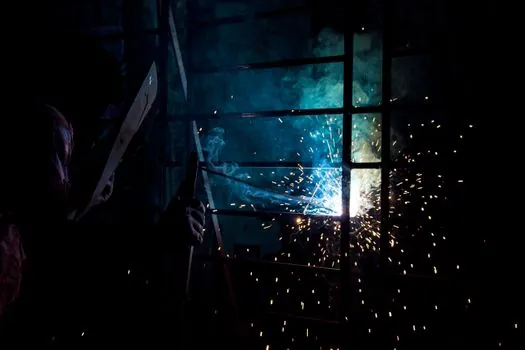
High dig suits E6010/E6011/E7010 cellulosic rods on open-root pipe and structural joints, downhill welding where the welder drives the electrode into the gap, and out-of-position work where a short arc and a strong surge are needed to keep the keyhole open [S1]. Low to moderate dig suits E7018 and other low-hydrogen iron-powder rods on fillet and butt joints in plate, on vertical-up and overhead beads, and on any work where globular transfer would otherwise throw spatter under surge clearing [S1][S5].
Beginners benefit from a moderate, fixed setting that produces a forgiving short-arc response without violent puddle ejection, while experienced structural and pipe welders typically run dig near zero for E7018 stringers and turn it up only for the root pass on a 6G pipe joint [S1][S3]. For reference on how a different closed-loop control problem is set up against a similar short-circuit-driven process, see the spindle preload discussion at bearing preload on angular contact spindles, and for the static side of fit selection the ball bearing shaft fit range and load class article covers clearance choices in much the same data-driven tone.
Trackable signals for the next cycle: manufacturer literature updates to inverter arc-force curves (E6010 vs E7018 default maps), revised AWS D1.1 commentary on dynamic SMAW controls, and field data on whether constant-power firmware (slope control) is being blended into CC dig loops on 2026–2027 model-year inverters. For background on the broader stick process the arc welding reference page summarises the supporting equipment.
The underlying component specifications are covered under force gauge, and weighing force.