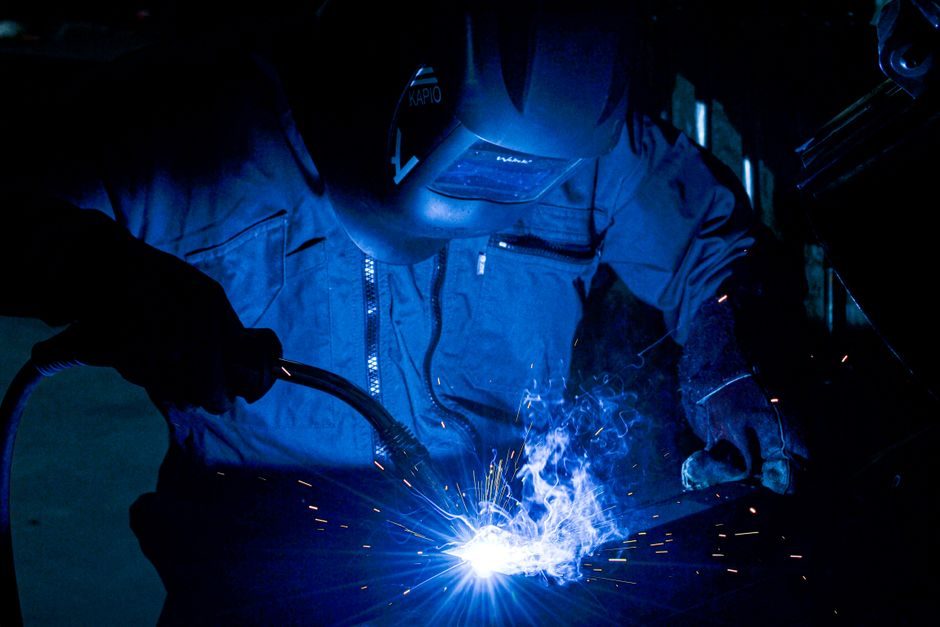
Arc welding machines in the 2026 market range from handheld manual stick/MMA units near 200 A to fully automated gantry cells rated 500 A and above, with separate price tiers for inverter desktop units and CNC stud welding cells priced US$4,500-55,600 per set on a 1-set MOQ. Procurement decisions turn on four levers: welding process family, output current range, duty cycle at rated output, and automation level (manual, semi-automatic, fully automated standalone cell).
The term "arc welding" covers any process that joins metals by melting the workpiece with an electric arc - MMA/stick, MIG/MAG (GMAW), TIG (GTAW), submerged arc (SAW), plasma and stud welding all fall under this umbrella [S6]. This guide is written for buyers evaluating a single machine purchase or a small cell; for fleet-level robotic lines, see the linear guide and motion platform spec page when sizing seam-tracking carriages.
Process Family Determines the Machine Class
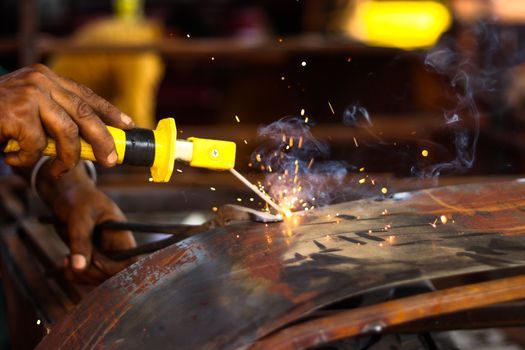
MMA/stick inverters remain the lowest-cost entry, typically 140-250 A output, suitable for site work and repair; MIG/MAG adds wire feed and shielding gas, raising throughput on thin-gauge steel; TIG delivers cleaner beads on stainless and aluminium at the cost of operator skill; submerged arc and plasma sit at the high-throughput end for thick plate and stainless cladding [S6]. Stud welding is its own product line: a Shanghai Nuben listing on 2026-06-01 prices desktop stud welding machines at US$4,500-55,600 per set (MOQ 1 set), with the same band covering automatic and CNC stud welders built on linear guide rails - a useful benchmark for any buyer comparing stud welding cells to MIG cells.
Buyer takeaway: do not compare a US$300 stick inverter against a US$30,000 robotic cell on price. Define the process family first, then compare within it. Chinese OEM line cards published in 2026 (Aolong, 2026-06-27) explicitly separate gas welding, manual welding, argon-arc (TIG), MIG and stud welders as distinct SKUs rather than variants of one product [S3].
Current, Duty Cycle and Input Power: The Three Numbers That Decide Spec
Output current is the headline number. A 200 A class machine covers sheet steel up to ~6 mm; a 350-500 A class machine (for example the WSM-500) is the standard rating for structural fabrication and medium-thickness plate work [S5]. Duty cycle is the second decisive number: a 60% duty cycle at rated output (the common industry baseline) means the machine can sustain full current for 6 of every 10 minutes before thermal cutback; an automated gantry welder running continuous beads through a long seam typically demands 80-100% duty at rated amps, not 60%.
Input power is the third lever. Single-phase 220 V is fine up to ~200 A; above that, three-phase 380 V / 50 Hz becomes mandatory. The TRUMPF TruArc Weld 1000 cell is supplied as a fully equipped, TÜV-tested, CE-marked machine tool with integrated exhaust and anti-glare housing - meaning the spec sheet has to cover the whole cell, not just the power source [S1]. Inverter technology has spread across price tiers: even the gantry MZ/TZ automatic welding machines from DX Blast (2020-07 baseline) use A.C. inverter control for stable arc and fast travel speed, with a three-spindle seam-tracking arc-guide mechanism that keeps torch alignment without drift [S2].
Automation Levels: Manual, Semi-Auto, Automatic Standalone
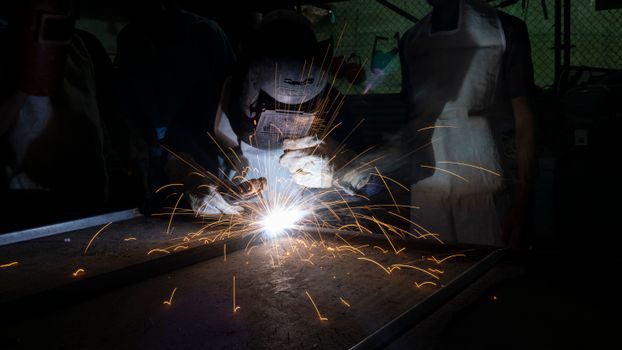
Three tiers dominate 2026 catalogs. (1) Manual machines: handheld electrode holder, no wire feed, no travel carriage - lowest cost, operator drives bead quality. (2) Semi-automatic: MIG/MAG with wire feed and a hand-held or fixture-mounted torch, sometimes on a cross-slide - the bulk of light-fabrication shops sit here. (3) Automatic standalone cells: gantry or double-column machines with seam tracking, flux auto-recovery (submerged arc) and integrated controls; the TZ double-column-beam automatic welding machine is the larger-frame version of the MZ gantry, with welding machine and main frame under one integrated controller for higher efficiency [S2].
TRUMPF's TruArc Weld 1000 is the upper-tier reference: a CE-certified, TÜV-tested cell with exhaust, anti-glare housing, and one- or two-station operation selectable by component and lot size, programmable with video tutorials and minimal training [S1]. Chinese OEM literature from coldrollformingmachinery.com (2026-05-29) markets the heavy-duty high-frequency arc welding robot system as covering "almost all areas of welding production, including automotive vehicles and spare parts" - positioning the robotic arc cell as a generalist workhorse rather than a niche tool [S4].
Comparison: Where Each Option Wins on Decision Criteria
Four decision criteria line up the main options directly. (a) Output current: manual stick inverter tops out near 250 A; MIG/MAG semi-auto covers 200-400 A; automatic gantry/robotic cells start at 350 A and reach 500+ A continuously. (b) Bead consistency: manual is operator-dependent; semi-auto improves repeatability; automated cells with seam tracking hold tolerance without drift [S2]. (c) Operator skill required: manual = highest, semi-auto = medium, automated cell = lowest (program, not weld). (d) Capital cost: manual US$100-1,000 band; semi-auto US$500-5,000; stud/CNC cells US$4,500-55,600 per set; automated gantry/robotic cells US$30,000-200,000+ depending on cell integration [S1][S4]. A shop running under 200 m of weld per month is overspending on automation; a shop running 2,000+ m of longitudinal seam on profile work is underspending without a gantry.
Who This Is For, and Who It Is Not For
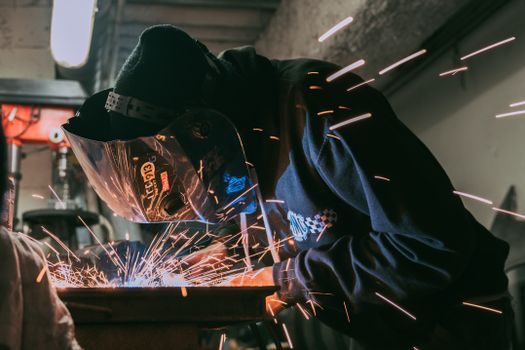
This guide is for: small fabrication shops picking a first MIG or upgrading from stick to inverter MIG; OEM buyers comparing gantry and robotic arc cells for profile or sheet welding; sourcing teams benchmarking Chinese OEM stud welders and automatic welding machines. It is not for: buyers specifying one-off aerospace TIG welds (different process class, different spec sheets); buyers needing coded pressure-vessel welds (look for ASME Section IX-qualified procedures, not just a CE-marked power source); buyers evaluating laser welding or resistance spot welding (different physics, different decision tree - resistance spot work in panel lines pairs naturally with the kind of motion platforms covered in the crossed-roller guide reference). [S1]
Limits, Failure Modes and Sourcing Red Flags
Three failure modes dominate field returns. (1) Undersized duty cycle: a machine rated 60% at 350 A will thermal-cutback within minutes on a continuous gantry pass, so always derate for automated duty. (2) Mismatched wire feed: MIG/MAG requires feed rollers, liners and drive rolls matched to wire diameter and type (solid vs flux-cored) - a common silent failure on cross-brand sourcing. (3) Missing cell-level safety: an inverter power source alone is not a CE welding cell; CE certification covers the integrated cell with exhaust, anti-glare housing and interlocked guarding, as TRUMPF specifies for the TruArc Weld 1000 [S1].
Sourcing red flags in 2026 listings: vague "heavy duty" claims without an amp rating or duty cycle; product pages that do not state input phase/voltage; CNC stud welders advertised with no travel-length spec on the linear guide rail (which determines max workpiece length); Alibaba/Made-in-China listings with no third-party audit report. Verified OEM line cards like Aolong's 2026-06-27 update [S3] and TRUMPF's product page [S1] are the safer baseline. For buyers also weighing adjacent metalworking equipment, the cost-lever logic in the shot blasting machine price guide tracks the same China-sourcing variables - type, abrasive/spec equivalent, MOQ and supplier audit depth.
Standards, Certification and Where to Verify
For European installs, CE marking on the whole cell is the baseline; TRUMPF publishes TÜV-tested, CE-certified cell status for the TruArc Weld 1000, covering exhaust, housing and operator-safety subsystems [S1]. Chinese OEM literature for the MZ/TZ automatic welding machines cites A.C. inverter control with three-spindle seam-tracking and integrated flux auto-recovery as standard design points [S2]. For high-frequency arc welding robot systems, Chinese OEM claims of "almost all areas of welding production" should be cross-checked against the buyer's own WPS/PQR requirements - OEM coverage is a marketing claim, not a procedure qualification [S4]. For stud welding cells, the 2026-06-01 price band on Made-in-China.com (US$4,500-55,600 per set, MOQ 1 set) is the cleanest public benchmark for sourcing.
Trackable signals over the next quarter: (1) new inverter topology claims (e.g. higher switching frequency, smaller transformer) surfacing on Chinese OEM product pages; (2) cell-level CE/TÜV audit reports being published as downloadable PDFs rather than marketing copy; (3) price drift on the US$4,500-55,600 stud-welder band as CNC rail specs standardise. Buyers comparing arc welders to adjacent metalworking cells can also reference the cutting machine spec page when sizing a fab cell that welds and cuts in one bay.