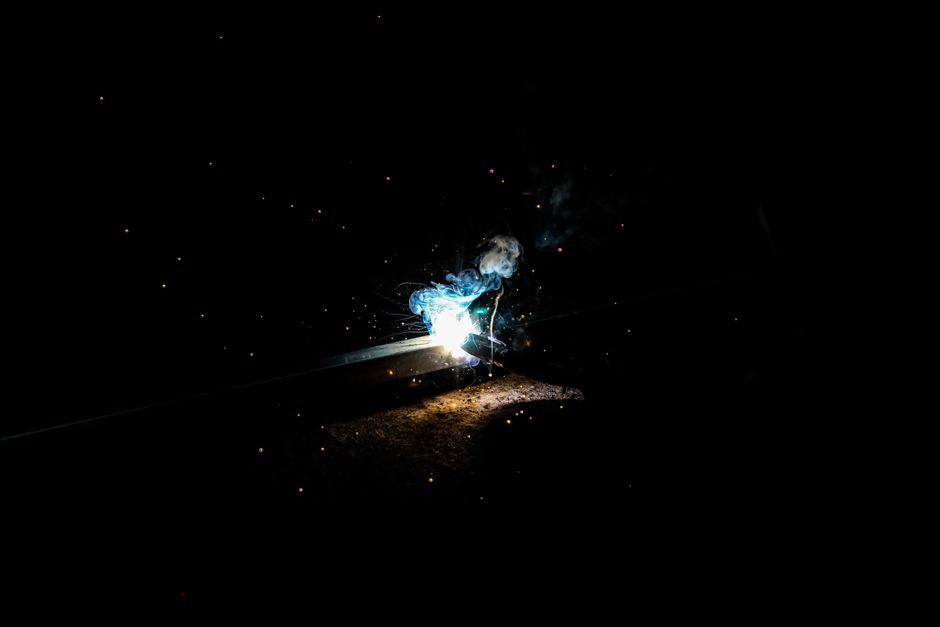
On 2026-06-04 sourcing snapshots, Chinese B2B marketplaces list MMA/stick-style AC arc welders at US$ 515.00–620.00 per piece (1 piece MOQ, Shanghai Sanyu Industry Co., Ltd.) and US$ 357.00–380.00 per piece (1 piece MOQ, Hubei supplier) [S8]. A separate Hubei listing on the same snapshot shows higher-amperage AC arc welding equipment at US$ 3,000.00–7,000.00 per piece from Bcamcnc Machinery (Shandong) [S8] — illustrating the tenfold price spread driven mainly by output current class.
For a hands-on overview of how arc welders stack up against other processes, the comparison piece Arc Welder vs TIG Welder: 2026 Spec Cut for Fabricators and Buyers is worth reading alongside this cost guide. The Arc Welding Machine 2026 Buying Guide: Current, Duty, Process, Spec companion article maps the spec-side decision tree; this article maps the price-side one.
Price bands observed on 2026-05 / 2026-06 B2B listings
Three discrete price tiers appear consistently across 2026 snapshots on made-in-china and alibaba channels. Tier 1 — light commercial/light-industrial MMA units, typically 200–250 A class: US$ 357.00–620.00 per piece, 1 piece MOQ [S8]. Tier 2 — mid-power AC models (around 400 A class) such as the WSM 500 platform advertised on 2026-05-21: typically US$ 500–1,200 depending on vendor and accessory bundle [S5]. Tier 3 — heavy-industrial MMA/PE 500 A inverter-class machines, MOQ 5 pieces, listed as "Negotiable" on 2026-04-20 with model code Zx7-500 / PE50-500 from a Guangdong welding-power-source manufacturer [S7].
Across these listings, the unit price spread is roughly 1 : 2 : 10, and the spread tracks output current class (200 A → 400 A → 500 A) and inverter vs transformer topology far more tightly than it tracks brand. Buyers should treat any quote that is 30 % below the band for its amperage class as a flag to verify open-circuit voltage, duty cycle @ 40 °C, and IP rating before paying.
What actually moves the price: current, duty cycle, process and topology
Four spec levers explain almost all of the variance seen in 2026-05 to 2026-06 listings. (1) Rated output current: a 200 A MMA stick welder commonly lists below US$ 400, whereas 500 A-class industrial inverters cluster at US$ 1,500–7,000 per set [S7][S8]. (3) Process capability: dedicated MMA-only units are cheaper than combined MMA/TIG or MIG/MMA dual-process units, which is why multi-process or "synergic" welders carry a 20–40 % premium over single-process siblings. (4) Topology: IGBT inverter platforms are priced 15–30 % above legacy thyristor/transformer units at the same amperage, but recover the gap in electricity cost because inverter no-load consumption is typically 30–50 W vs 100–200 W for transformer sets.
For buyers comparing similar-looking 500 A units, request four numbers in writing: rated current, duty cycle at rated current, open-circuit voltage (OCV), and input kVA at rated load. Two of those four — duty cycle and OCV — are the variables that most often hide inside a low headline price.
Cost of ownership beyond the sticker price
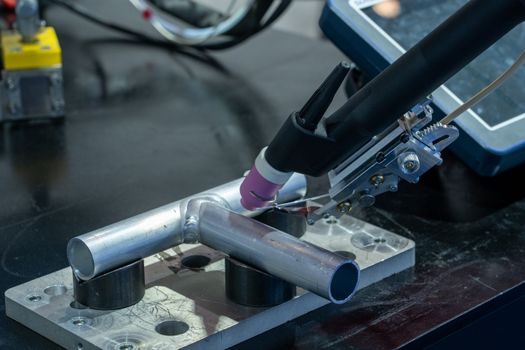
Purchase price is roughly 30–50 % of the 5-year cost of an arc welder in typical fabrication-shop duty; the rest is consumables, power, electrodes, and shielding gas for mixed-use shops. Electrode cost per kg of deposited weld is the dominant consumable line and scales with process — basic E6013 / E7018 stick electrodes are cheaper per kg than low-hydrogen E7018-1 or stainless 308L/309L rods. Power cost scales with input kVA, duty cycle, and shop hours; for a 500 A inverter running 6 hours/day at 60 % duty, expect roughly 6–9 kWh/shift, which at 2026 industrial tariffs in most regions is a small but measurable line item. [S1]
Three additional cost drivers frequently missed in headline comparisons: (1) cable and cooler losses — a longer secondary cable run or a clogged water cooler for a TIG-torched arc welder can waste 5–10 % of input energy. (2) Maintenance intervals — inverter IGBT modules and rectifier stacks have a defined service life and a replacement cost that should be amortized into the spec sheet, not discovered at failure. (3) Operator skill — process and equipment category details are catalogued in welding reference texts such as the "高等职业教育机械类专业十二五规划教材 — 焊接专业英语" 5-unit compilation covering welding fundamentals, stress and cracking, common processes, cutting, and NDT methods (2024-12-26) [S9], which is useful when a buyer is benchmarking what a given operator is expected to do per shift.
Comparison: MMA stick vs AC transformer vs inverter at a glance
For an apples-to-apples cost view, three configurations appear repeatedly in 2026 sourcing data. AC arc welding machines from Chinese manufacturers are listed at approximately US$ 357–620 per piece (e.g., US$ 357.00–380.00 from a Hubei supplier and US$ 515.00–620.00 from Shanghai Sanyu Industry Co., Ltd.) [S8]. (b) AC transformer arc welder, 300–400 A class, US$ 515–620 per piece: cheaper than inverter at the same amperage, heavier, slower arc response, higher no-load losses [S8]. (c) Inverter MMA/PE platform, 500 A class (e.g. Zx7-500 / PE50-500), US$ 3,000–7,000 per set, MOQ 5 pieces, negotiable [S7][S8]: highest unit cost but the lowest cost-per-deposited-kg at high duty, lightest weight per amp, and the most flexible process options. The right pick is determined by duty cycle and operator skill, not by sticker price alone.
Standards, certification and sourcing signals to verify in 2026
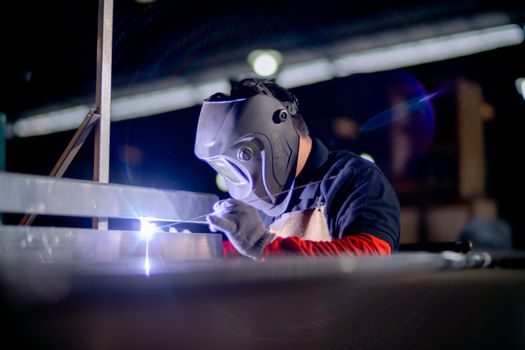
For European-bound shipments, ATEX conformity assessment (Directive 2014/34/EU) and the relevant IEC 60079-series explosive-atmosphere standards apply only when the welder is rated for use in zoned hazardous areas — most general-shop arc welders are not in scope, and buyers should not pay an ATEX premium unless the deployment site actually requires it. For North American sites, look for CSA or UL listing of the welding power source and confirm the input voltage matches the plant distribution (208 V / 230 V / 460 V three-phase are the common North American classes; 380 V / 400 V three-phase is the common European class). For process qualification of the welds themselves, ASME Section IX and ISO 15614-1 are the most commonly cited procedure-qualification references for arc-welded joints, and the fabricator's WPQ (welder performance qualification) record is the document to actually check before signing off a job. [S2]
Two sourcing-channel signals matter in 2026. First, on alibaba / made-in-china, the 1-piece MOQ listings at US$ 357–620 [S8] are essentially sample / showroom pricing — real production-run pricing on those same units moves with quantity tiers and Incoterm (EXW vs FOB vs CIF). Second, suppliers advertising "Audited Supplier" or "Diamond Member" status (e.g. Shanghai Sanyu Industry Co., Ltd. [S8]) have passed a third-party on-site audit, which is a useful proxy for export-readiness on documentation, but is not a substitute for checking the specific test report against your standard.
Spec-side companion: current class, OCV and duty cycle
Three numbers decide whether a given arc welder can do a given job. (1) Rated output current must exceed the upper bound the WPS (welding procedure specification) calls for, with margin — a 350 A process is not safely run on a 300 A power source, even at 100 % duty. (2) Open-circuit voltage (OCV): MMA inverter units typically sit at 60–80 V OCV; AC transformer units often sit at 50–80 V; higher OCV improves arc strike on dirty or rusty steel but raises shock hazard. (3) Duty cycle at rated output: a 60 %-at-500 A rating means the machine can deliver 500 A for 6 of every 10 minutes without tripping thermal protection; at higher ambient (e.g. 40 °C shop floor) the effective duty cycle drops, which is why heavy-industrial shops typically spec 100 %-at-rated-current machines and pay the premium. [S3]
For buyers cross-referencing process details against consumable cost, the broader encyclopedia entry on arc welder consolidates the process family (MMA, TIG, MIG/MAG, submerged-arc) so a procurement spec can be written without conflating arc welder categories. Related mechanical-design references such as the linear guide and crossed-roller guide entries are useful when a welding positioner or a gantry is being specified alongside the welder, since the positioner's rigidity and travel accuracy set the practical deposition rate.
Track two numbers into Q3 2026: the 2026-04-20 Zx7-500 / PE50-500 [S7] unit price when re-quoted against a published quantity tier, and the 2026-06-04 AC arc welder price band [S8] for any 200 A-class SKU moving more than 20 % above or below the US$ 357–620 corridor. A clean break outside that band is the single best signal that either copper, IGBT, or freight costs have shifted materially.