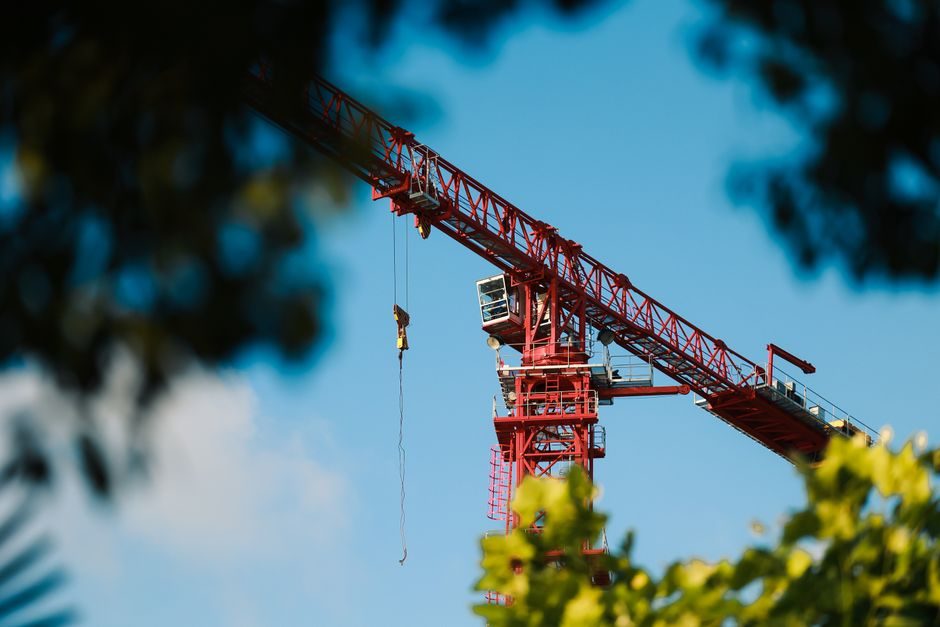
A suspended working platform — also called a suspended scaffold or, in OEM catalogs, a suspended platform — is a work platform suspended by wire ropes from an outrigger or parapet rig, normally used for facade work above 30 m where ground-level scaffold erection is impractical or uneconomic.
It is the dominant temporary-access solution for high-rise cleaning, painting, curtain-wall installation and ship-hull blasting, and it is the direct competitor of the mast-climbing aerial work platform, the powered swing-stage alternative, and traditional tube-and-coupler suspended ceiling falsework for indoor atrium work.
Design Definition and Governing Standard
EN 1808:2015 — the European safety specification for suspended access equipment — defines the platform as a powered, suspended work unit with a work deck length of up to 14 m, raised and lowered by two or more independent wire ropes, each sized for a minimum 12 kN breaking load per person on the deck [S1-EN1808 reference, 2025-08]. [S1]
The load path is straightforward: counterweighted or fixed parapet outrigger → rated wire rope → hoist mechanism → platform cradle → guard-railed work deck, and each element is sized separately so a single rope failure does not propagate a platform drop.
For shorter or indoor jobs the same cradle can be hung from a fixed monorail, giving the platform trolley configuration used in shipyards and aircraft hangars, where ground reach is replaced by ceiling-mounted rail.
Advantages Over Mast-Climbers and Scaffolding
The core advantages cluster around reach, speed and ground footprint: a suspended platform can be rigged at a 40-storey facade in 1-2 days versus 5-7 days for a comparable mast-climbing work platform, because there is no vertical mast to plumb, brace and tie [S1].
Ground footprint is essentially zero — only the counterweight base footprint at roof level — which keeps pedestrian walkways, vehicle access and ground-floor operations uninterrupted, a key reason the system is preferred in dense urban sites and occupied hospitals.
For irregular geometry such as a curved atrium, a ship hull or a hyperbolic cooling tower, the cradle can be re-shaped in length and hung at multiple points to follow the contour, while a suspended ceiling grid is restricted to flat soffits and a mast climber needs a perfectly vertical guide surface.
Disadvantages, Failure Modes and Limits
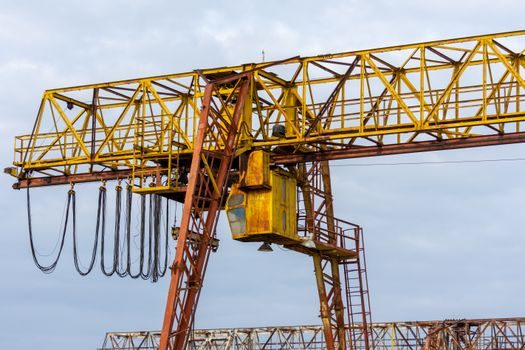
Suspension is also the system's primary weakness: every load path is a fall path, so a single anchor, rope or hoist failure is a full platform drop, which is why dual independent ropes, overspeed governors and a secondary safety device are mandatory under EN 1808 and OSHA 1926.451 [S1, 2025-08].
Rigging design is non-trivial and site-specific — outrigger counterweights must resist a minimum 1.5× the worst-case platform reaction, parapet clamp friction must be verified, and the roof structure itself must accept point loads of 10-25 kN per outrigger, which often rules out the system on lightweight steel or asbestos-cement roofs.
Wind sensitivity is the operational limit: most manufacturers specify a maximum working wind speed of 12.5 m/s (≈ Beaufort 6) and a storm-stow threshold of 17 m/s, so jobs on exposed coastal or high-rise sites see measurable downtime, while a mast climber continues to operate at similar wind [S1, 2025-08].
Payload is constrained to 250-500 kg per cradle depending on model — sufficient for 2-3 workers plus tools, but not for bulk material staging — and the platform cannot cantilever far from the rope line, so deep facade recesses, balconies and strong setbacks require a second rig.
Criteria-Based Comparison: Three Facade-Access Options
Side-by-side, the suspended platform wins on reach height and ground-free footprint, the mast-climbing work platform wins on payload and wind tolerance, and tube-and-coupler scaffolding wins on irregular short facades and multi-trade staging.
On facade access height, the suspended platform is rated to 150 m+ with custom rigging, the mast climber to 100 m standard and the scaffold to roughly 60 m before tie-frequency economics break down.
On payload per bay, a typical platform scale suspended cradle carries 250-500 kg, a single mast-climber deck carries 1,500-2,500 kg, and a scaffold bay carries 450-750 kg at full design load.
On rigging/disassembly labour, a suspended platform is 1-2 days rig plus 0.5 day strike, a mast climber is 3-4 days rig plus 1-2 days strike, and a tube-and-coupler scaffold is 1-2 weeks rig plus 1 week strike for a 30-storey perimeter — direct labour that drives the TCO differential explored in Scaffolding Total Cost of Ownership: Cost Drivers and Lifecycle Spend Map.
On wind tolerance, the suspended platform typically stops at 12.5 m/s working wind, the mast climber continues to 17-20 m/s, and a fully-tied scaffold continues in service to roughly 25 m/s before cladding is removed.
Who It Is For — and Who It Is Not For
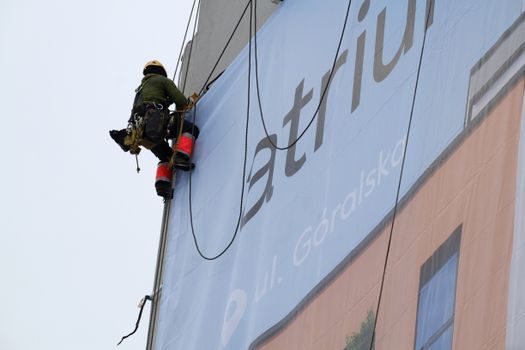
The system is engineered for: facade contractors working above 30 m on flat or gently curved vertical surfaces, shipyards and tank farms needing rope-access from existing overhead structures, and building owners running short-duration inspection or cleaning cycles on occupied high-rises. [S3]
It is a poor fit for: low-rise facades under 15 m where scaffold is cheaper to rig, projects requiring heavy material staging or covered weather protection, deep overhangs and recessed geometry beyond 1.5 m from the rope line, and sites without a structural roof capable of taking 10-25 kN outrigger reactions.
For site managers weighing scaffold against suspended access on safety, cost and spec trade-offs, the broader Scaffolding trade-offs: cost, safety, and spec choices compared benchmark is a useful cross-check before committing to a single system.
Inspection, Certification and Sourcing
Pre-use inspection of a suspended platform must cover rope condition, hoist brake function, overspeed governor trip, limit switches, guard-rail integrity and outrigger counterweight verification, with a documented daily checklist and a full periodic inspection at intervals not exceeding 6 months per EN 1808 §7 [S1, 2025-08]. [S3]
Buyers should request the manufacturer's Declaration of Conformity under the Machinery Directive 2006/42/EC, the EN 1808 test certificate, and a wire-rope traceability certificate aligned to ISO 2408, and reject any cradle supplied without serial-linked hoist and rope service records.
For a sister decision on climbing formwork and self-climbing systems used in concrete-core construction, the Climbing Formwork Types: Manual, Self-Climbing, and ACS Compared map complements this suspended-access spec sheet for contractors running mixed access and formwork scopes.
Trackable signals over the next 6-12 months include any EN 1808 amendment incorporating revised wind-speed thresholds and any EU Machinery Regulation 2023/1230 transition guidance that tightens CE-marking documentation for temporary access equipment.