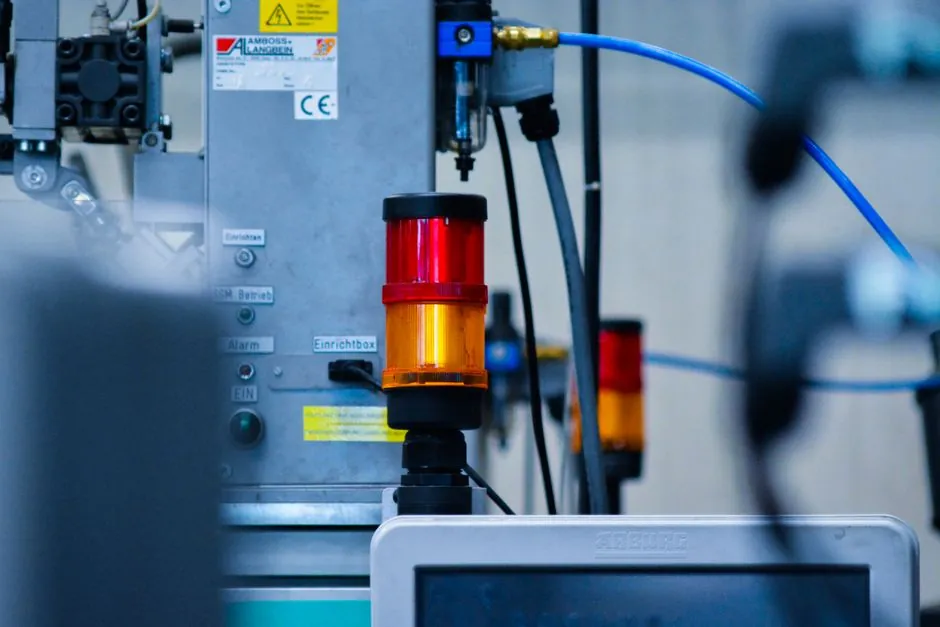
Autonomous process operations are graded on a five-level maturity scale, with Level 1 defined as operator decision support and Level 5 defined as full plant-wide autonomy [S2][S4].
Process plants sit at different maturity levels across different units, and the level is decided by technology, personnel, process criticality, and business importance, not by software purchase alone [S2].
Level 1: Operations Assistance and the OT Baseline
Level 1 is the most common starting point in current process facilities: the operations technology stack (DCS, PLC, SIS, MES) collects data and presents it for human decision-making, while the human still issues every setpoint change [S2][S4]. This level is the practical baseline for any process control retrofit that wants to preserve operator authority over safe operation [S5].
At Level 1, systems provide operational assistance through decision support or remote assistance, with humans remaining in charge of safe operations and still responsible for a high number of field inspections [S1][S5]. The instrumentation layer at this stage typically relies on standard 4-20 mA with HART, and field measurements feed a pressure transmitter array that the operator, not the controller, interprets.
Level 2: Regulatory Automation, Where Most Plants Live Today
Level 2 is regulatory automation, defined as continuous closed-loop control where the automation system maintains a specific setpoint by manipulating one or more process variables, for example a PID loop driving a control valve to hold flow [S2][S4]. Survey data from ARC Advisory Group, gathered jointly with Chemical Processing's sister publication Control, found the best process operations currently sit at the advanced regulatory maturity tier, with the majority of respondents expecting appropriate plant operations to run at a level of selected autonomy over the coming years [S4].
Level 2 is the level at which the multifunction process calibrator becomes a daily tool, because every regulatory loop still requires periodic proof tests against a traceable reference, and most plant QA budgets are sized to that loop count rather than to higher-level autonomy work.
Level 3 to Level 4: Advanced Regulatory and Selected Autonomy
Level 3 (advanced regulatory) layers conditional information, model-predictive control, and inferential sensors on top of PID, so the controller responds to a wider operating envelope rather than a single measured variable [S2]. Level 4 extends that conditional logic to closed-loop optimization across a domain, where the system can adjust setpoints and operating targets without operator pre-approval, which is where the term selected autonomy is most often applied in survey responses [S4][S6].
For pulp-and-paper, refining, and petrochemical assets, the process calibration burden shifts at this stage: instead of calibrating each loop individually, the loop's deviation against the model becomes the alarm, which is why first-principles dynamic models and digital twins are the cited enablers for Level 4 in refining and petrochemicals [S3][S6]. Valmet positions its own roadmap around three milestones that map onto this transition: partially automated (people specify set points and handle safe operation), highly automated, and fully autonomous [S5].
Level 5: Full Autonomy and What It Actually Requires
Level 5 is a fully autonomous operation where AI-driven systems make decisions related to both normal and abnormal operations, removing the human from routine decision cycles [S2]. The ARC framework and ABB's mining mirror both describe Level 5 as extending autonomy into planning, scheduling, production, and maintenance, not just real-time control [S1][S2][S6].
The June 2025 review by Baldea frames the move from automated to autonomous process operations as a transition where current trends push toward a higher degree of automation, but caution that the word "autonomous" in industry marketing often outruns the engineering reality, with most cited cases still being selective optimization rather than plant-wide self-driving control [S3]. The 2026 IIoT-World explainer reinforces the same point: autonomous production process industries use digital twins, software-defined automation, and AI to handle feedstock variability and energy constraints, and the binding constraints remain safety case acceptance, cybersecurity, and regulatory sign-off rather than the algorithms themselves [S7].
Where the Levels Apply and Where They Do Not
The 0-to-5 maturity model was developed by ARC Advisory Group and applies to continuous and batch process industries such as chemicals, refining, pulp-and-paper, power, and upstream/downstream oil and gas [S2][S4]. It does not apply cleanly to discrete assembly, where a different model tied to AGV fleets and line-side robotics dominates; for that world, the AGV robot density and per-line robot count discussion is the more relevant reference.
The framework also assumes the unit, line, or plant can be bounded: an un-bounded scope (for example, a multi-site supply chain) is a planning problem, not an autonomous-operations problem in this sense, and should be handled with planning software rather than bolted onto a Level 4 control system. The ABB mining scale makes the same point: underground mobility, ventilation, and production scheduling are not single-loop problems, so even Level 5 there is reached by a clear milestone ladder, not a single software drop [S1].
Comparison: Level 2 Versus Level 4 Versus Level 5 on Engineering Criteria
A practical comparison of the three autonomy tiers that process engineers most often specify against: Level 2 regulatory control typically runs in real time with no optimization horizon and accepts a deviation band of a few percent of span; Level 4 closed-loop optimization adds an economic objective across a domain (a unit or a reactor train) and can move setpoints inside an envelope; Level 5 extends to multi-domain planning and maintenance, with a human in an oversight role rather than a control role [S2][S4][S6]. On data infrastructure, Level 2 needs a DCS plus reliable instrumentation, Level 4 needs a converged OT/IT stack with a digital twin and historian, and Level 5 needs the same plus model-management, cybersecurity, and a formal safety case [S3][S7]. On staffing impact, Level 2 reduces operator manual moves but keeps them in the loop, Level 4 reduces operator setpoint traffic, and Level 5 is positioned as a response to the structural shortage of qualified personnel willing to staff 24/7 plants [S2].
Trackable signals for the next 6 to 18 months: the next revisions of the ARC maturity survey, the publication of more peer-reviewed Level 4 case studies with measured energy or yield deltas, and any safety standard (ISA-84 / IEC 61511 family, IEC 62443 for cyber) explicit guidance on autonomous operation boundaries.
For related coverage, see Medium-level order picker platform height range: 2.8 m to 12.1 m spec cutoffs.