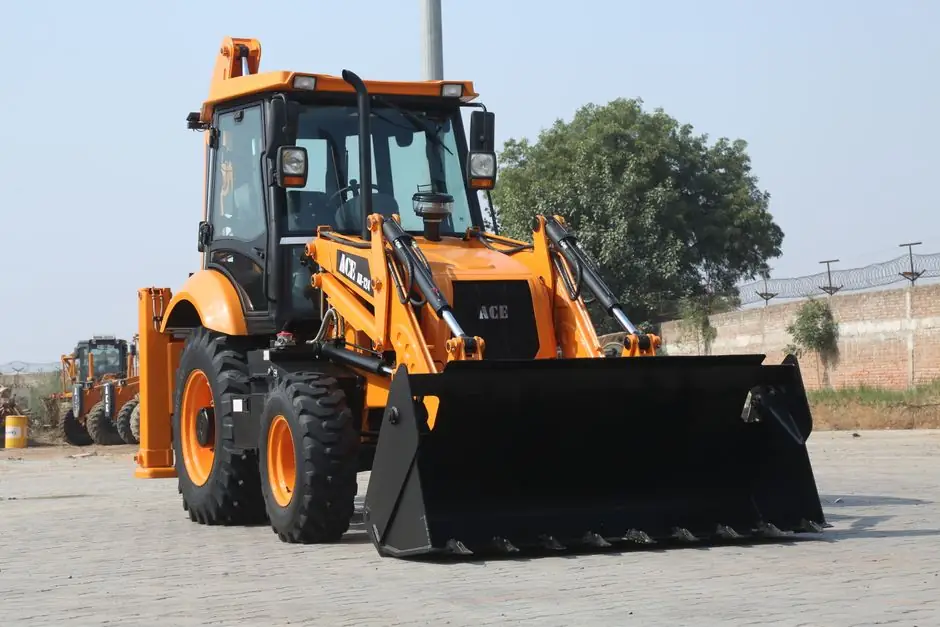
A backhoe loader pairs a rear hydraulic digging arm with a front loader bucket on a single self-propelled chassis, and typical digging depth runs 12-16 ft, with some models reaching nearly 20 ft [S2]. Rotation is mechanically limited to about 200°, and on-road travel speed is roughly 25 mph, so the same machine can trench, load, and relocate between scattered tasks without a lowboy [S2].
The category sits in the middle of the construction-machinery spectrum, lighter and more mobile than a dedicated crawler excavator, but heavier and more capable than a skid steer loader. Contractors, utilities, municipalities, and farms buy or rent backhoe loaders when one machine has to cover loading, light excavation, and material transport across a job that changes daily [S1][S3].
Core advantages: one chassis, two work tools, low transport cost
The headline advantage is duty coverage: a backhoe loader can dig up trees and roots, transport mulch and aggregate, relocate boulders, push soil into piles, and excavate small ponds, all from a single unit with an operator in one cab [S1]. The front bucket handles loading and material handling while the rear arm handles trenching, so the machine rarely sits idle between phases of a spread-out job [S3].
Transport cost is structurally lower than a dedicated excavator because the unit is road-legal and self-mobile, eliminating a lowboy haul between close-by sites [S2]. For multi-task environments such as municipal works, farmland renovation, site leveling, and earthwork backfilling, combined operating efficiency has been reported 40-70% higher than running a comparably sized excavator across the same work mix, since the backhoe loader eliminates dead-head travel and secondary loading steps [S4]. Attachment breadth reinforces this: drills, forks, hammers, plow blades, road booms, and compaction wheels all bolt onto the rear arm or front loader, expanding the duty envelope without a second machine [S2].
Disadvantages and operating constraints
The trade-off is raw digging power: a backhoe loader cannot match the breakout force, swing freedom, or trench depth of a purpose-built excavator, and 200° rotation forces repeated repositioning on continuous dig cycles [S2][S4]. Stabilizer footprint is narrower than a crawler, so heavy prying or deep digging at full reach needs careful set-up, and finished surfaces can be scarred by the tire contact patch during slew [S2].
Size and weight also matter on tight urban sites: while shorter than an excavator-and-truck combo, a backhoe loader is longer and heavier than a skid steer loader, so access through narrow gates and soft lawns can be a problem [S1]. Spec discipline is therefore critical: choosing a model with insufficient hydraulic flow, too-shallow dig depth, or the wrong coupler type forces the operator back to manual methods, eroding the productivity gain that justified the purchase in the first place [S1].
Backhoe loader vs excavator vs wheel loader: a criteria-based comparison

Selection reduces to four gates: dig depth and breakout force, slew range, mobility, and total cost of ownership. On the first two gates an excavator wins, with 360° rotation, deeper dig depth, and higher hydraulic force suited to demolition, mining, foundation work, and pile driving [S2][S4]. On mobility and cost a wheel loader and a backhoe loader both outclass the excavator, since both drive on-road and skip lowboy transport between local sites [S2].
The backhoe loader occupies the middle: rotation limited to about 200°, dig depth 12-16 ft, moderate breakout force, but road-legal at ~25 mph and capable of both loading and trenching [S2]. For broader construction machinery and equipment fleets, this is exactly the "multi-tool" slot: not the deepest digger, not the fastest loader, but the one machine that covers 80% of daily tasks on small and mid-scale sites. When a project goes heavy on continuous deep digging, mining, or large-scale demolition, the excavator still wins on breakout force and 360° swing regardless of the backhoe's versatility [S2][S4].
Application fit: who the backhoe loader is for, and who it is not
Backhoe loaders fit multi-trade contractors, rental fleets, municipal public works, utility crews, and farms running 5-10 scattered tasks per day across a wide area, where one machine has to trench, backfill, load a truck, and move a pallet between workfaces [S1][S3]. Typical wins are landscaping, light demolition, utility installation, road repair, snow clearing with plow blades, and stumping or pond excavation on rural lots [S1][S2].
They are the wrong tool for long continuous dig cycles in hard rock, large commercial building excavations, mining, and deep foundation work that demand the breakout force and 360° swing of a dedicated excavator [S2]. For pure loading duty on aggregate yards, a wheel loader typically delivers higher bucket productivity and lower cost per ton moved. Choosing wrong on these gates costs more than the rental delta: it shows up as missed schedules, underused attachments, and forced reinvestment mid-project [S4].
Selection gates a process engineer checks first

Before signing a PO or rental, match four numbers to the work: required dig depth (12-16 ft covers most utility and foundation work, but spec up to ~20 ft for deep drainage), front loader rated operating capacity, backhoe bucket breakout force, and on-road travel speed for site-to-site moves [S2]. Verify that the coupler type matches the hammers, augers, compaction wheels, and forks already owned, since mixed couplers force a second fleet of attachments [S1][S2].
Then run the operating economics: a backhoe loader has a lower purchase price than a comparably capable excavator, lower transport cost because it self-drives, and a smaller fuel and operator footprint than running two single-purpose machines [S2][S4]. The cost of ownership only beats the alternatives when the work actually uses both ends of the machine; if 90% of hours are pure trenching, the excavator wins on cycle time even at higher daily rate. Track cycle-time data, fuel burn per shift, and attachment utilization over the first 90 days, and respec the fleet the moment a pattern shows up. The next signal to watch is the 2026 rental-fleet refresh, where attachment commonality across backhoe loaders and skid steer loader platforms will increasingly drive coupler standardization decisions.
Related analysis: Plasma Cutter Selection for Concrete Work: What Cuts, What Does Not, and Which Specs.