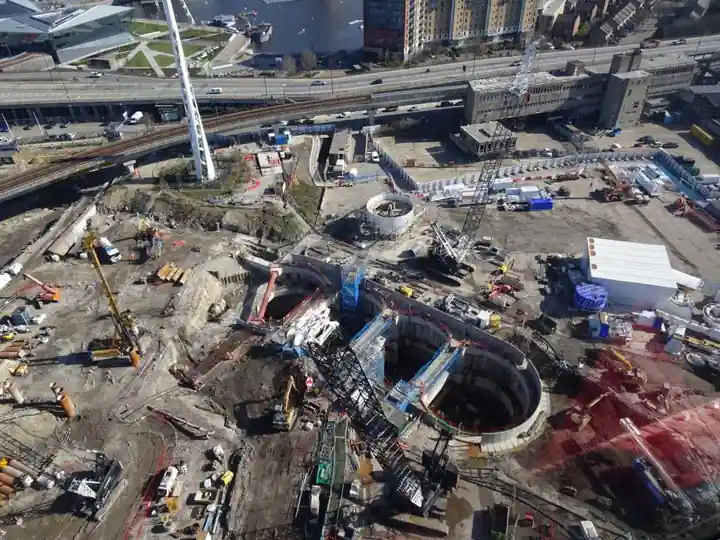
A tracked undercarriage and a building-mounted runway are the two design choices that separate these crane classes, and that single difference cascades into mobility, site prep, capacity profile, and operating cost [S1][S3].
Crawler cranes are mobile, self-supporting units used on construction sites, mines, and uneven ground where no permanent structure exists [S3]. Overhead bridge cranes are building-supported lifting systems with a hoist and trolley that travel along a horizontal girder, used for high-frequency indoor lifting in factories, warehouses, and assembly lines [S1][S2][S6]. Crawler units travel with the load; bridge units stay put and let the load come to them. The selection decision therefore hinges on whether the work moves to the crane or the crane stays in a fixed envelope.
Crawler Crane Operating Envelope and Ground Pressure
Tracked undercarriages spread load over a long, wide footprint, which is why crawler cranes are specified on soft soil, mud, or graded earth where outrigger pads would punch through [S3]. A tracked undercarriage delivers low ground bearing pressure compared with rubber-tired mobile cranes, allowing lifts on unprepared terrain that a wheeled unit cannot enter.
For module lifts, crawler units can pick and walk with the load, eliminating the need for a transport vehicle between pick points. The trade-off is speed: tracked travel is slow, typically a fraction of a wheeled crane's travel speed, so cycle-time-driven indoor work is the wrong fit. Crawler cranes also require controlled rigging space around the unit because the boom radius changes as the machine walks or slews.
Overhead Bridge Crane Capacity and Runway Geometry
Bridge cranes are the heavyweights of the overhead lifting universe, typically the physically largest and highest-capacity class installed in a facility [S4]. The runway geometry drives the spec: spans above about 65 feet (roughly 20 m) or lifts above 15 tons (about 13.6 t) push selection toward a double-girder configuration, which also places the hoist on top of the girders for greater vertical hook travel [S4].
A single-girder configuration is common for shorter spans and lighter lifts, where the trolley rides underneath the beam and the building height is the limiting factor on hook approach. Double-girder bridge cranes are built for heavier, more demanding environments and use two parallel bridge beams with a trolley that runs between them [S7]. Bridge crane capacity on standard industrial builds commonly reaches well into the hundreds of tons, and the unit travels along two parallel runways either built into the building structure or supported by freestanding floor columns [S4][S6].
Side-by-Side Selection Criteria
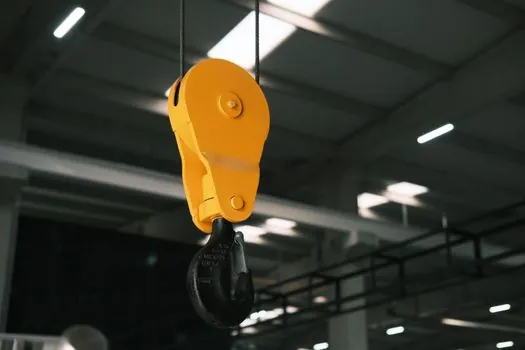
The decision matrix below lines up the two classes on the four criteria that actually drive the purchase or rental call. Data points are taken directly from the cited references; where a value is not stated in the research, the cell stays qualitative. [S5]
Support and installation: a crawler crane is self-supporting on its tracks and needs only ground bearing capacity, no runway or building modification [S3]. A bridge crane needs elevated runway beams tied into the building or into freestanding column supports, which is a long-term structural commitment [S1][S4]. For a deeper look at the indoor heavy-lift end of this range, the overhead bridge crane reference page lays out girder, trolley, and runway configurations in detail.
Mobility and relocation: crawlers walk to the next pick under their own power, which is why they dominate large outdoor sites that change every few weeks. Bridge cranes are fixed to one building envelope and cannot move between facilities without a full dismantle and re-install [S1][S4]. The outdoor, relocatable cousin of the bridge crane, the gantry crane, uses A-frame legs on ground rails for the same job in shipyards, container yards, and staging areas where no building exists [S1][S5].
Capacity profile: bridge cranes carry the heaviest sustained indoor loads because the runway and building carry the reaction loads rather than the ground [S4][S6]. Crawler cranes carry the heaviest outdoor lifts on tracked chassis, with high single-pick capacity but no cycle-time advantage. For outdoor heavy-lift service on rough ground, the crawler crane reference page catalogues the tracked-chassis variants and boom configurations.
Cycle, precision, and indoor fit: a bridge crane's electric trolley and hoist deliver repeatable, controlled indoor motion at high duty cycles, which is why they are the default in steel mills, machine shops, and assembly lines [S2][S6]. Crawler units are sized for pick-and-set work, not high-frequency cycles, and they are not normally deployed inside enclosed plants.
Site Preparation, Cost, and Structural Demands
Ground bearing pressure governs crawler crane site work: a properly specced tracked unit can operate on prepared gravel, hardstand, or engineered mats without a concrete slab, which lowers mobilization cost on greenfield sites [S3]. A bridge crane install is a building project in its own right, with runway beams, column ties, electrification (conductor bar or festoon), and structural reinforcement driving both lead time and upfront cost above a comparable gantry [S1].
That higher upfront cost is recovered through duty cycle: a bridge crane runs for years in the same envelope at high frequency, while a crawler crane is typically a project asset that demobilizes after the lifts are done. Procurement teams running a total-cost comparison on a fixed indoor facility therefore favor bridge cranes, while project-driven outdoor work favors crawlers.
Duty Cycle, Environment, and Use-Case Fit
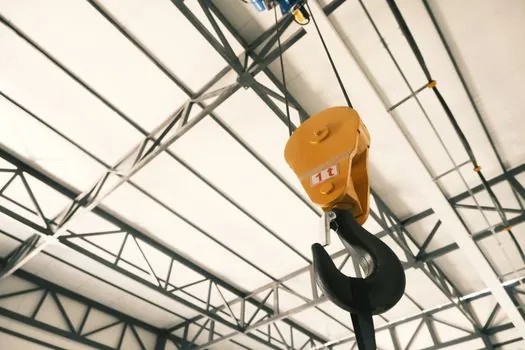
Indoor, high-cycle production: a bridge crane is the correct class. The runway stays put, the load moves along X-Y axes under a single operator, and the hoist can be specified for the duty group the application requires [S2][S4][S6]. This covers steel service centers, paper mills, heavy machinery assembly, and any plant where the same pick happens hundreds of times per shift.
Outdoor project lifts, modular construction, energy and infrastructure: a crawler crane is the correct class. Track-mounted units walk between picks on graded ground, pick modular sections weighing hundreds of tons, and demobilize when the project closes [S3]. They are also the default for sites with soft soils where outrigger-bearing mobile cranes would sink.
Hybrid and adjacent use cases: a gantry crane is the outdoor, ground-rail-mounted variant used when the lift is recurring but no building exists, and a mobile crane is the wheeled, roadable alternative when the unit must drive between sites under its own power at highway speed. Neither replaces the other, and neither replaces a bridge crane inside a fixed plant.
Limits, Failure Modes, and Sourcing Standards
Crawler crane failure modes concentrate in track wear on abrasive ground, out-of-level picking (load swing on uneven terrain), and ground-bearing failure when site surveys miss a soft pocket. Bridge crane failure modes concentrate in runway alignment drift, conductor-bar wear, and overload events where the hoist exceeds the rated capacity for the duty group. In both cases, the rated capacity on the nameplate is the binding spec, and lifting above it invalidates the design margin. [S1]
Standards and sourcing: bridge crane design and testing falls under CMAA 70 / CMAA 74 in the US and FEM 1.001 / ISO 4301 in Europe, and OSHA 1910.179 covers US operator and inspection requirements. Crawler crane design tracks ISO 4301 and OEM structural ratings, with travel and slew limits documented in the operator's manual. Procurement specs should reference these standards explicitly rather than relying on a generic "heavy lift" descriptor, and a working crane scale paired with the hoist gives a real-time load check that catches overload events before they damage the structure.
Field signal to watch: any project where the same indoor envelope needs a crane for more than two shifts per day, five days a week, is a bridge crane application; any project where the lift points move across an outdoor site over months is a crawler crane application. The two rarely compete head-to-head, but when they do, the ground-vs-building support question is the tiebreaker.
See also our earlier report, TIG Welding Machine Spec Map for Bridge Construction.