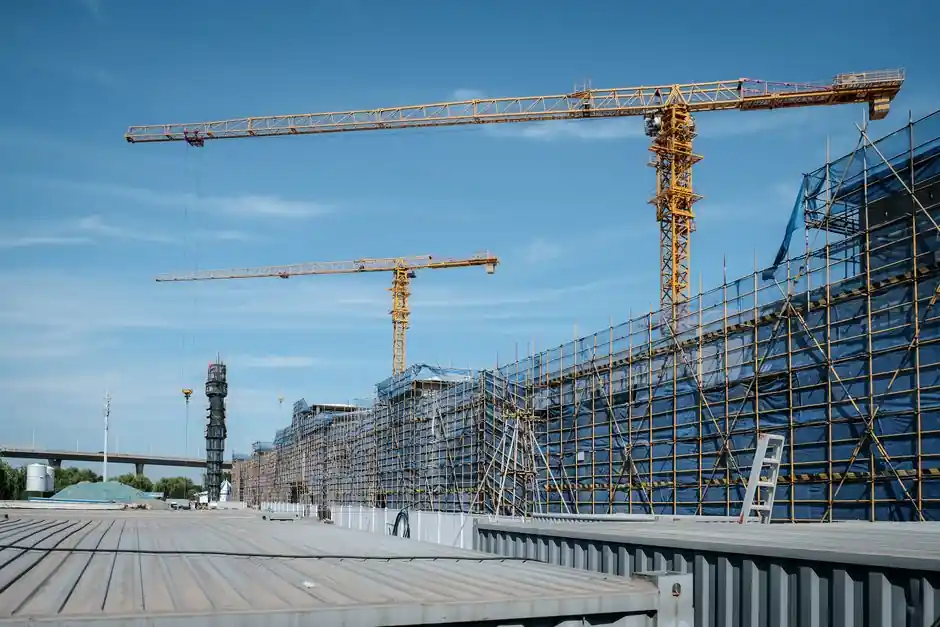
Crawler cranes travel on continuous tracks and lift without outriggers or ground anchors, giving them a structural edge on uneven terrain and remote sites where the machine must reposition frequently during the lift plan [S1][S2].
Tower cranes are fixed to a foundation or to the building under construction, combining a vertical mast with a horizontal jib that slews 360° to deliver loads at heights and radii a tracked machine cannot match, which is why they dominate high-rise urban cores [S1][S4]. Picking between them is a function of project duration, site footprint, ground bearing pressure, lifting height, and crew certification path, not raw capacity alone.
Structural Layout and How Each Crane Carries Load
A crawler crane packages its boom, jib, counterweight, and operator cab on a tracked undercarriage, with the house containing the engine, hydraulics, and controls that drive hoisting, slewing, and travel [S2]. Because the tracks distribute load over a long footprint, crawler cranes lift heavy loads without outriggers, a critical advantage on soft pads, mud, or compacted sub-base where jack pads would punch through [S1][S2].
A tower crane inverts that geometry: a vertical mast anchored to a foundation carries a horizontal jib and counter-jib, and the lifting hook travels along the jib via a trolley for precise radial placement at height [S2][S5]. The static-crane family, of which the tower crane is the dominant high-rise variant, depends entirely on permanent foundations for stability and cannot move during operation [S3][S5]. The crawler crane, by contrast, sits in the mobile-crane family and trades fixed-mast reach for tracked mobility across rough ground [S3].
Capacity, Reach, and Operating Envelope
Modern crawler crane models from manufacturers such as Kobelco span roughly 60 t to 600 t, with units like the 250-ton class deployed on heavy infrastructure, port, and canal works [S2]. Typical lift heights for crawler cranes sit in the 50 m to 150 m boom-plus-jib range once a lattice extension is rigged, which is well below the working height of a typical tower crane but adequate for refineries, power plants, and bridge erection [S2].
Tower cranes are engineered for vertical reach: their masts climb with the building, and jib lengths commonly range from roughly 40 m to 80 m, giving a working radius that covers an entire high-rise floor plate from a single footprint [S1][S5]. Because the load is hung from a trolley on a horizontal jib rather than from a luffing boom, a tower crane places material with finer radial accuracy at height, which is the deciding factor on concrete cores, steel erection, and curtain-wall lifts [S2].
Site Conditions: Ground, Space, and Weather

Track undercarriages let a crawler crane traverse rough, uneven, or soft ground that would defeat outrigger-stabilized machines, including muddy refinery yards, open-pit approaches, and unmade access roads [S1][S2][S3]. On confined inner-city plots, however, the same long footprint becomes a liability, since the tracks, counterweight tail swing, and assembly area can exceed the available pad.
Tower cranes need a level, prepared foundation or a structural tie-in to the building, plus a clear overhead corridor for jib rotation, which is why urban high-rise sites accept the setup cost in exchange for a small ground footprint and 360° slewing coverage [S1][S5]. Operators stop lifting on both crane types once winds exceed manufacturer and site-specific limits, with tower-crane crews in particular governed by stricter wind-out-of-service thresholds because of the elevated load and large sail area of the jib [S6].
Setup Time, Project Duration, and Logistics
Crawler cranes arrive on a lowboy, walk off under their own power, and are typically rigged in hours to a day, which makes them economical for short-duration lifts and projects that need the crane to walk between multiple pick points [S1][S2]. Long-term infrastructure projects that require a crane to remain on station for months still favour crawlers, but only if the lift pattern keeps moving; a static pick zone over many months wastes the machine's core asset, its mobility.
Tower cranes require foundation work, erection by a secondary mobile crane, climbing or tying-in cycles as the building rises, and eventual dismantling, a process that can add weeks of pre-lift activity and significant budget before the first productive lift [S1][S5]. For high-rise and large-footprint industrial builds measured in years rather than months, that front-loaded cost amortizes across thousands of lifts and pays back in consistent vertical reach and small site footprint, the comparison matrix that mirrors the one in our aerial work platform vs tower crane decision map where reach versus mobility trades against setup cost.
Decision Matrix: Crawler vs Tower, Criterion by Criterion
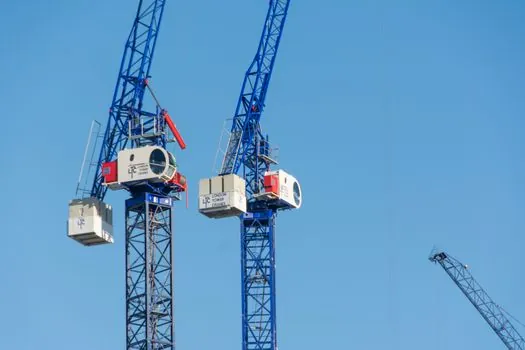
On ground conditions, crawler cranes tolerate soft, uneven, or unpaved terrain because the tracks spread load over a long footprint, while tower cranes require engineered foundations or structural tie-ins and a level pad [S1][S2][S5]. On mobility, crawler cranes walk the site under their own power without disassembly; tower cranes are stationary once erected, and reach is the trade the owner accepts for that loss of travel [S2].
On vertical reach, tower cranes deliver 360° slewing at mast heights that climb with the structure, suiting high-rise cores; crawler cranes top out at roughly 50 m to 150 m of boom-plus-jib and are stronger in radial lift than in pure height [S1][S2][S5]. On setup time and cost, crawler cranes mobilize in hours to a day with no foundation, whereas tower cranes need foundation works, a separate erection crane, and climb cycles that add weeks of pre-lift activity [S1][S5]. On duration fit, crawler cranes suit short to mid-term projects with shifting pick zones; tower cranes suit multi-year builds where the crane sits on one footprint for thousands of lifts.
Operator Certification and Crew Pathway
Mobile crane and tower crane training diverge because the control stations, sight lines, and safety architectures are different: tower-crane operators typically work from a cab high on the mast with radio or video reference to the load, while crawler-crane operators sit at the machine's house with direct sight to the pick [S4]. NCCCO-style certification paths in the U.S. and equivalent national schemes elsewhere issue separate credentials for lattice-boom crawler, hydraulic mobile, and tower crane operation, which is why a site that runs both machine types may carry two operator rosters.
For contractors building a long-term crew, the practical guidance is to qualify operators on the machine type that matches the dominant project profile, then cross-train on the secondary type, since switching certifications after years on one machine resets the supervised-hours clock in most jurisdictions [S4].
Use-Case Recommendations and Failure Modes
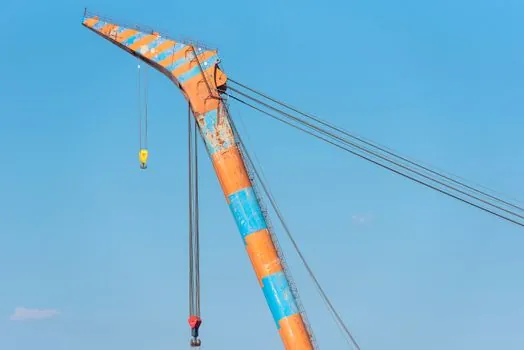
For oil and gas refineries, power plants, port handling, and bridge or wind-farm erection on unmade ground, a crawler crane is the default pick, with capacities from roughly 60 t to 600 t covering most pick weights and the tracked chassis absorbing the ground-preparation penalty that a tower crane's foundation would impose [S2].
For high-rise residential and commercial towers, hospital and university cores, and any project where the build envelope climbs past roughly 50 m with a tight urban footprint, a tower crane is the default, because radial reach, 360° slewing, and a stationary base outperform any tracked machine in that envelope [S1][S2][S5]. Common failure modes to plan against: a crawler crane assigned to a long, static pick zone wastes its mobility premium, while a tower crane specified on weak or unprepared ground invites foundation settlement; both modes are preventable with a site-specific geotech review and a written lift plan, the same discipline covered in our related aerial work platform vs gantry crane spec map.
Sourcing, Standards, and Trackable Signals
Crawler and tower crane specifications sit under overlapping but distinct standards: ASME B30.5 (mobile and locomotive cranes) covers crawler and other mobile units, while ASME B30.3 (construction tower cranes) and EN 13000 (cranes, mobile cranes) govern the fixed-mast family, and FEM 1.001 / ISO 4301 provide load and classification guidance that rental fleets quote in the data plate [S1][S5]. Wind-out-of-service thresholds, slew limits, and climb-cycle procedures are typically OEM-specific and must be read off the crane's operations manual rather than inferred from the crane family [S6].
Trackable signals to watch on a live project: published wind-out-of-service speeds from the OEM, the OEM's revised ground-bearing pressure charts for tracked assembly on improved soil, and any jurisdiction-specific update to operator-certification hours for tower vs. lattice-boom crawler. These three data points will resolve most spec ambiguity between the two machine classes before the crane hits the gate.
For component-level specifications, see signal tower light.