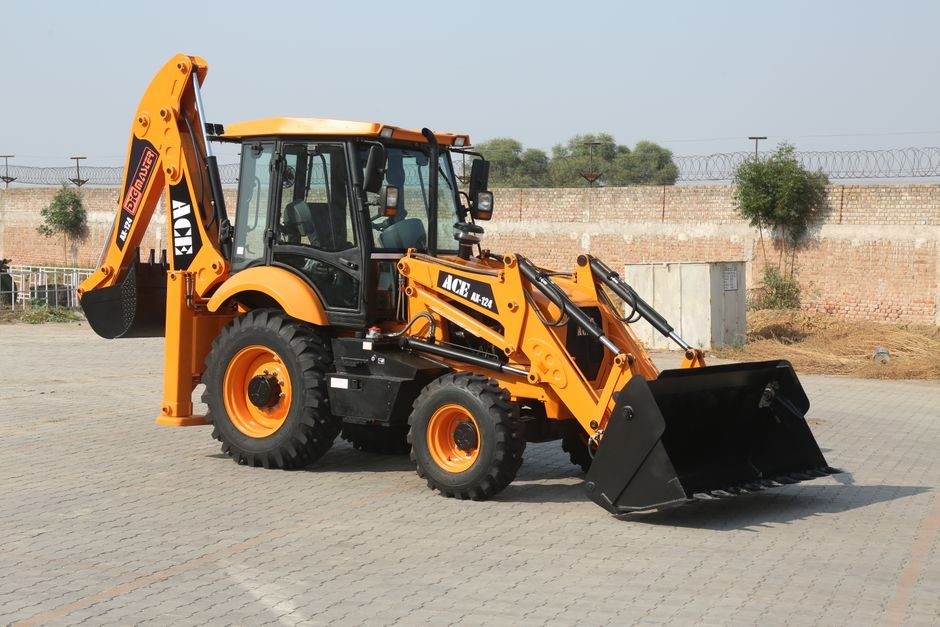
A backhoe loader integrates three work tools on one chassis — a rear excavator, a front bucket loader, and a center-mount tractor — and is sold by Chinese export suppliers such as Shandong Davoo Machinery, Weifang Yishan Heavy Machinery, and Jining China Power Machinery in operating classes that cluster between 1.0 m³ bucket capacity and 0.3 m³ backhoe bucket [S1][S3][S5]. A road roller is a single-purpose compactor built around one or two cylindrical drums (or pneumatic rubber tires) and is stocked by the same export channels, including Massbetter Industrial and Shandong Davoo, in single-drum, tandem, and pneumatic-tire configurations [S1][S4].
The two machines do not overlap in primary function: the backhoe loader is a material-handling and digging tool with a compaction byproduct, while the road roller is a dedicated density-achievement tool. For an engineer choosing between them in 2026, the decision is governed by soil type, lift thickness, and required compaction percentage rather than by horsepower alone. Job sites that need both functions typically run one backhoe loader plus a dedicated roller rather than substituting one for the other.
Machine Definition and Working Principle
A backhoe loader is a four-wheel-drive tractor with a loader bucket on the front and a backhoe (rear excavator) on the back, typically built on an articulated chassis with a center pivot for tight-radius work. Massbetter Industrial's WG30-25 export model, listed at US$42,000 per unit with 5,000 PCS/year capacity, illustrates the typical 4WD backhoe-loader class sourced from Chinese OEMs [S6]. The front loader lifts and carries loose material; the rear backhoe digs trenches down to roughly 3-4 m on compact models and deeper on larger units; the tractor midsection provides the hydraulic pump drive, operator station, and road speed up to 30-40 km/h for short site relocations.
A road roller applies static weight and dynamic vibration through one or more drums to compact soil, aggregate, or asphalt. Single-drum vibratory rollers carry the compactive effort in one steel drum plus drive tires; tandem rollers split the effort across two vibrating drums for asphalt finishing; pneumatic-tire rollers use rubber tires for kneading action on bituminous layers. Operating weight is the dominant spec — small walk-behind plates start near 100 kg, ride-on tandem rollers commonly land between 1,200 kg and 14,000 kg, and large single-drum soil compactors exceed 20,000 kg.
Selection Criteria: Trenching and Utility vs Density Targets
Specify a backhoe loader when the work centers on excavation, trenching, loading, and backfill: utility line installation, foundation dig, light demolition, landscaping, and small road repair. The decision gates are bucket breakout force, backhoe dig depth, loader lift capacity, and the ability to swap attachments (auger, breaker, compactor plate) on the rear stick. For a deeper frame of reference on spec gates, see the backhoe loader selection guide, which lists five hard cut-offs buyers should enforce. [S1]
Specify a road roller when the work centers on achieving a target density: Proctor / Modified Proctor percentages for sub-base and subgrade, or a specified air-void content on asphalt lifts. The decision gates are drum width, static linear load (kg/cm), dynamic force (kN), frequency (Hz), and amplitude (mm). On cohesive soils, a padfoot or sheepsfoot drum shears the layer to drive out air; on granular soils, a smooth drum with high amplitude achieves the required relative density. Vibratory frequency typically sits between 25 Hz and 50 Hz depending on the lift thickness and material.
Power, Drivetrain, and Hydraulic Architecture
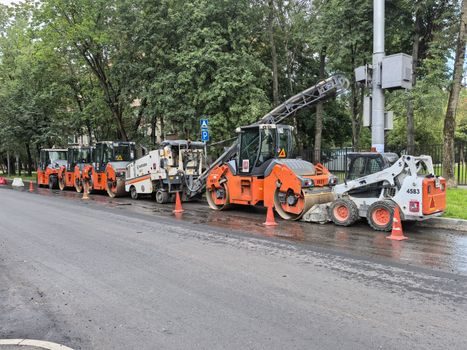
Backhoe loaders in the Chinese export class typically use diesel engines in the 50-100 hp range, with a torque-converter powershift transmission, two- or four-wheel drive, and a load-sensing hydraulic system feeding the loader, the backhoe, and the steering. The backhoe is usually center-mounted with a side-shift mechanism so the operator can dig close to a wall or curb. Hydraulic flow in the 100-150 L/min class is common for attachment work; auxiliary circuits route to the rear for hydraulic breakers and compaction plates. [S2]
Road rollers in the same export channel use diesel engines sized to machine weight — small tandem rollers carry 25-50 hp, while large single-drum soil compactors need 100-150 hp to drive vibration and grade. Drivetrain is hydrostatic on most modern units, with separate pumps for travel and vibration so the operator can adjust frequency and amplitude on the go. Articulation is standard on larger rollers for tight turning, and on some models a torque-proportioning differential prevents drum slip on soft subgrade.
Use Cases: When Each Machine Earns Its Hour Meter
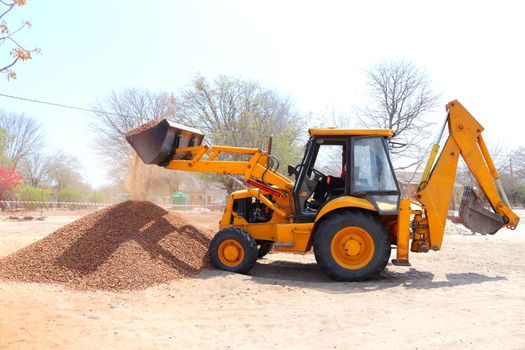
Backhoe loader work hours are maximized on small civil sites: water and sewer line installation, electrical and telecom trenching, residential foundation dig, swimming-pool excavation, light landscaping, and small demolition. A backhoe loader can trench, lay pipe, backfill, and compact with a plate attachment — all without leaving the site. For general equipment-cost benchmarking across earthmoving classes, the excavator 2026 price and cost guide gives the tonnage and emission tier context that sits adjacent to backhoe-loader buying decisions. [S3]
Road roller work hours are maximized on road construction, parking lots, driveways, and landfill cells. The roller follows the paver on asphalt lifts, achieving density lift by lift; on embankment work, it follows the scraper or dump truck in 200-300 mm lifts. Pneumatic-tire rollers add value on bituminous surfaces where tire kneading seals the layer and chases out the last air voids. The roller does not dig, it does not load, and it does not trench — its hour meter is density, not cubic meters.
Compaction Output: Static vs Dynamic, Drum Type Comparison
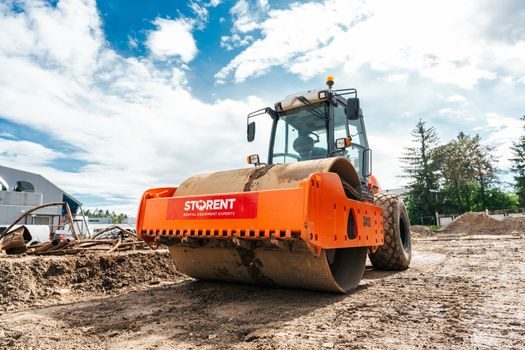
Roller compaction is governed by four interacting parameters: static linear load (machine weight divided by drum width), dynamic centrifugal force (kN), frequency (Hz), and amplitude (mm). Smooth drums work best on granular soils and asphalt; padfoot or sheepsfoot drums concentrate pressure to shear cohesive soils; pneumatic-tire rollers provide kneading compaction that smooth drums cannot. The table below lines the main roller types against the four decision criteria a buyer should weigh in 2026: [S4]
Single-drum vibratory: high amplitude, low frequency on cohesive soils; high frequency, low amplitude on granular soils. Best for sub-base and embankment work. Not suitable for finish rolling on asphalt. Tandem vibratory: two drums, narrower drum width per side, lower static linear load; designed for asphalt lifts and thin overlays. Pneumatic-tire: kneading action, no vibration, used for intermediate and finish rolling on bituminous surfaces and for sealing clay liners at landfill sites. Static three-wheel or tandem: low speed, no vibration, used for small asphalt patches and pavement repair where vibration would damage adjacent structures.
Limitations, Failure Modes, and Common Buying Mistakes
Backhoe-loader failure modes cluster around hydraulic contamination (loader and backhoe share a tank, so metal fines from the backhoe cylinder circulate through the loader valve), boom pivot wear on the rear linkage, and overheating of the torque converter under sustained load. The most common buying mistake is under-specifying hydraulic flow — a 50 hp backhoe loader with a 60 L/min pump cannot run a hydraulic breaker at full pressure and cycle time. Buyers should also verify the backhoe dipper length and stick geometry for the required dig depth; a short stick on a 1.0 m³ backhoe limits production. [S5]
Road-roller failure modes cluster around drum bearing failure (water ingress on the vibrator housing), eccentric-shaft wear that throws the vibration frequency off target, and amplitude-cylinder leaks on models with adjustable amplitude. The most common buying mistake is over-purchasing — a 14,000 kg tandem roller is the wrong tool for a 200 m² driveway, and a 3,000 kg walk-behind cannot meet a 98% Modified Proctor spec on a 300 mm lift. Match the roller to the lift thickness, the material, and the required density; bigger is not always faster.
Sourcing Channels, Standards, and 2026 Market Signals
Both machine categories are heavily concentrated in Chinese OEM and trading-company supply: Shandong Davoo Machinery (Jinan, est. 2019-08-02, 13 employees) lists road roller, backhoe loader, and mini excavator as primary categories [S1][S2]; Weifang Yishan Heavy Machinery lists backhoe loader, road roller, wheel loader, and telescopic forklift on its catalog page [S3]; Massbetter Industrial (Luoyang) supplies road roller, backhoe loader, and forklift as a trading-company channel [S4]; Jining China Power Machinery (Shandong) lists backhoe loader, mini excavator, and diesel generator with North and South American export markets [S5]. For a quick encyclopedia-level orientation on the backhoe loader and the road roller categories, the spec-side cross-reference is the fastest way to set the working definitions before quoting.
Buyers in 2026 should track two signals: emission-tier transition for off-road diesel engines (which raises the price of Tier 4 Final / Stage V configured machines and changes the residual value curve of Tier 3 stock), and freight cost normalization on China-origin heavy-equipment export lanes, which feeds directly into the FOB quotation spread. Standard references that govern both machine classes include ISO 6165 for the basic identification and vocabulary of earth-moving machinery, and ISO 12100 for the risk-assessment and safety-design framework. The two machines remain complementary rather than competitive — fleet planners should expect to run a backhoe loader and a roller in parallel on most civil and road jobs, not to choose one over the other.