
Balancing valves for pulp and paper should be sized from the required GPM flow and expected pressure drop, not simply from the nominal pipe size.
The practical duty spans clean stock, fiber-laden slurry, chemical streams, steam, and recovery systems, so valve geometry and trim must match both flow demand and erosive or corrosive media.
Define the balancing duty before selecting a valve
A balancing valve is selected to distribute flow or equalize pressure between branches; it is not automatically an isolation device. The minimum specification should identify the actual GPM in each branch, the design flow condition, the available pressure drop, the fluid density, and whether the valve will operate fully open, throttled, or at a variable control position [S9].
The service definition also needs the pulp consistency, fiber type, freeness, temperature, pressure, and solids content. Mill processes include pulping, bleaching, stock preparation, papermaking, recycling, and chemical recovery, and each zone has different fluid behavior [S4]. A valve selected from nominal line size alone can be oversized, undersized, or unstable when the operating flow changes.
For abrasive stock, the balancing valve must be evaluated as part of the complete control loop, including the actuator, positioner, and installed piping arrangement.
Match the valve type to the process condition
Ball valves with a V-port offer accurate control of paper stock and are used for clean or dirty stock applications [S8]. Segmented ball valves can provide throttling or diverting duty, but their performance depends on the segment geometry, trim, and the resulting flow characteristic.
The following comparison is a practical screening tool rather than a universal selection rule:
For fiber-laden stock, compare V-port segment valves with single-bevel or double-bevel ball valves on control accuracy, erosion resistance, and maintenance access; compare triple-eccentric disc valves on capital cost and large pipe size suitability. Gate valves provide low pressure drop when fully open but act too slowly for throttling, so they belong in the isolation comparison rather than the balancing-valve shortlist [S1].
The angle-seat valve is another option where tight shutoff and staged throttling are priorities, but it must be checked against pulp solids, chemical compatibility, and actuator sizing.
Set the hydraulic and material limits
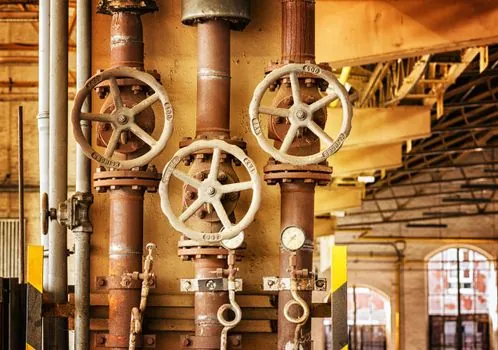
Hydraulic sizing must use the minimum and maximum GPM conditions rather than a single nominal flow. The valve should be checked for adequate authority at the required control position, and its pressure-drop curve must be compared with the actual system curve at operating density and temperature [S9].
Material selection must cover more than the normal process stream. Mill media can contain wood fibers, silica, and other abrasive solids, while process streams may include sodium hydroxide, sodium sulfide, chlorine dioxide, peroxide, ozone, and alkaline extraction chemicals [S1][S5]. Wetted components therefore need to be assessed for erosion, corrosion, and fiber packing.
Valve material must also be compatible with boil-out or solvent chemistry used to remove scale and biological deposits. A seal or trim that performs well in process service can fail during acid or alkali cleaning if the cleaning chemistry is excluded from the compatibility review [S3].
Temperature cycling also matters. Steam-injected digesters and recovery equipment can impose rapid thermal changes that affect seating, packing, and dimensional stability [S1]. Confirm the valve's pressure-temperature rating, seat material, stem packing, actuator limits, and allowable travel before releasing the data sheet.
Use the valve as part of a control system
A balancing valve only performs predictably when the complete valve, actuator, and positioner package can respond accurately and repeatably to the controller output. Continuous improvement is driven by decreasing process variability while increasing process reliability, which can have a positive impact on profit margins [S3].
Specify the required response and cycle rate, the control signal, the fail position, the positioner range, and the diagnostic method. Partial-stroke testing or inline diagnostic testing can be included where the installed arrangement supports it. For stock control, evaluate the actuator for the force needed at the valve's maximum differential pressure, not at zero differential pressure.
Automatic recirculation is a separate hydraulic function and should not be confused with balancing duty. An automatic recirculation valve is appropriate where a defined recirculation flow must be maintained during unloading or low-demand operation; it does not replace a branch-balancing valve selected from GPM and pressure-drop data.
Apply service-specific exclusions

Do not use a balancing valve as a substitute for a full-bore isolation valve when low pressure drop and dependable shutoff are required.
Do not use a generic segmented ball valve for every stock application. The main options are V-port segment valves for accurate stock control, triple-eccentric disc valves for large-pipe economic isolation or diverting, and globe-type valves where throttling control is more important than minimum pressure loss [S2][S8].
Check-valve selection is also a separate exercise. Swing and dual-plate check valves protect pumps and prevent reverse flow in bleach-plant feedwater and black-liquor systems, while axial-flow designs are more appropriate where low cracking pressure and low resistance are specific requirements [S1].
Build a procurement-ready data sheet
The minimum data sheet should include the minimum, normal, and maximum GPM for each branch; design pressure and temperature; fluid density; pulp consistency; fiber type; freeness; scale tendency; chemical composition; and cleaning chemistry. It should also state the valve function, actuation method, fail action, leakage requirement, allowable pressure drop, trim material, seat material, actuator limit stops, and required maintenance access [S3][S4].
For procurement review, ask the supplier to submit a line-specific hydraulic calculation, the valve sizing method, the flow characteristic at the intended travel range, materials of construction for wetted parts, and test or inspection requirements. The control valve selection guide for pulp and paper is useful for extending the same application review beyond balancing duty.
Final acceptance should be tied to traceable process data: measured GPM, design pressure drop, operating temperature, media chemistry, and the selected trim grade. A balanced branch that meets its GPM target under minimum-flow conditions, without unstable hunting or excessive erosion, is the practical selection outcome [S9].