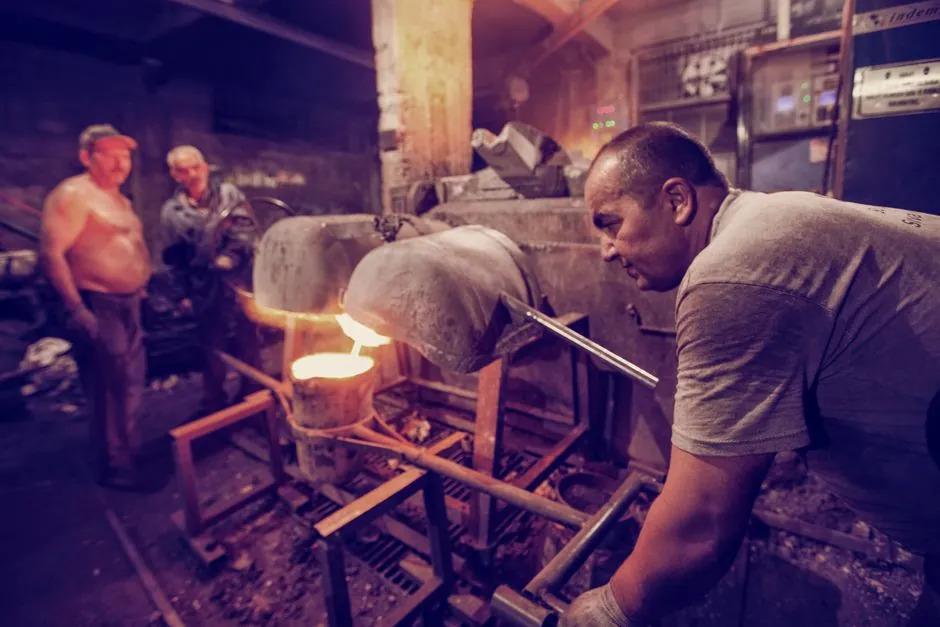
A bale-out crucible furnace sized 200-500 kg aluminum, fired by natural gas at 650-760 deg C bath temperature, is the typical point-of-use melter-and-holder at small-to-mid high pressure die casting cells where the alternative is a pumped or laundered central melt system [S2][S3].
The defining mechanic is that molten metal is "baled out" by a hand-held skimmer ladle, not poured through a spout or pumped: the operator dips the ladle into the open crucible and carries the shot to the die casting machine cold-chamber shot sleeve [S1][S2].
Furnace Configuration and Refractory Lining
Crucible bale-out furnaces for aluminum are built in three structural variants: lift-out (the crucible itself is hoisted out of the furnace shell with tongs), stationary (the crucible sits permanently inside a gas- or oil-fired shell), and tilting (the shell rotates to pour through a spout, used when a spout-bale is preferred) [S1][S3]. The lift-out pattern, shown as Figure 7.3(a) in ASM's Aluminum Alloy Melting, Holding, and Dosing reference, uses a separate pair of crucible tongs and a transfer carriage, which is feasible for sub-150 kg iron-equivalent charges but scales poorly past 250 kg because of operator ergonomics [S1].
Crucibles themselves are typically silicon carbide or clay-graphite for gas-fired service, replaced on a 6-24 month cycle depending on flux exposure, melt temperature, and number of cold-charging cycles [S2][S3]. Electric resistance-bale units replace the burner with top-mounted silicon-carbide radiant elements, which is preferred in foundries where combustion products contacting the melt are objectionable (e.g. cosmetic trim, aerospace investment castings feeding the same line) [S2].
Energy, Metal-Loss, and Throughput Math
For unalloyed aluminum, roughly 58% of the thermal energy input goes into heating the solid charge from ambient to the ~660 deg C melting point, 34% into the latent heat of fusion, and only about 8% into superheating to a 700-740 deg C pouring bath [S4]. A stationary gas-fired bale-out furnace at this duty typically lands at 750-900 kWh per tonne of aluminum melted when measured as fuel input, compared with 550-650 kWh/t for a regenerative shaft melter of the same throughput [S4].
Metal loss is the second cost lever, and the one most directly affected by furnace choice: a bale-out crucible with an open bath and no cover gas will oxidise 1.5-2.5% of the charge as dross, which at 5,000 t/year of throughput translates to roughly 75-125 t of aluminum locked in dross, or EUR 150,000-250,000 at the 2026 LME cash-buyer band used in StrikoWestofen's published cost model [S4]. The same model credits a 1% yield improvement to a controlled-atmosphere shaft melter as worth 5-10 cents per kilogram of finished casting, the figure that typically drives the capex decision between a bale-out cell and a centralised die casting melt shop [S4].
Comparison: Bale-Out Crucible vs Shaft Melter vs Holding-Only Bale

Selection between furnace types sits on four axes, and a process engineer should weigh each one against the cell's shot-weight cadence, not the foundry's total throughput. The table below summarises the three layouts most often seen in front of a 400-800 tonne cold-chamber HPDC machine. [S4]
Bale-out crucible (melts + holds in one shell, operator-dipped) scores low capex (roughly EUR 20,000-50,000 installed for a 300 kg unit) and high flexibility on alloy changes, but is the worst performer on dross rate and the worst fit for cells drawing more than 8-10 shots per hour because the operator-paced ladle becomes the throughput bottleneck [S2][S3][S4]. Shaft melters (centralised, pumped or laundered to multiple cells) win on energy per tonne and metal-loss per tonne but lock the foundry into a single alloy circuit and a 1-3 month commissioning window [S4][S5]. Holding-only bale-out furnaces (no melting function, fed from a central melter via ladle or launder) sit in the middle: lower capex than a shaft melter, better dross than a melt-and-hold bale, but they need a gravity die casting machine cell or a die-cast cell that can accept a pumped supply at the right pressure window [S5].
Where Bale-Out Fits the Cell, and Where It Does Not
Bale-out crucible furnaces are the right answer at die casting cells with two or fewer HPDC machines, alloy changeovers more frequent than once per shift, and shot weights under roughly 8 kg, the kind of layout common in job-shop automotive trim, hardware, and short-run aluminum die casting machine work [S2][S3]. They are the wrong answer at cells pulling more than 12 shots/hour, at cells with no floor space for a transfer ladle path, and at any cell inside a foundry that already runs a shaft melter for the same alloy [S4][S5].
Operationally, the cell-side rule of thumb is to keep the bath within +/-10 deg C of the set point and to skim dross on every shift change, because aluminium oxide build-up on the meniscus is what drives the next failure mode: ladle pick-up of inclusions that end up as the H13 die soldering precursors documented at length in H13 die soldering in aluminum HPDC. The die casting die itself pays the price for a dirty bath: a 0.5 mm soldering band on a die insert is typically traced back to a 2-3% dross-rate furnace upstream, not to the spray or release chemistry.
Standards, Sourcing, and Cell-Side Pitfalls

Stationary gas-fired bale-out furnaces for non-ferrous service are normally quoted against manufacturer-rated thermal input, with CE conformity under the Machinery Directive and, for installation in EU sites, ATEX zoning for the burner's ignition area (typically Zone 2 around the burner shroud) and the ladle-transfer path [S2][S3]. Crucible replacement cycles, refractory specification, and stack-emission limits are governed by local plant permitting rather than a single harmonised standard, so the spec sheet should pin refractory grade, SiC crucible class, and NOx burner class rather than rely on a generic "to code" clause [S2].
Two trackable signals to watch through the rest of 2026: regulatory pressure on open-bath dross rate in EU aluminum die casting, which is the lever most likely to push job shops off bale-out and onto covered or shaft-melted supply; and the steady migration of cell-level automation, where a die casting cell automation retrofit can either hide the operator-paced ladle bottleneck with a simple robot dip, or expose it as the new throughput ceiling. Either way, the bale-out crucible is not disappearing from the cell; it is being pushed into a narrower niche of small-batch, multi-alloy, low-capex casting.