
An automated die casting cell is a coordinated cluster of peripherals around a die casting machine, where the three stations that define cycle time and part consistency are die spray, robotic extraction, and the trim press [S1].
Typical cold-chamber aluminum cells combine a dosing furnace, sprayer, extraction robot, trim press, conveyor, and downstream inspection under one control sequence, with cycle times typically pulled below the manual baseline by synchronizing all three stations to the machine's open/close signals [S1][S4].
Spray Station: Release Agent, Cooling, and Dry-Off
Die spray is the first station to act on the open die after part removal, and it controls release-agent film thickness, die surface temperature, and cycle-to-cycle cooling repeatability [S1][S3]. Modern spray robots expose manually programmable spray time, spray point, and spray amount per zone, with the sprayer head mounted on a linkage arm that reaches into the die half without contacting the cavity [S3].
Release agent dilution, atomization air pressure, and number of nozzle axes are the three variables that decide spray quality; a consistent spray pattern is one of the cited reasons an automated cell beats a manually sprayed cell on cycle stability [S6]. A die cast cell running with automation has a faster and more stable cycle time, as well as a more consistent spray pattern, per General Die [S6].
For H13 tool steel running ADC12 or A380, stable spray controls the soldering tendency on the cavity surface, which is why spray is paired with die-temperature feedback rather than a fixed open-time delay [S8].
Extract Station: Robot, Gripper, and Quench Path
The extraction robot takes the casting out of the open die and transfers it to the next station, with a typical reach into a cold-chamber die platen at 200-1000 t locking force [S5]. Gripper geometry is part-specific: experienced integrators design claw hands for inlay pieces and use precise material-handle arms for stable, reliable gripping, per Yizumi [S3].
Many die casting cells use robots to remove the part, trim the part, mark the part, and put it in the box for shipment, per Shibaura Machine, which makes extract the natural starting point for a multi-station cell [S7]. In a Dynacast Lake Forest cell, the robot extracts parts, passes them through a quench, then through a dryer to blow off excess fluid before handing off to the trim press [S4].
The extract station is also where scrap is segregated: usable biscuit and runner are routed back to the dosing furnace for re-melt, while flash and overflow ride a separate path to external recycling, with the cell-level yield rate logged automatically [S4].
Trim Station: Press Tonnage, Die Geometry, and Flash Removal

The trim press separates runners, overflows, and flash from the cast part in a single, controlled operation, and modern trim dies are specialized tools designed to remove this excess material in one stroke rather than relying on secondary hand-deburring [S8]. Trim dies are matched to the cast die geometry, with clearance and shear angle set by the gating layout and the alloy's hot-short behaviour [S8].
Acme Alliance runs program-specific automated trim presses inside each cell on locking-force platforms up to 1000 metric tons, with in-line robotic trimming, precision flash removal, and integrated quality inspection as a defined trim stack [S5]. Kurt's rimrock-style automation adds auto ladle, auto spray, auto extract, shot monitoring, automatic plunger lube, and trim unloading as the standard trim-and-handling package [S2].
Trim and secondary operations are commonly pulled to the die cast machine rather than a remote cell, which keeps the empty-package return loop short and the cycle visible on one HMI [S2].
Cell-Level Comparison: Manual vs Partially Automated vs Lights-Out
The three deployment levels differ on labor, capital, and cycle visibility, and the data points in the research anchor each level to a specific outcome [S2][S4].
Manual cell: one operator per machine handles ladling, spraying, extraction, and trim-press loading; cycle time is limited by the slowest manual step and the spray pattern is operator-dependent [S6].
Partially automated cell (most common in the supplier base): dosing furnace, robotic spray, extraction robot, and trim press run from a shared sequencer, with operators retained for trim die changeover, inspection, and packaging. Kurt reports over 89% automation across its die cast division, and lists auto ladle, auto spray, auto extract, shot monitoring, automatic plunger lube, and trim unloading as the standard build [S2].
Lights-out / continuous-flow cell: full robot handoff from extract through trim, CNC, tumble wash, dryer, and packing, with one operator retained only for the final box pack-out. Dynacast's Lake Forest cell cut overall customer cost by 60% versus the traditional cast-plus-secondary batch route by eliminating CNC operator, wash load/unload, and inter-station queues [S4].
Selection Criteria: When Spray-Extract-Trim Automation Pays Back
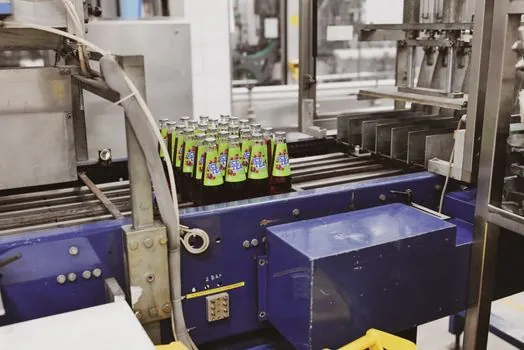
Spray-extract-trim automation pays back fastest on long-running, single-platform parts with stable cycle time, and pays back slowest on high-mix short-run work where trim-die changeover dominates the schedule [S5][S4]. Acme Alliance states each casting cell is configured to support controlled cycle performance, consistent part quality, and repeatable dimensional performance, with cross-program equipment alignment as the gating design choice for high-mix programs [S5].
Three selection criteria line the main options up against each other: production volume per SKU (favors lights-out), trim-die changeover frequency (favors partial automation), and required downstream process (favors full integration when CNC, wash, or inspection follow) [S4][S5].
The cited Lake Forest savings only applied to a specific project at the right volume; Dynacast flags that an automated cell is created for a specific project and is not a typical run for the plant, with capital cost as the gating constraint for job shops [S4].
Limitations, Failure Modes, and Integration Risks
Spray stations fail when release-agent dilution drifts, atomization air pressure drops, or nozzle alignment moves out of the taught path, all of which show up as die soldering or cold-shut on the next cast [S3][S6]. Extract stations fail when gripper wear changes the part's center of gravity in the robot's path, which usually shows as a die-half collision rather than a thrown part [S7].
Trim presses fail when flash thickness creeps up because the cast die has worn, and the trim die then has to absorb the extra shear and chokes the cycle [S8]. Cell-level failure modes show up as lost cycle time rather than as a single-station stop, which is why the cell controller tracks yield rate and downtime per station rather than per machine [S1][S4].
For aluminum HPDC on H13 tooling, the H13 soldering window sets the upper bound on cycle time, and the spray station is the only station that can hold the die inside that window. For alloy choice between A380 and ADC12, the injection pressure map sets the extract-side dwell before the part can be safely pulled.
Standards, Sourcing, and Trackable Signals
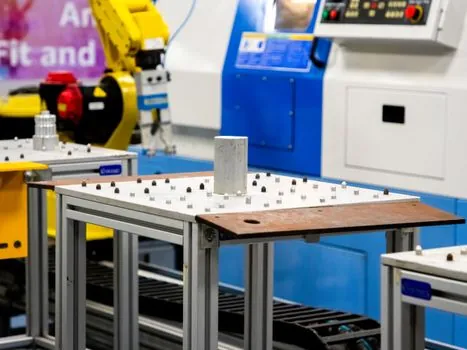
No single ISO or EN standard governs the spray-extract-trim stack as a unit; the cell is engineered against the die casting machine's CE/UL package plus the robot integrator's ISO 10218 industrial robot safety file, with cell-level risk assessment per ISO 12100 [S1][S4].
Trackable signals to watch in the next reporting cycle: cell-level yield-rate dashboards (now commonly phone-accessible per the Dynacast cell build), trim-die changeover time as a share of total cell uptime, and spray-nozzle replacement interval as a proxy for die-cavity wear [S4][S5]. The CE vs UL machinery decision matrix is the relevant cross-reference for cell exports to North America versus the EU, and the AC servo pairing rules set the sizing constraint for the sprayer and extract axes on most modern cells.
Detailed specification references: die casting, and die casting die.