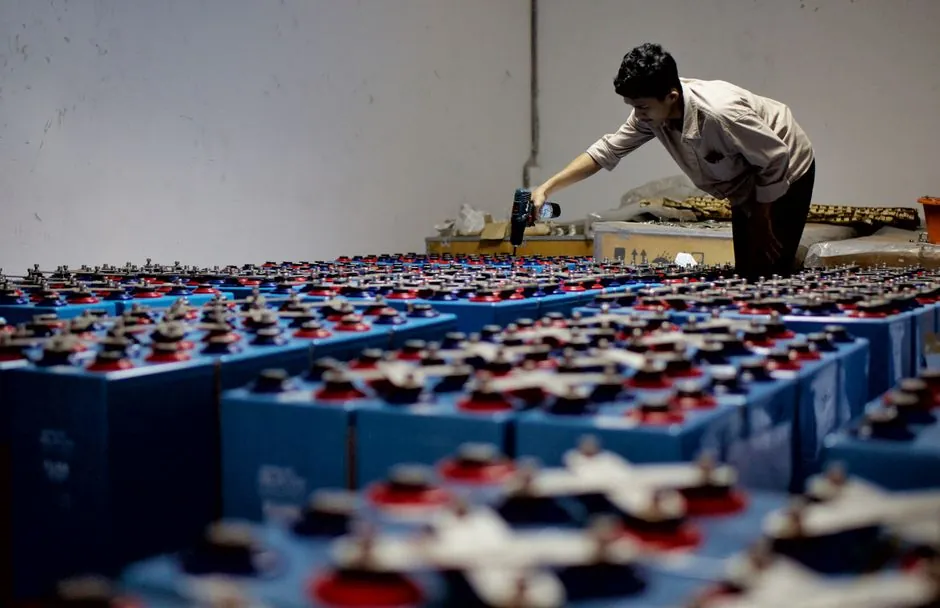
Industry 4.0 adoption in cell manufacturing is being pulled forward by a market that is projected to grow from USD 93.48 billion in 2026 to USD 241.96 billion by 2031, a 20.95% CAGR, with cylindrical cells holding 53.5% of 2025 share and pouch cells expanding at 25.8% CAGR through 2031 [S1].
Five driver clusters carry roughly 18.8% of the forecast CAGR impact: EV mandates at 5.2%, utility-scale storage at 4.8%, gigafactory build-out under IRA and EU battery regulations at 4.1%, cost-down learning curves at 3.5%, and 4680-class cylindrical plus large-format prismatic formats at 2.9% [S1]. Process engineers reading this should treat each driver as a separate Industry 4.0 investment line, not a single digital-transformation budget.
Industry 4.0 in cell manufacturing: scope and definition
Industry 4.0 inside a battery cell gigafactory covers the full stack from electrode coating dry-room humidity control (commonly held near -40 to -60 °C dew point on solvent-based NMC lines) to cell formation cycling, aging racks, and pack-level EOL testing, all wired into MES and historian layers. The Mordor Intelligence framework attributes 53.5% of 2025 cell share to cylindrical formats and 44.9% to NMC chemistry, which is the relevant baseline when sizing inspection and formation capacity [S1]. Modeling and simulation now sits inside this stack as a peer to physical metrology: COMSOL-style multi-scale workflows run from microscale chemistry through cell geometry into pack thermal coupling, which is the same data spine MES, APC, and digital-twin layers consume [S2].
Selection criteria for Industry 4.0 cell line investments
Three numbers should drive a 2026 capex decision: (1) target $/kWh exit cost, (2) scrap rate at formation and aging (typically 1 to 5% in volume lines), and (3) dry-room energy per kWh of throughput. Sodium-ion lines for low-cost mobility and ESS are cited at a 2.3% CAGR contribution, while solid-state variants are projected at 40.5% CAGR from 2026 to 2031, which forces different inline inspection (no electrolyte wetting, different X-ray contrast) [S1]. The load cell class used in electrode roll calendering and winding tension control must therefore be specified per chemistry, not per factory.
For electrode coating, calendering, and stacking, the inline measurement chain typically includes laser caliper, beta-backscatter basis weight, and IR or microwave moisture; resolution and scan width must be matched to the 4680-format web speed of roughly 30 to 80 m/min seen on Chinese prismatic lines. In formation and aging, flow meter selection on thermal management skids is non-trivial because deionized water/glycol mixtures need corrosion-resistant wetted parts and a turndown ratio that handles idle versus peak cycling loads. Process engineers should treat the industrial valve map as a parallel selection to the cell format decision: a sodium-ion line and a high-nickel NMC line have different thermal-loop chemistry, hence different elastomer and seat-material requirements.
Who Industry 4.0 cell lines are for, and who should wait

The build is for three buyer profiles: automotive OEM captives (Tesla, BYD, Hyundai), utility-scale BESS integrators, and Tier 1 cell makers building IRA- or EU-bonus-qualifying capacity in North America or Europe. Solid-state and sodium-ion lines remain R&D and pilot scale for most Western buyers, while Chinese suppliers (CATL held 37% global share in 2024) already run giga-scale LFP and are layering solid-state pilot capacity [S1]. Buyers that should wait are those with sub-2 GWh annual demand and no IRA or EU incentive capture, because the per-kWh fixed-cost overhead of a fully digital line does not amortize under that volume.
Options comparison: cylindrical 4680 vs prismatic LFP vs pouch NMC
On four decision criteria relevant to an Industry 4.0 spec, cylindrical 4680-class wins on pack-level structural integration and tabbing simplicity, large-format prismatic LFP wins on cost per kWh and long cycle life (the format favored in Chinese BESS), and pouch NMC wins on energy density at the cell level but loses on swelling-management overhead in MES data models [S1]. Energy-storage system applications are advancing at a 29.4% CAGR to 2031, which is the segment where LFP prismatic and large cylindrical formats dominate spec sheets [S1]. Asia-Pacific captured 52.8% of 2025 share and is forecast to grow at 25.2% CAGR through 2031, so any benchmark MES/APC architecture should be validated against an APAC reference line before locking the spec [S1].
Lithium-ion overall still makes up about 85% of all battery demand, and CATL, Tesla, LG Energy Solution, and Panasonic are the names cited as continuing to scale production globally through 2025 [S3]. The takeaway for spec authors: lock the format decision (cylindrical vs prismatic vs pouch) and the chemistry band (LFP vs NMC vs sodium-ion vs solid-state) before selecting sensors, valves, or MES tags, because each combination changes the dry-room setpoint, formation protocol, and aging rack channel count.
Real use cases across automotive, BESS, and eVTOL

Automotive held 55.1% of cell market size in 2025 and is the segment where 4680 structural packs and large-format prismatic packs are competing for OEM platform wins [S1]. BESS is the second pillar, with utility-scale demand growth contributing 4.8% of forecast CAGR impact and named as a medium-term (2 to 4 year) global driver led by North America and China [S1]. Aerospace and eVTOL add a third, smaller but fast-moving use case: weight trumps cost, and simulation at the cell and pack scale becomes a hard requirement rather than a nice-to-have [S2].
Modeling at different scales is the engineering reason Industry 4.0 investments have a defensible ROI: microscale modeling studies battery chemistry, porous structures, and aging; cell-level modeling analyzes geometric and material property effects on operation and life; pack-level modeling covers cells plus electrical connections and cooling to ensure uniform operation [S2]. A pressure transmitter on the thermal loop, a load cell on the winding shaft, and a pressure sensor in the formation chamber are all data sources that feed the same pack-level model.
Limitations, failure modes, and standards gaps
Three failure modes recur in 2024 to 2025 cell line buildouts: dry-room humidity excursions during coating startup, formation channel drift on aging racks, and pack-level thermal-runaway detection latency. Each is a data-quality problem before it is a hardware problem, and the Industry 4.0 stack only helps if the historian layer is rate-matched to the fastest physical event (typically a thermal-runaway onset in the millisecond to second range). Government programs cited as accelerating demand include the U.S. Inflation Reduction Act, the European Battery Alliance, India's PLI scheme, and China's NEV policies, all of which add compliance tagging to the MES layer that has to be auditable, not just logged [S3].
Solid-state and silicon-anode variants are explicitly called out as "highly adopted" but still pilot-scale for most Western programs, so spec authors should not assume 2026-vintage solid-state data sheets are production-ready [S3]. For a sourcing-side view, the battery cell sourcing from China spec map and the gigafactory equipment spec map are the two reference articles worth opening in parallel when locking a 2026 cell line spec.
Sourcing signals and trackable next nodes

Two trackable signals to watch through the remainder of 2026: (1) any update to the 20.95% to 20.98% CAGR band that bridges Mordor and Spherical forecasts, since the two reports agree on a 2025 base near USD 93.48 billion but differ on 2031 versus 2035 endpoint sizing [S1][S3]; (2) the BESS installation cadence, which is the segment with the cleanest 29.4% CAGR signal and the most direct link to grid-scale Industry 4.0 retrofits [S1]. A third watch item is the BESS and grid-scale storage capacity snapshot, which pairs cell-format decisions with utility procurement cycles.