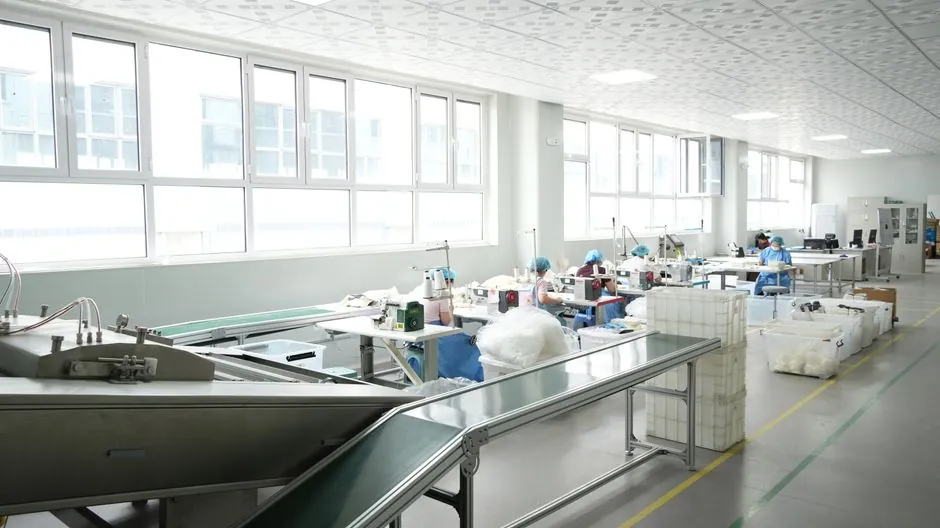
Battery cell manufacturing equipment divides into three process blocks, electrode manufacturing, cell assembly, and cell finishing, with most cell-format-independent work concentrated in the first and third [S5].
Selecting the right tool per station is dominated by interface quality, throughput matching and traceability depth rather than headline machine specs, a point driven home on any production line that has lost a shift to a sorting station that cannot feed a welder rated for 40 joints per minute [S2].
Three-Block Process Map and Where the Capital Goes
The PEM of RWTH Aachen / VDMA reference structure splits cell production into electrode manufacturing, cell assembly, and cell finishing, with electrode production and cell finishing largely independent of cell type, while cell assembly forks for pouch, cylindrical, and prismatic formats [S5]. This split is the reason gigafactory capex runs into the hundreds of millions, while pack-assembly capex (the second capital program that often gets conflated with cell-making) is a much smaller, faster-to-deploy stack covering sorting, cleaning, insulation, welding, BMS integration, and end-of-line testing [S2]. MarketsandMarkets sizes the cell-side equipment market at USD 15.63B in 2025, projected to USD 36.94B by 2030 at 18.8% CAGR, with coating, calendering, formation, and testing machines as the highest-adoption categories [S4].
Electrode Manufacturing: Mixing, Coating, Drying, Calendering, Slitting
Front-end precision sets the baseline for energy density and structural integrity, and Upton's process map lists vacuum planetary mixers and continuous twin-screw extruders for slurry homogenization, slot-die coaters for uniform wet-film deposition on copper (anode) and aluminum (cathode) foils, multi-zone roll-to-roll drying ovens to control binder migration, and high-pressure calender rollers to hit target porosity [S3]. Slitting and notching are the tolerance-tight stations: Targray publishes a knife-unit spec of slitting width accuracy ±0.05 mm, gap adjustment accuracy 1-2 µm, blade materials SKD11 / SKH51 / cemented carbide at HRC 58-64 / HRA 88+, diameters Ø80-Ø130 mm, runout ≤3 µm, parallelism ≤5 µm, and cut surface roughness Ra ≤0.8 µm [S1]. For notching dies, electrode thickness range 100-190 µm, total circumference burr under 7-10 µm, delamination under 200 µm, and single-run output 600k-800k anode/cathode hits before regrinding are typical contractual numbers [S1].
Cell Assembly: Winding vs Stacking, Format-Specific Tooling
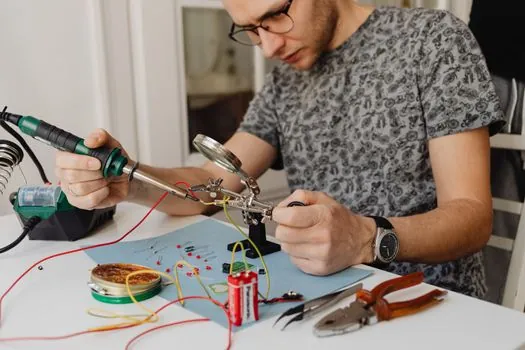
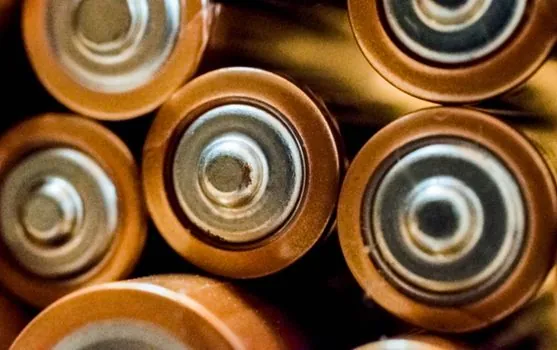
Cell assembly forks by format, and the equipment stack swaps accordingly: cylindrical formats such as 18650 and 21700 use high-speed winding machines, automated grooving and casing insertion, and laser welding of tabs; prismatic cells use a different stacking or Z-fold hardware set; pouch cells use lamination of the separator as a defining step [S3][S5]. Within each format, the same theme of interface dominance applies, a winding station that delivers a slightly misaligned jellyroll costs the laser welder its yield regardless of the welder's own ppm spec [S2]. In a pack line, the equivalent precision bottleneck appears earlier, in cell feeding, plasma cleaning, and insulation application, before the cells ever reach a contact fixture [S2].
Pack Assembly Stack: Sorting, Cleaning, Welding, EOL Test
Pack assembly equipment takes finished cells and turns them into modules and packs, and the spec list per station is well defined: OCV, IR, and ACIR measurement for cell testing and sorting; plasma cleaning and vision-verified insulation placement; laser or ultrasonic welding with inline weld integrity testing; controlled torque on bolted joints; leak testing; BMS programming; and end-of-line validation [S2]. Selection criteria that matter on a real quote comparison are sustained throughput, supported cell formats, changeover time, weld verification, traceability depth, testing coverage, and service response, rather than the headline throughput number [S2]. Integrated turnkey lines reduce multi-vendor procurement risk by giving one engineering partner ownership of takt calculations, equipment interfaces, data architecture, commissioning, and ramp-up [S2].
Comparison of the Main Equipment Options on Selection Criteria
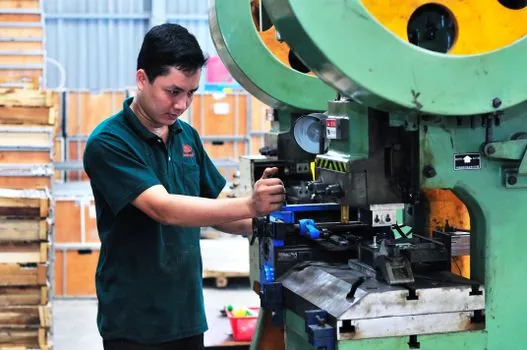
Across the equipment landscape, three option classes compete on distinct criteria: front-end cell-making tools (mixing, coating, calendering, slitting), format-specific cell-assembly tools (winding for cylindrical, stacking for prismatic, lamination for pouch), and pack-assembly stations (sorting, cleaning, welding, EOL test) [S3][S5]. On capex scale, front-end cell-making tools are the heaviest, with market value concentrated in coating, calendering, formation, and testing [S4]; on changeover flexibility, pack-assembly stations win because they support multiple cell formats and future expansion with automated quality control and cell-level traceability [S2]; on tolerance, slitting and notching are the tightest stations, with width accuracy ±0.05 mm and burr under 7-10 µm as the published reference values [S1]. For sourcing strategy, the supply base is concentrated in China, Japan, and South Korea, with European OEMs positioned as growth opportunities, and lead suppliers including Lead Intelligent Equipment, Yinghe Technology, Hitachi High-Tech, Dürr Group, and ANDRITZ Schuler [S4][S9].
Suppliers, Standards, and Sourcing Constraints
Major cell-making equipment suppliers include Lead Intelligent Equipment (China, 1.8 million m² of R&D and production facilities, over 5,000 R&D professionals, more than 3,200 patents), Yinghe Technology (China), Hitachi High-Tech (Japan), Dürr Group (Germany), and ANDRITZ Schuler (Germany), all pursuing capacity expansion, strategic collaboration, and AI-integrated line launches [S4]. PEM of RWTH Aachen and VDMA document the process reference structure, ISBN 978-3-947920-03-7, third edition, Frankfurt am Main, December 2018, and the supply base is dominated by SMEs, with VDMA representing more than 3,200 mechanical engineering member companies [S5]. For pack-line buyers, the practical sourcing constraint is multi-vendor interface risk, which is why turnkey integrators are increasingly specified over piecemeal procurement [S2].
Limitations and Failure Modes Buyers Should Plan For
The dominant failure mode is interface mismatch, where a high-spec station upstream cannot feed the next station at rated takt, capping the line at the weakest link rather than the strongest [S2]. Slitting and notching dies have a published single-run output of 600k-800k anode/cathode hits before inspection and regrinding, with up to 20 regrinds per mold and a full mold overhaul required after two reuse cycles following punch and die replacement, so consumable-life planning belongs in the capex model from day one [S1]. Pouch, cylindrical, and prismatic cell-assembly tools are not interchangeable, and any retrofit across formats typically requires a changeover program that the OEM must quote separately [S5].
Trackable signals for the next planning cycle: the USD 15.63B (2025) to USD 36.94B (2030) equipment-market trajectory at 18.8% CAGR [S4], and the continued concentration of cell-making equipment supply in China, Japan, and South Korea with European OEMs as a documented growth pocket [S9]. For related energy-equipment spec work, see the TOPCon solar cell competitive landscape 2026 and the energy storage 2026 cell chemistries map.
For the relevant spec sheets and selection criteria, see additive manufacturing material, linear guide, and load cell.