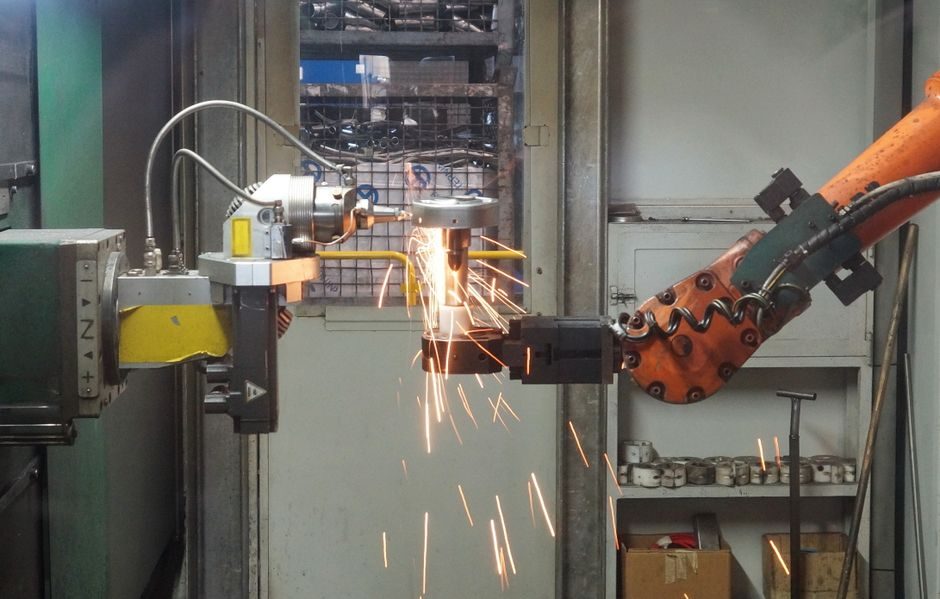
Rolling-element bearing production follows a fixed sequence — tube/ring forging, rough and finish turning, heat treatment, superfinishing grinding, and assembly — with ISO 9001-certified Chinese volume plants such as Wuxi BC Bearing Manufacturing and Wuxi Shenxi Bearing Manufacturing running the full chain on GCr15 bearing steel, with listings showing minimum order quantities as low as 2 pieces at around $10 per unit for double-row spherical roller types [S1][S2].
The chain is the same whether the end item is a ball bearing for a small electric motor, a ceramic-bearing hybrid for a spindle, or a heavy linear-bearing carriage — what shifts is the material, the tolerance window, and the grinding wheel specification [S1][S2].
Step 1 — Steel Selection and Forging/Tube Billet
Bearing-grade through-hardening steel GCr15 (the Chinese designation equivalent to AISI 52100 / DIN 100Cr6) is the workhorse material quoted by both Wuxi BC Bearing Manufacturing and Wuxi Shenxi Bearing Manufacturing for their double-row spherical roller and cylindrical roller lines, with one Shenxi listing naming "Gcr15 Steel Replacement 22222" for a heavy-duty spherical cylindrical roller bearing [S2].
Forging temperature windows for GCr15 are held in the 1100–1200 °C range for hot ring forging, after which the forged ring is normalized. Volume producers run ring-rolling mills that compress the wall thickness and bring the blank close to the finished inner/outer race geometry, leaving a controlled machining allowance of typically 0.5–2.0 mm per face for the subsequent turning station [S1][S2].
Step 2 — Turning, Drilling and Pre-Heat-Treatment Machining
CNC lathes and vertical machining centers rough and finish-turn the inner and outer rings to within roughly ±0.05 mm on diameter, with oil grooves, snap-ring grooves and lubrication holes added on the same cell. Shenxi's catalogue lines — "Spherical Cylindrical Roller", "Double Row Brass Cage" spherical roller 239/670CAW33 — all carry this turned-races-before-heat-treatment discipline, because subsequent quench-and-temper would distort soft rings beyond recoverable tolerance [S2].
For tapered and cylindrical roller bearings, the rollers themselves are turned from bar stock on multi-axis CNC turning centers to a diameter tolerance window of roughly ±0.005 mm before being centerless-ground to final size. Brass or steel cages (Shenxi lists "Brass Cage" variants explicitly) are machined as a separate sub-assembly and heat-treated only when the design calls for a case-hardened cage [S1][S2].
Step 3 — Heat Treatment: Spheroidizing, Quench, Temper
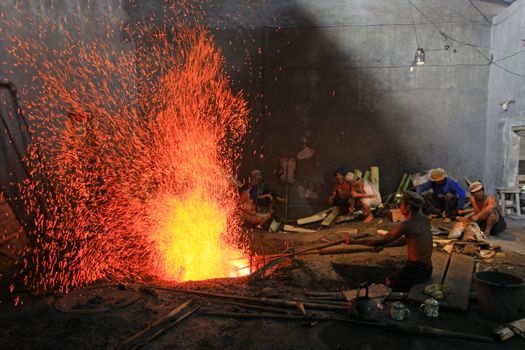
The mechanical envelope of a bearing — hardness, dimensional stability, fatigue life — is set in heat treatment. GCr15 rings are spheroidize-annealed before machining, then austenitized at roughly 840–860 °C, oil- or salt-bath quenched, and tempered at 150–200 °C to land in the 60–65 HRC working hardness window. This sequence is what allows Shenxi's "Low Noise" and "High Speed" marketing claims to be backed by a measurable metallurgical condition, not just a clean surface [S2].
For large-diameter spherical roller bearings in the 239/670 size class, controlled-atmosphere or vacuum furnaces are used to limit decarburization on the raceway, and a sub-zero (-70 °C to -80 °C) treatment step is often added before temper to convert retained austenite. Wuxi BC Bearing's emphasis on "Low temperature raise" in its product copy is a direct consequence of correctly executed heat treatment, not a feature added in assembly [S1].
Step 4 — Grinding, Superfinishing and Raceway Geometry
Raceway geometry is where premium bearings are won or lost. Wuxi BC Bearing specifies "Auto CNC digital grinders" as a manufacturing capability, which in practice means CNC angular-contact or CBN-wheel surface grinders holding roundness and surface finish to roughly 0.1–0.2 µm Ra on the raceway [S1].
Grinding follows a fixed route: rough grind → fine grind → superfinish, with each step removing progressively less material (typically 0.01–0.05 mm per pass on the finish pass) to avoid grinding burns. The "High Reliability Long Life Reduce knocked-down trouble" language on BC Bearing's product page [S1] is a direct claim about controlling this grinding step and the burn/crack defects that show up when it drifts. Roller parallelism and crowning are also ground in this cell, and noisy bearings in the field are almost always traceable to a problem in this station rather than the steel chemistry.
Step 5 — Cleaning, Assembly, Lubrication and Noise Testing
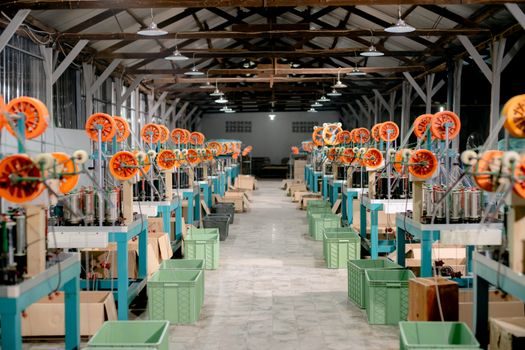
After grinding, every ring and roller set is washed in a multi-stage aqueous cleaner to bring residual contamination below the sub-milligram range, then matched to a clearance class (C2, C0, C3, C4, C5) before assembly. Shenxi's "ISO9001 Certified Low Noise Bearing" descriptor in its 22222 listing points to a documented process at this stage, typically including a Soken or ABEC-class noise test on every batch [S2].
Grease filling, shield/seal pressing and final runout testing close the line. Volume Chinese producers run batch MOQs as low as 2 pieces on Alibaba storefronts, but a single 239/670CAW33 spherical roller (one of the larger sizes Shenxi lists) carries a $1,900 minimum order of 1 piece — a useful indicator of the working capital tied up in a single heavy-bearing assembly [S2]. This is one reason why crossed roller guide and bearing buyers should look at MOQ alongside per-piece price when comparing sources.
Process Comparison: Ball vs Cylindrical Roller vs Spherical Roller
The three dominant rolling-element families diverge sharply in their process load. A deep-groove ball bearing is the simplest cell — small rings, ball-set graded, pressed steel or brass cage, and one grinding setup per raceway. Cylindrical roller bearings add a roller-grinding station and tighter raceway profile control, and are typically specified where radial load and high-speed capability both matter. [S1]
Spherical roller bearings (Shenxi's core line in 22222, 22234 and 239/670CAW33 sizes) are the most process-intensive: heavy ring forging, large-diameter heat treatment, two-row raceway grinding on a curved profile, and a heavy brass or steel pin-type cage — which is why a single 239/670 unit carries a $1,900 price tag against the $10 entry-point on a small double-row spherical [S2]. For buyers comparing across options alongside adjacent components like ball valve sourcing, the rule of thumb is that roller bearings always cost more per unit than a same-bore ball bearing, and the gap widens with size class.
What to Verify When Sourcing a Chinese Bearing Plant
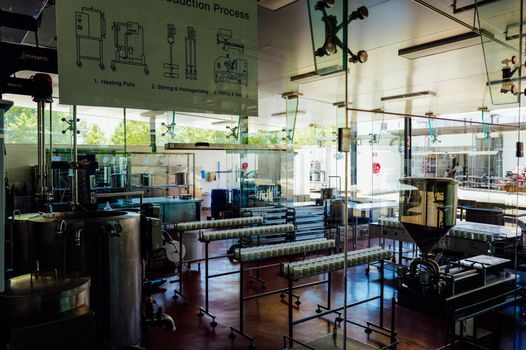
Three checks separate a working volume source from a problem one. First, the ISO 9001 certificate number and the issuing CB — both BC Bearing and Shenxi claim ISO 9001 alignment, and the certificate should be verifiable on the issuing body's register [S1][S2]. Second, the heat-treatment furnace type: a continuous mesh-belt austempering line is fine for small GCr15 rings but inadequate for 239/670-class large-diameter raceways, which need a vacuum or controlled-atmosphere furnace to avoid decarburization. Third, the grinding spec — "Auto CNC digital grinders" is a useful phrase, but the buyer should ask for the actual surface finish figure (Ra in µm), the roundness tolerance, and the grinding-wheel grade [S1].
Lead-time discipline on a 2-piece MOQ at $10 [S2] and the same plant's ability to run a 1-piece $1,900 heavy-spherical order are two very different conversations — the first is a stock SKU, the second is project-driven and likely 30–60 days. Buyers who mix the two SKUs in one PO should expect different production slots and different quality-loop durations, regardless of the catalog page [S2].
Wuxi BC Bearing's "Best service Fetch in advanced technique of bearings production" claim [S1] is the type of catalog line that should be read as a marketing wrapper, not a spec — the underlying signal is whether the plant owns its grinding cells (it does, per the "Auto CNC digital grinders" line) and whether it controls the heat treatment in-house. For adjacent industrial buying categories where a similar make-vs-buy split exists — electric motor stator winding, core making machine sand-system assembly — the same discipline applies: verify the cell, not the catalog.