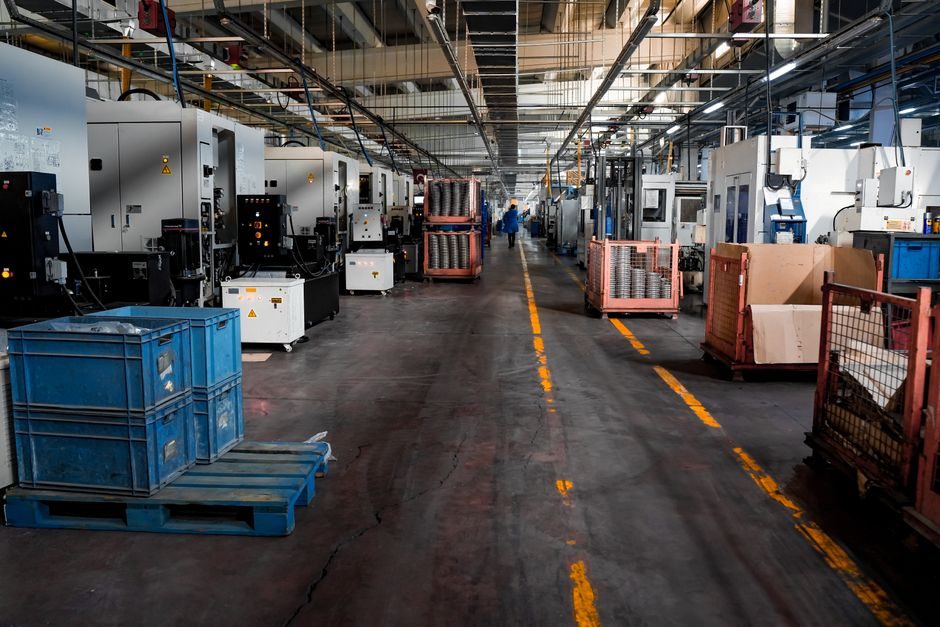
Made-in-China's side-bearing directory listed 2,000+ manufacturers and 6,000+ products on 2025-07-01, signalling the depth of the China-side long-tail [S4]. Across the same week, three Chinese factory sites — DAZ (Ningbo-area roller/miniature/stainless), Quanzhou Arrow (pillow blocks, insert bearings, plummer blocks, spherical plain, thermoplastic housings), and Jiuchuang Intelligent Equipment (bearing automation, tapered bearing assembly, bearing testing) — presented three distinct value-chain positions: finished bearings, mounted bearing units, and bearing-making machinery [S1][S3].
Outside China, R.T. Bearings Ltd (UK) positions itself on custom design and manufacture for the mechanical-handling industry rather than catalogue distribution [S5], while Delhi-based DCDC Bearings stacks catalogue SKUs from multiple global brands — SKF, NBC, ARB — under one roof [S2]. The pattern is a familiar one: short-tail branded catalogue on one side, long-tail custom on the other, with Chinese mid-tier filling the OEM/private-label gap.
China-side long-tail: more than 2,000 manufacturers, organised by product family
Made-in-China's side-bearing channel returned 2,000+ manufacturers and 6,000+ products on 2025-07-01, with main-product taxonomy centred on "Bearing, Ball Bearing, Roller Bearing, Pillow Block Bearing, Deep Groove Ball Bearing" [S4]. The directory's faceted filters — material, shape, certification, application — are the practical procurement surface, not the headline count. A 2026-05-30 cross-listing on Made-in-China's Construction & Decoration channel returned 3,004 products under "Ball Bearing Slide" alone, illustrating how the same factory network spills into furniture hardware as well as industrial [S6].
Factory-level positioning is split. DAZ Bearing clusters around the size/segment axis: miniature, small, middle, large-size, plus carbon, stainless, and plastic-wrapped SKUs [S1]. Quanzhou Arrow Bearing Co. clusters around the mounted-unit axis: pillow blocks, insert bearings, plummer blocks, spherical plain, thermoplastic housings — the OEM-style mounted-bearing niche [S3]. Buyers looking for roller bearing components typically go to the size-segmented factories, while buyers looking for pillow-block bearing assemblies go to the mounted-unit specialists, with limited overlap at the SKU level.
India: distributor stacks, not manufacturer tiers
DCDC Bearings (Delhi) lists deep-groove ball bearings, tapered roller bearings, pillow-block bearings, spherical roller bearings, cylindrical roller bearings, angular-contact ball bearings, and self-aligning bearings — and explicitly names SKF, NBC, and ARB as its stack [S2]. That mix is distributor arithmetic, not manufacturing depth: a single Indian supplier is shipping seven families of ball bearing and roller-bearing geometries sourced from at least three brand owners.
The trade-off is well-known to procurement. Multi-brand stacking cuts the buyer's vendor count and simplifies logistics, but ties lead-time and warranty to the distributor rather than the OEM. For standard deep-groove or tapered-roller SKUs where interchangeability is high, this is fine; for application-engineered thrust bearing or slewing bearing builds, the route typically reverts to direct-OEM engagement in China, Europe, or Japan.
UK specialist fabricator: design-led, mechanical-handling focus
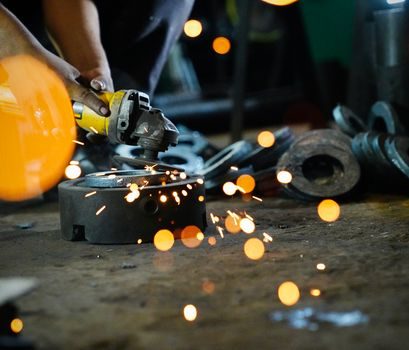
R.T. Bearings Ltd describes itself as offering "a design and manufacturing service for the supply of all types of components for use in the Mechanical Handling Industry," with engineering support running from design through manufacture [S5]. The page does not publish a catalogue SKU count, capacity figure, or material-grade list; the value proposition is the design-stage co-engineering, not catalogue breadth.
This positions the UK niche between the Indian brand-stack distributor and the Chinese long-tail factory. R.T. Bearings is the appropriate route for low-volume, application-specific builds — conveyors, elevators, bulk-handling gear — where a linear bearing or mounted bearing has to be designed against the machine envelope, not picked from a stock list. For high-volume standard SKUs, UK pricing typically cannot match China or India on landed cost, and the specialist fab route is reserved for parts the catalogues do not cover.
Comparison: which supplier type fits which bearing job
Decision criteria for buyers typically collapse to four: (1) bearing family, (2) volume, (3) customisation depth, (4) lead-time. The Made-in-China long-tail wins on volume + standard family (deep-groove, roller, pillow-block) at the lowest unit cost, with 3,004 products listed in a single sub-category (Ball Bearing Slide) as of 2026-05-30 [S6]. Indian brand-stack distributors win on single-PO convenience and on warranty routing for the seven standard families DCDC lists [S2]. Chinese mounted-unit specialists like Quanzhou Arrow win on OEM/private-label pillow-block runs with a focused product set [S3]. UK mechanical-handling fabricators like R.T. Bearings win on custom design for non-catalogue geometries [S5].
As one engineer put it on a procurement forum thread cited by industry coverage, "the factory that lists 6,000 products is the factory you call when your standard is 'good enough' — not when the spec says otherwise."
Signals worth tracking into 2H 2026

Three trackable signals from the July 2026 directory sweep: (1) whether the Made-in-China side-bearing count — 2,000+ manufacturers / 6,000+ products as of 2025-07-01 — moves materially above the 2,000-manufacturer mark in 2H 2026, indicating continued factory entry despite margin pressure [S4]; (2) whether Quanzhou Arrow and DAZ add formal ISO 9001 / IATF 16949 certificates to their public pages, since OEM automotive and industrial buyers require that paperwork before issuing POs [S1][S3]; (3) whether R.T. Bearings publishes a numerical capacity or material-grade list on its UK site, which would signal a shift from design-services fab to mid-volume production [S5]. Related coverage of machine tool supply chains and offshore wind bottlenecks shows bearing demand pulling from spindle and turbine-gearbox lines, so the 2H 2026 watch list should also include spindle-bearing and large-diameter slewing-bearing lead-times as the upstream tell. The third signal is whether the Indian distributor tier starts to publish digital inventory APIs, since the multi-brand-stack model is most exposed to e-commerce disintermediation.