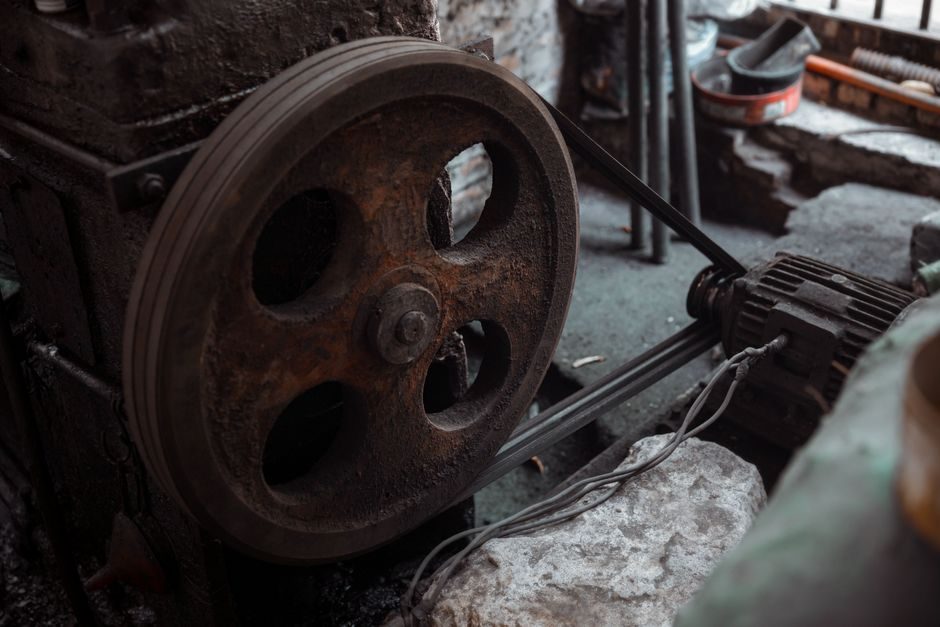
The RUVILLE 55480 belt tensioner for AUDI / SKODA / VW (FAW) V-ribbed belt drives is a 5-rib unit, 75.5 mm outer diameter, 21.5 mm wide, cross-referenced to OE 038 903 315 D / 038 903 315 P [S6]. That single part number is the first install checkpoint — a 4-rib tensioner on a 5-rib belt, or a 76 mm OD unit where the engine management expects 75.5 mm, fails the vibration check at idle within minutes of start-up.
Belt tensioners in this category are spring-loaded automatic units, not adjustable idlers: the installer does not set a static deflection, the mechanism does. The job is to verify the part, the rib count, the routing, and the centre-bolt torque — then verify the drive under load. A useful background page on the component family is the belt tensioner reference; the flat belt and ribbed belt pages cover the belt side of the same drive.
Symptom: Tensioner Replaced but Belt Still Squeals at Start-Up
Rib count mismatch is the dominant root cause on European V-ribbed drives: the RUVILLE 55480 carries 5 ribs at 75.5 mm OD / 21.5 mm width, and the OE cross-reference list (AUDI 038 903 315 D, AUDI 038 903 315 P, SKODA 038 903 315 D) is the only valid match for the listed applications [S6]. A pulley one rib off changes the effective belt length on the drive and shifts alignment on every accessory sheave, which reads as chirp at cold start and as a thrown rib within 5,000 km.
Corrective action is verification, not adjustment: confirm the part number on the box matches the OE cross, count the grooves on the back of the old tensioner pulley with a flashlight, and confirm OD with calipers before the new unit goes on the bracket. If the numbers match, the squeal is routing or torque, not the tensioner itself — see the next section.
Symptom: Tensioner Pulley Wobbles or Arm Does Not Return
Wobble or a stiff / non-returning arm is a spring-fatigue failure inside the automatic tensioner, not an installation error — the assembly is a sealed unit on most modern V-ribbed drives and the OE Caterpillar C-12 industrial engine parts list (group 1989766 BELT TENSIONER GROUP - ENGINE - INDUSTRIAL) carries the tensioner as a single line-item, not as serviceable sub-components [S1]. Field acceptance test is hand-feel: with the belt off, the arm should swing smoothly through its full travel and hold position at any point; any notch, click, or visible radial play on the pulley bearing means scrap the unit, do not install it.
Corrective action: replace the complete assembly, never the pulley alone, on sealed designs. Reuse is only acceptable on serviceable designs where the manufacturer publishes a spring test load; the China-supplier listings for auto/truck belt tensioners (JAC, HOWO, Foton/Forland spare-parts families) confirm the aftermarket treats each tensioner as a single replacement SKU rather than a rebuildable [S4].
Symptom: Belt Deflection Outside Spec After Install
Automatic tensioners do not have a "set deflection" step in the workshop sense — the mechanism sets it. Installer-side verification is run-in: start the engine, let it idle 60 s, then measure mid-span belt deflection on the longest span between two fixed pulleys using moderate thumb pressure, and compare to the vehicle service manual value. The Y-axis belt installation procedure on the LH-Stinger 3D-printer build (M3 hex nut, M3×8 mm button-head screw, glue the nut into the belt-clamp socket before assembly to stop it dropping into the extrusion) is the same logic at small scale: clamp first, then route, then tension — not tension first then re-clamp [S2].
Corrective action if deflection reads high: shut down, recheck that the tensioner is fully seated on its bracket and the centre bolt is torqued to the OEM Nm value (not snug, not "good enough"). Do not pry the arm to add tension — the internal spring is the only authority. Acceptance: mid-span deflection inside the manual's mm window, no chirp at cold start, no belt-edge dusting on any sheave after 5 minutes of idle.
Symptom: Belt-tracking / Alignment on a Linear Belt Drive
For linear-belt drives (CNC, 3D-printer gantries, conveyor light-duty), a tensioner is also a tracking device: misalignment between the driving pulley and the idler shows up as the belt walking off the teeth, not as a tension problem. The Y-axis belt installation note routes the belt through the extrusion before attaching the rear belt clamp for exactly this reason — geometry before tension [S2]. A wider linear guide context and a crossed-roller guide reference apply when the linear stage is the load-bearing frame, not the belt.
Corrective action: re-check pulley-to-pulley parallelism with a straightedge across both end faces before re-tensioning. On a belt conveyor carryover, the same rule scales up — tracking is set by the geometry of the end pulleys, not by the take-up winch. Acceptance: belt runs centred on both pulleys for a full empty-belt rotation, no edge contact with the pulley flange.
Symptom: Cross-Reference Mismatch Across Dayco / INA / Ruville Lines
Cross-reference data is now a paid freelance service on the open market — Dayco belt tensioner cross-reference jobs appear as standalone listings on freelancer.com, signalling that the catalogues no longer line up on a public spreadsheet [S3]. The Hutchinson / INA / IPD brand set appears in the same eBay timing-belt tensioner listings for Opel / Vauxhall / Chevrolet / ZAZ / Fiat / Alfa Romeo applications, with a GBP 5.86 standard international postage tier as the lower-cost aftermarket channel [S5].
Corrective action for a buyer: treat the OE number (e.g. AUDI 038 903 315 D) as the master key, then confirm the aftermarket brand's published cross (RUVILLE 55480, INA equivalent, Dayco equivalent) carries the same 5-rib / 75.5 mm OD / 21.5 mm width triplet [S6]. If the cross does not list those three numbers, the listing is wrong — do not buy on brand alone. Acceptance: the box label, the OE part number stamped on the back of the old unit, and the aftermarket catalogue cross all match on rib count, OD, and width.
When NOT to Re-Tension — Replace the Tensioner
Re-tensioning a worn automatic tensioner is not a repair: once the internal spring has lost its cold and hot load curve, no amount of centre-bolt torque will restore correct drive tension. The hard replacement triggers are visible radial play on the pulley bearing, an arm that does not hold mid-travel, a stamped OE date code older than the belt (tensioner should always be replaced with the belt, not before it fails), and any sign of damping-fluid weep on the housing. On a heavy industrial drive such as the Caterpillar C-12 328 kW @ 1800–2100 rpm arrangement, the belt tensioner group is a planned-service line-item, not a breakdown part [S1].
Trackable signals going forward: (1) whether aftermarket brands begin publishing the rib-count / OD / width triplet directly on the retail box instead of only in the catalogue cross-reference [S4][S6]; (2) whether OE 038 903 315 D supersessions land on the AUDI / SKODA / VW (FAW) tensioner line within the next two part-revision cycles [S6]. For related drive-component selection, the timing pulley types and classifications reference covers the matching pulley side of the same drive train.