
Retail bench scales cover a useful load range of roughly 0.5 kg to 150 kg and dominate the price-computing, prep-counter, and ship-from-store use cases that appear behind most grocery, deli, and small-warehouse counters [S4][S5]. Medium-capacity bench scales serve the broadest cross-section of applications, including food portioning, retail trade, and pharmaceutical dispensing [S4], and digital product variants held an estimated 68.4% of the global bench scale market share in 2025 [S4].
Selection in a retail context is gated less by load cell engineering than by three practical questions: what capacity matches the heaviest single SKU or parcel, what readability and legal-for-trade certification the local weights-and-measures authority requires, and how the scale will physically survive the counter environment (washdown, produce juice, flour dust, packaged goods). This article maps those gates against real option types, with verification pointers.
Load capacity and readability: pick capacity first, readability second
Rice Lake's selection guide tells buyers to measure the dimensions and weights of the smallest and largest items first, because a single scale covering a 30 g chocolate truffle and a 25 kg catering tray is rarely optimal [S2]. In retail practice that pushes operators toward two adjacent units, e.g. a 6 kg x 1 g precision prep scale and a 60 kg x 20 g ship-from-store scale, rather than one compromise. Prime USA's platform-vs-bench comparison confirms bench units sit at the compact, low-capacity, high-readability end of the weighing family, distinct from the floor platform class that handles pallets and drums [S5].
A working rule used by deli and produce buyers: pick a scale with capacity at 1.5-2x the heaviest single item you expect to weigh, and readability no coarser than 1/500 of capacity, otherwise the price step per gram gets rounded away at the till. Bench and portable scales are explicitly designed for diverse applications, from basic weighing to challenging wet or hazardous conditions [S1], so a counter-side stainless bench unit is usually the right form factor, not a floor platform, regardless of brand preference.
Legal-for-trade certification: NTEP, OIML, and the price-computing distinction
Any scale that prints a price based on weight sold direct to consumer in the U.S. needs a National Type Evaluation Program (NTEP) Certificate of Conformance, and the equivalent in most export markets is OIML R76 approval [S2]. Without it, a produce counter scale is a non-compliance event waiting for the state inspector. Retail equipment catalogues therefore group price-computing and printing scales, labelers, and retail software as a distinct family from general industrial bench units [S2].
Readability and class matter here, not just the certificate number: an NTEP Class III scale at 60 kg x 20 g covers most ship-from-store backroom work, while a 15 kg x 5 g Class II unit fits cheese, coffee, and bulk spice counters where price per 100 g is the legal unit. The global market data shows digital bench scales held 68.4% share in 2025, driven by precision and connectivity features [S4], which tracks with the regulatory drift toward traceable digital indicators over mechanical dials.
Connectivity, data output, and the Industry 4.0 counter
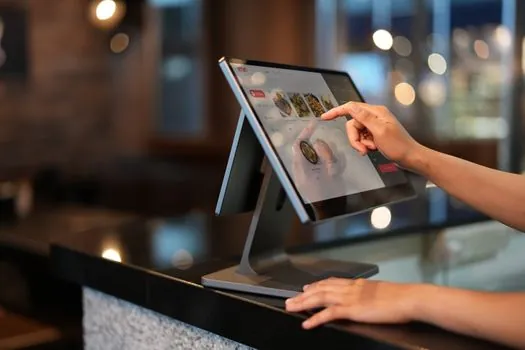
An estimated 72% of new bench scale installations in developed economies in 2025 incorporated some form of digital data output capability, up from 49% in 2019 [S4]. The practical interface list buyers should expect on a 2026 retail-spec bench scale is USB, Bluetooth, RS-232, and Ethernet at minimum, with Wi-Fi appearing on the higher-tier POS-connected units [S1][S4]. RS-232 still rules the back room because it pairs with legacy label printers and scales-management software without driver pain.
Mettler Toledo, named in the market research as the leading global competitor with an estimated 18.3% share in 2025 [S4], builds retail weighing on the same indicator platform that serves industrial lines (the IND360/IND400/IND700 family sits under their industrial catalogue) [S1], which is why an MT retail counter scale can usually share firmware and service tooling with the back-room bench units. For multi-store chains, that commonality matters more than any 0.1 g readability difference between vendor offerings.
Build, environment, and IP rating for retail counters
Retail counters see spills, produce mist, flour, deli washdowns, and occasional impacts, so the platform material and ingress rating are not optional. DSC Balances lists digital, stainless steel, and counting scales as the three common retail-commercial variants, with stainless construction tied to wet and washdown environments [S6]. Stainless 304 platform, IP65 indicator, and a sealed load cell underneath is the minimum credible spec for a deli or fish counter; dry-goods and ship-from-store can usually drop to IP54 and painted mild steel.
Stainless construction also maps onto the food-contact regulatory expectations in the U.S. and EU, which is why manufacturers of meat, cheese, and produce equipment converge on stainless bench platforms rather than aluminium or powder-coated steel. For a single-site shop, this is the one place to spend the extra money; the readability and indicator class matter less than the daily washdown survival. A more detailed overview of washdown-rated equipment in industrial settings lives in the distribution cabinet reference, which covers sealed enclosure spec logic that translates directly to scale selection.
Retail use cases versus who should buy a floor scale instead

Bench scales are the right answer for produce, deli, cheese, coffee, candy, bakery prep, bulk spice, jewelry, and ship-from-store parcel weighing, plus the back-room portioning for grab-and-go [S3][S5]. The Minebea Intec application note explicitly lists retail environments, including general shops and markets selling product by weight, and jewellery counters needing high accuracy, as core bench-scale use cases [S3].
They are the wrong answer for pallet weighing, full drum receiving, livestock, and any single item above roughly 150-300 kg, where a floor platform or pallet jack scale takes over [S5][S7]. Discount Scales' 2026 comparison makes the cut explicit: a scale should match your load size, accuracy requirements, and work environment, and the wrong class will cost you productivity, not just precision [S7]. When a retail operator is weighing 200 kg inbound rice bags at the back door, the correct answer is a low-profile floor scale, not a beefed-up bench unit.
Comparison: digital vs stainless vs counting bench scales for retail
For a retail buyer comparing the three main bench-scale types on the shortlist, the decision grid is short and concrete [S6]:
Digital bench scales (basic): lowest cost, typically 0.01-0.1 kg readability, plastic or painted platform, IP54, suited to dry back-room ship-from-store and basic pricing. Trade-off: not washdown-rated and rarely NTEP Class II.
Stainless bench scales: 304 or 316 stainless platform and housing, IP65-IP69K options, NTEP/OIML approvals common, readability 1-50 g depending on capacity, the default for deli, meat, fish, cheese, and any washdown zone. Trade-off: 1.5-3x the cost of a basic digital unit, and the heavier platform affects portability.
Counting bench scales: dual-resolution load cell plus a parts database for piece-count by weight, used in retail back-room for packaging, hardware, and small electronics kitting. Trade-off: overkill for direct-to-customer pricing, but valuable when a retail operation also does B2B fulfillment [S6].
The decision usually collapses to: stainless + NTEP for the customer-facing counter, basic digital for dry-goods back room, counting scale only if you actually run a piece-count workflow.
Standards, sourcing, and verification checklist

The standards that matter for a retail bench scale are the legal-for-trade ones, not generic ISO quality marks: NTEP Certificate of Conformance (U.S., administered by NCWM), OIML R76 (international, the basis for most non-U.S. approvals), and EC type approval under the Measuring Instruments Directive (MID) for EU sale [S2]. For food-contact zones, FDA food-safe material compliance on the platform and indicator housing is the additional gate, and for any scale used in a washdown area, an IP rating verified against IEC 60529 (not just marketing copy) is the real check.
On the supply side, the global bench scale market was valued at $2.8 billion in 2025 and is projected to reach $4.6 billion by 2034 at a 5.7% CAGR, with Asia Pacific holding an estimated 36.5% share (about $1.02 billion in 2025) [S4]. Industrial applications held 38.2% of revenue and manufacturing end-users 31.4% in 2025 [S4], so the catalog and aftermarket support a retail buyer can pull from is broad and competitive, which is good for pricing leverage. The procurement signal worth tracking is whether the chosen unit ships with a current NTEP or OIML certificate number printed on the nameplate, not just a generic 'legal for trade' sticker. For background on how indicator and controller enclosures are specced for similar industrial environments, the power distribution reference covers the parallel logic. Track the next NCWM publication cycle and any vendor-specific firmware update notices on the chosen indicator family before placing a multi-store order.
For the relevant spec sheets and selection criteria, see bench scale.
This topic is covered further in Needle valve selection for marine service: materials, pressure classes, and seat geometry.