Pulp and paper mills run three distinct balancing problems: high-pressure stock and white-water headers (typically 0.6–1.6 MPa), low-pressure hood-and-building HVAC loops, and the steam/condensate dryer section where the duty swings with grade changes. Across all three, the engineering requirement is the same — hold a target differential pressure (ΔP) under variable flow — but the right valve architecture changes with the medium, the temperature, and the solids loading [S3].
Chinese valve makers now publish PN16 static balancing valves, dynamic flow-control units, and differential-pressure (DP) control valves as stock product lines (e.g. Hebei Huahui's Botou range and the Asiadon export portfolio covering more than 50 model codes across 245–600 series) [S2][S3]. Sizing these correctly for pulp-and-paper duty depends on three numbers: line size, design ΔP, and the cleanliness of the fluid.
Why pulp-and-paper service is a special case
Pulp stock at 3–6% consistency carries fibre, sand, and lime scale that erodes standard throttling plugs. A balancing valve on a stock line must therefore use a hardened seat (Stellite 6 or equivalent) and a flow path that does not trap solids; the Beloit Corp. JPS59110969A design (1983) illustrates the underlying principle still used in modern stock-line valves — a balance piston acted on by the two loop pressures, with a separate regulating piston and a relief line to dump overload [S1]. The lesson for spec writers is that the valve must have an explicit pressure-relief path, not just a throttling element, when one side of the loop is a pulsating pump discharge.
Clean-water loops (hood spray, mill HVAC, machine-room heating) behave more conventionally: here the bottleneck is accuracy, not wear. Static balancing valves with calibrated Cv or Kv index dials (typically 8–16 indexed positions) and a fixed orifice give repeatable commissioning numbers — the technician dials the index, reads the design flow, and locks the bonnet [S3].
Static vs dynamic vs DP-control: which architecture fits which loop
A static balancing valve is a fixed-orifice throttling device commissioned to a single design point; it does not react to load changes. A dynamic balancing valve (often labelled "dynamic flow control valve" or "automatic balancing valve") holds a constant flow over a ΔP window — typically 14–80 kPa for HVAC-grade units, wider windows for industrial dynamic units. A differential-pressure (DP) control valve holds a constant pressure differential across a circuit and is the workhorse for variable-load heating/cooling networks [S3]. For a paper machine's dryer section, where steam flow follows reel speed, DP-control is usually the correct primary control; the static balancing valve is then used only at terminal coils where the load is steady.
The trade-off matrix for spec writers looks like this. Cost: static < dynamic < DP-control (roughly 1× / 2× / 3× at the same size). Commissioning time: static is the longest because each valve is hand-dialled, dynamic is the shortest. Solids tolerance: static (with the right seat) > dynamic > DP-control. Suitability for variable-load headers: DP-control > dynamic > static. The wrong choice — putting a static valve on a variable-load dryer header — is a common rework cause: the valve is either fully open or fully closed, and the loop never stabilises.
Material and pressure-class selection
For white-water and clear-water loops, ductile-iron bodies (ASTM A536 65-45-12) with EPDM seats and 304 stainless stems are the mainstream PN16 / ANSI 150# build, and they cover the 1.6 MPa working-pressure envelope that dominates paper-mill HVAC and stock dilution water [S2][S3]. For hot stock, black-liquor heater drains, and digester-area service, 316 stainless or carbon-steel WCB bodies are the realistic step up; a full stainless trim is rarely justified unless chloride or pH excursions are documented. For vacuum-side condensate and dryer drainage, the relevant reference is the ball valve and butterfly valve ranges used as upstream isolation — choose the balancing valve so its end connections match whatever isolation is already installed, otherwise the installer will be adapting flanges in the field.
Two practical rules of thumb from the field. First, never install a balancing valve smaller than DN50 on a stock line; the higher velocity accelerates wear, and the index dial on small static valves is too coarse to set accurately below ~1.5 m/s. Second, on the steam side, take the balancing-valve body rating as a hard ceiling: a PN16 valve on a 1.7 MPa saturated-steam line is a one-cycle failure, because the rating is for water service, not steam at temperature.
Instrumentation and commissioning
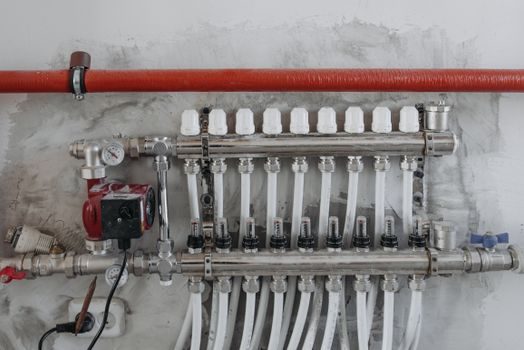
A balancing valve without a measurement port is half a valve. Specify at least one pair of pressure-tee test ports across the valve body so a differential manometer can be connected during commissioning; the Kv (or Cv) index is then read off the manufacturer's chart for the measured ΔP and the design flow. Modern dynamic units go further and carry an integrated flow-sensor with 4-20 mA output, which feeds the control valve trim loop on the same header. For loop isolation during commissioning, plan on a ball valve up- and downstream of every balancing valve — otherwise the technician cannot isolate the static-valve set-point for re-verification at the next outage. [S3]
A real-world pulp-mill pitfall is the check valve on the return side of a closed loop: if the swing-check is undersized, it can chatter and the balancing valve will appear to drift. Confirm the check-valve Cv is at least 1.5× the balancing-valve Cv at the same opening, and inspect the spring rating against the pump's minimum continuous duty point.
Standards, sourcing, and what to verify on the data sheet

Body marking should reference the pressure-class standard (PN16 / ANSI 150#) and the body-material standard. Seat-leakage class for modulating service follows the typical industry convention (Class IV for throttling, Class VI for tight shut-off), and end flanges should match the mill's existing bolt pattern so no adapter rings are needed. The 1980s Beloit pressure-regulating-and-balancing design [S1] and the 1980s US4174726A hot/cold pressure-equalising building-water patent [S4] are still cited as baseline prior art in modern valve-patent families — useful background when a mill engineer is reviewing a new supplier's design rationale.
On the sourcing side, Chinese manufacturers (Hebei Huahui, Asiadon export portfolio, plus broader Cangzhou/Botou cluster) currently list static, dynamic, and DP-control balancing valves in DN50–DN300, PN16/PN25, with ductile-iron or WCB bodies [S2][S3]. When evaluating a new supplier, ask for: (a) hydrostatic test certificate per body rating, (b) seat-leakage test result at the rated class, (c) flow-certification curves for at least three index positions, and (d) material certificates for wetted parts. The supplier's published product family is a good first filter — a vendor with a structured balancing valve range plus a clear dynamic balancing machine QA story is a better long-term partner than a single-model trader. Related coverage of industrial-valve spec discipline and the butterfly valve line is in the Steam Trap Selection: Type-by-Duty Spec Map article, which applies the same PN16 / body-material logic to steam-side hardware.
Trackable next signals: (1) the next outage's balancing-valve Kv re-verification report on at least one stock and one HVAC loop, which is the real test of any installed unit; (2) any pulp-mill upgrade that adds a dynamic flow-control unit to a variable-load hood header — that will validate the dynamic-vs-static decision in operating data, not just on paper.