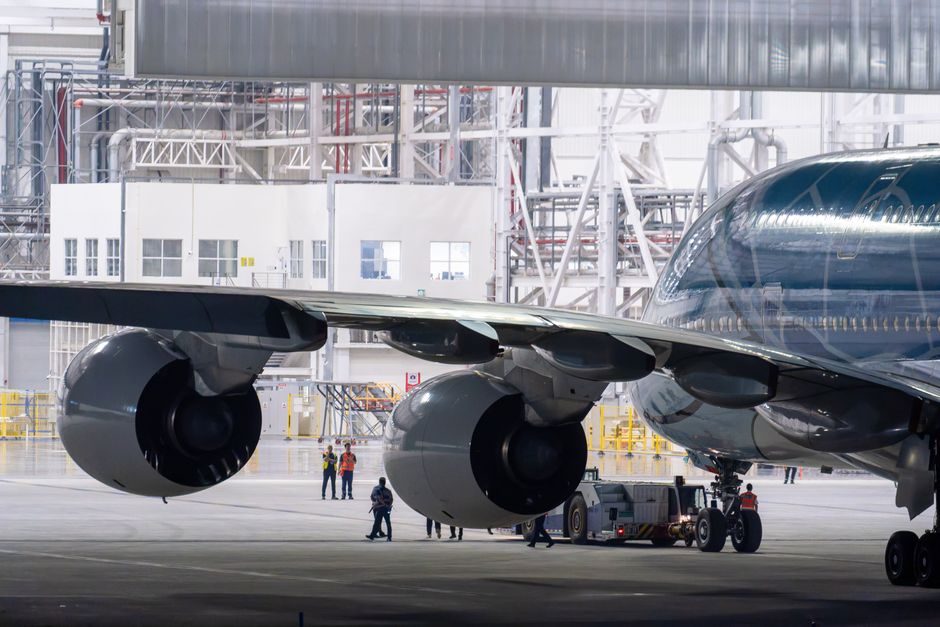
For most aerospace primary structure in 2026, carbon steel in the 0.05-0.30% C (low-carbon / mild) and 0.30-0.60% C (medium-carbon) ranges defined by current mill catalogs [S5] is not the spec-winning material — aluminum alloys, titanium, maraging steels, and carbon-fiber-reinforced polymer carry the strength-to-weight and fatigue arguments.
What carbon steel IS still good for in an aerospace build: non-structural brackets, ground support equipment (GSE) jigs, tooling plates, and shop furniture — applications where 350-600 MPa tensile, easy weldability, and a low per-kg price beat exotic alloys. See the carbon steel grade overview for the band-by-band chemistry, and contrast against the stainless-steel and alloy-steel families that actually fly.
Aerospace Service Envelope vs. Plain-Carbon Capability
Commercial transport airframes operate between roughly -55 °C (ISA tropopause cold soak) and +85 °C skin, with sustained skin temperatures on supersonic and some military platforms pushing 120-160 °C. Plain low-carbon steel in the 0.05-0.30% C band loses Charpy impact toughness sharply below -20 °C and shows a creep knee well below 300 °C, so it cannot serve skin or primary structure on any modern aerospace platform [S5].
For a useful aerospace-grade comparison, the stainless-steel 17-4 PH / 15-5 PH family holds 1100-1300 MPa UTS after H900 ageing, with usable toughness at -50 °C — that is why landing-gear sub-components, actuator rods, and fasteners move to PH stainless, maraging 250/300, or titanium 6Al-4V rather than A36/1018/1045 plain-carbon. The alloy-steel 4340 (40CrNiMoA) is the workhorse at ~1240 MPa UTS in the HRC 36-40 condition, still widely used for landing-gear forgings, but it is an alloy steel, not a plain carbon.
Grade-by-Grade Comparison for Aerospace Adjacent Hardware
Comparing the four grades that mill catalogs still sell as "carbon steel" against three decision criteria an aerospace buyer actually applies [S5]:
Low-carbon (0.05-0.30% C, e.g. A36 / 1018 / S235JR): 350-450 MPa UTS, excellent weldability, formable, cheapest — fit for GSE trolleys, benching, kitting trays, shop racks. Not for any load-bearing flight part.
Medium-carbon (0.30-0.60% C, e.g. 1045 / S45C / EN8): 570-700 MPa UTS in the Q&T condition, machinable, can be induction-hardened to HRC 55-60 on the surface — fit for jigs, fixture bases, dowel pins, hydraulic-shop adapters. Still not for fatigue-critical flight parts.
High-carbon (0.60-1.0% C, e.g. 1084 / 1095 / SK5): 800-1100 MPa UTS when drawn, springs and blades — used for spring washers, clips, snap rings, cutting blades in the manufacturing line. Spring-tempered wire in this band is what makes shop-side spring elements [S2].
Ultra-high-carbon (1.0-2.1% C, e.g. 1095 / W1 tool stock): wear-resistant, can be hardened to HRC 64-66 — used for punches, dies, form tools, and shop consumables. None of these is a candidate for a primary airframe element.
Where Carbon Steel DOES Earn a Slot in 2026 Aerospace Programs
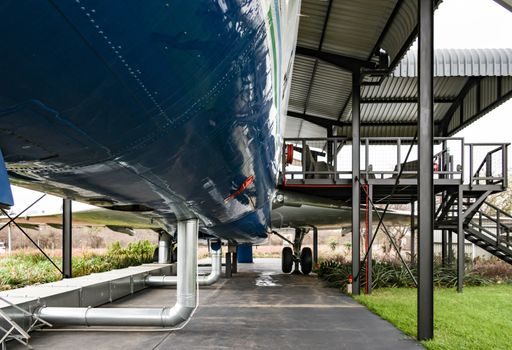
Three aerospace-adjacent use cases still pass a spec review in 2026 with plain-carbon grades [S1][S4][S5]:
Ground Support Equipment (GSE) structures: A36 / S235JR low-carbon plate for towing bars, engine-change dollies, work stands, and shipping cradles. Tensile 400-500 MPa is more than enough for static-loaded tooling, and weldability is a hard requirement for fabrication shops.
Tooling, fixturing, and shop consumables: 1045 medium-carbon induction-hardened for locating pins and bushings; 1095 high-carbon for cutting blades, drill bushings, and shop knives. Tempered spring wire in the 0.7-1.0% C band is a standard consumable for clamps and shop springs [S2].
Surface-treatment media: high-carbon cast steel shot and grit (0.8-1.2% C, hardness 40-65 HRC) for shot-peening and surface prep on aerospace alloys and composites, supplied in standard SAE J444 / J827 grades [S3].
What "Best" Means in 2026 — and What It Does NOT
Define "best" up front or the spec drifts. For a flight-critical aerospace part, "best carbon steel" collapses to a one-line answer: none — use stainless-steel 17-4 PH, 15-5 PH, maraging 250/300, 4340 alloy steel, titanium 6Al-4V, or carbon-fiber composite, depending on the load case. [S1]
For a non-flight, ground-shop, or manufacturing-tool application, "best" resolves to A36 / 1018 for welded structures, 1045 for wear-resistant pins, and 1095 for blades and springs. Mill stock in those grades is widely available with EN 10025 / ASTM A36 / AISI-SAE certifications and traceability [S4][S5].
The buyer who specifies "carbon steel" on an aerospace PR without naming the sub-band (low / medium / high) and the heat-treat condition (HR, CR, Q&T, normalised, spheroidised) forces a back-and-forth on every RFQ. Lock the chemistry and condition up front, against ASTM A29, A36, A108, A510, EN 10025, or JIS G4051 as applicable [S1][S5].
Standards, Certification, and Mill Traceability
Aerospace buyers demand mill test reports (MTR / EN 10204 3.1) with every heat, plus — for any flight part — PPAP, AS9100D / AS13100 controlled processing, and where applicable NADCAP special-process approval. For a non-flight carbon-steel buy (GSE, tooling), the minimum is a 3.1 MTR with C / Mn / S / P / Si and tensile / elongation / Charpy where the standard calls for it [S4].
Two certifications to keep on the wall when qualifying a carbon-steel source: ISO 9001:2015 minimum, and AS9100D if the part touches an aircraft — even a tooling plate that lives on a flight line should be AS9100-traceable in 2026 [S4].
For pipe, fitting, and flange components in test-rig or hydraulic-shop skids, ASME B16.5 / B16.9 / B16.11 with ASTM A105 (carbon) and A350 LF2 (low-temp carbon) cover most static-pressure aerospace ground systems [S6].
Limits, Failure Modes, and What to Reject
Three concrete reject-criteria in 2026 for any carbon-steel offer in an aerospace context: [S2]
Quenched-and-tempered low-carbon plate offered as a "high-strength" alternative to 4340 or maraging: hardness above HRC 30 in a plain-carbon matrix is almost always a sign of a miss-heat, and you will get H₂-embrittlement or stress-corrosion-cracking in service. Reject the heat, not just the lot.
Uncoated plain carbon supplied for any outdoor or hangar-deck duty: the 0.05-0.30% C band has no meaningful atmospheric-corrosion resistance; insist on hot-dip galvanising to ASTM A123, zinc-rich primer, or a paint system to MIL-PRF-23236.
Hardness-critical parts with no through-hardness guarantee: induction-hardened 1045 only has the case (typically 0.5-2.5 mm). For through-section hardness you need a quenched-and-tempered 4140 / 4340 alloy or a tool steel, not a plain-carbon grade.
Trackable signals to watch: AS9100D revision updates and any tightening of "special-process" coverage that may push more tooling into formal NADCAP scope; and the continued substitution of shot-peening media into finer SAE J444 grades as surface-treatment specs tighten on composite skins [S3].
For related coverage, see Belt Conveyor Suppliers 2026: China OEM Cluster, UK Integrators, Spec-Buying Levers.