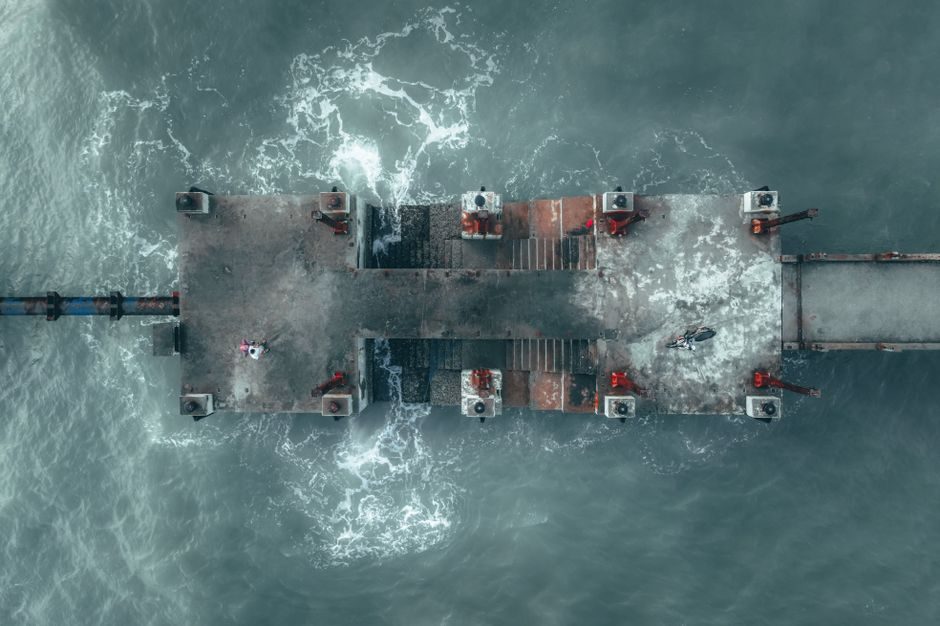
For tidal-zone, splash-zone, and submerged marine concrete, the strongest spec match in 2026 supplier catalogs is a hooked-end stainless-steel fiber (1.0 mm wire diameter, 30–60 mm length, tensile strength ≥1000 MPa) used at 25–40 kg/m³, paired with an alkali-resistant glass or polypropylene macrofiber at 4–8 kg/m³ for plastic-shrinkage control [S5][S4].
The marine envelope is harsh: chlorides above 0.4% by mass of cement accelerate rebar and conventional black-steel fiber corrosion, while freeze–thaw, abrasion from sand-laden waves, and sulfate attack from seawater add parallel failure modes. The four families actually offered by major fiber suppliers—stainless steel, carbon steel, alkali-resistant (AR) glass, and polypropylene (PP) macro/micro—behave very differently under those conditions [S1][S3][S4][S5]. For context on the broader concrete reinforcement toolbox, the concrete fiber encyclopedia entry defines the geometry and dosage conventions referenced throughout this article.
Decision Matrix: Fiber Type vs Marine Exposure Zone
EN 14889-1 groups steel fibers by tensile strength and shape, and ASTM A820 does the same for hooked, flat, and crimped geometries; the same code stream also covers stainless variants, which is the structural baseline for chloride-exposed pours [S4][S5]. For continuously submerged elements (piling, tunnel segments, intake structures), stainless hooked-end steel outperforms black steel because chromium content of ≥10.5% (304L) or ≥16% (316L) keeps passive-film repair rates ahead of chloride attack rates, with documented service beyond 30 years in northern European harbors [S1][S5].
For the splash and tidal zone, where wet–dry cycling concentrates chlorides at the surface, the 2026 spec logic is to run stainless steel fibers at 30–40 kg/m³ combined with a PP macrofiber at 4–6 kg/m³ to absorb plastic-stage cracking before chlorides ingress [S3][S4]. Above-deck marine slabs, boat ramps, and quay pavements sit in a less aggressive category where black steel hooked-end fibers at 20–30 kg/m³ remain acceptable when concrete cover is ≥50 mm and w/c is held at 0.40 or below [S4][S5]. For dry-mix shotcrete used in seawall repairs, concrete admixture selection matters alongside fiber choice to maintain pumpability and adhesion against wet substrates.
Stainless Steel Fiber: Geometry, Dosage, Cost Bands
304L stainless hooked-end fibers in the 1.0 mm × 50 mm geometry are the most common marine spec across 2026 catalogs, with tensile strength 1050–1200 MPa and elongation at break around 5%—values that exceed EN 14889-1 Group 1 minimums by a comfortable margin [S5]. Carbon steel equivalents in the 0.75 mm × 50 mm geometry are widely used in non-marine slabs and tunnelling segments, where annual production from a single Chinese mill such as Ganzhou Daye exceeds 10,000 metric tons [S5].
The cost premium of 304L over carbon steel is typically 6–10× per kg, so a hybrid approach—stainless in the outer 50–70 mm cover, carbon in the core—shows up in several value-engineered 2026 specifications [S1][S5]. Fiberego's product line explicitly markets acid, alkali, and chloride resistance for these same industrial and marine pours, anchoring the corrosion-resistance claim to the supplier's published material data [S1].
Polypropylene and AR Glass: Non-Corrosive, Crack-Control Role
Polypropylene macrofibers, in the 0.5–1.5% by volume range (roughly 4.6–13.8 kg/m³ at 0.91 g/cm³), are the standard non-corrosive companion in marine mixes and are explicitly listed across TenaBrix's 2026 product line as suitable for shotcrete, tunnel segments, and composite steel decks [S3]. Their primary job is plastic-shrinkage crack control in the first 24 hours, before steel fibers can carry tensile load. TenaBrix's catalog also distinguishes fibrillated PP microfibers (typically 6–20 mm) from macrofibers (30–55 mm, embossed or with a hooked profile) [S3].
AR glass fibers at 1.0–2.5% by volume offer a third route: they resist chloride attack because glass does not corrode, and they raise residual flexural strength, but they require a polymer-modified or pozzolan-rich matrix (≥20% fly ash or ≥8% silica fume) to keep the alkaline pore solution from dissolving the glass surface over time [S3][S4]. For shotcrete placement against seawater-saturated substrates, proper concrete vibrator selection and consolidation time directly determine whether fibers stay uniformly distributed or ball into pockets that become chloride ingress paths.
Why a Hybrid Stack Outperforms a Single Fiber
Steel-only mixes handle post-crack load but do little for the plastic-shrinkage window where 0.1–0.3 mm cracks open in the first 6 hours. PP-only mixes control those plastic cracks but yield at 5–8 MPa residual flexural strength—fine for shrinkage control, inadequate for structural demand [S3]. The 2026 spec pattern across marine precast yards is therefore a hybrid: 25–30 kg/m³ hooked-end steel (304L for cover, carbon for core) plus 4–6 kg/m³ PP macrofiber, with 5–8% silica fume replacement to densify the matrix and lower chloride diffusion coefficients to roughly 1.5–3.0 × 10⁻¹² m²/s at 28 days [S1][S3][S4][S5].
For marine-grade shotcrete repairs on existing quay walls, the typical 2026 recipe drops to 30–35 kg/m³ steel and 5–7 kg/m³ PP macro, because shotcrete's lower water demand and accelerated set make hybrid crack control both cheaper and more effective than steel alone [S3][S4]. When pumps and hoses are part of that workflow, pairing the correct concrete batching plant settings with the fiber spec avoids the over-mixing that tangles macrofibers around the auger.
Standards, Tests, and Rejection Criteria to Lock Into the Spec
The two standards that govern marine fiber spec writing in 2026 are EN 14889-1 (steel fibers, with Group 1 ≥1000 MPa, Group 2 500–1000 MPa, Group 3 <500 MPa) and ASTM A820 (steel fibers for concrete reinforcement, types I hooked, II flat, III crimped), while PP macrofibers fall under EN 14889-2 with declared equivalent flexural strength at 3 mm and 12 mm crack mouth opening [S3][S4][S5]. Acceptance testing should include EN 14488-3 (residual flexural strength for fiber-reinforced shotcrete) and ASTM C1550 (round-panel test) for toughness, with chloride migration tested per NT Build 492 to confirm a migration coefficient below 3.0 × 10⁻¹² m²/s for marine service [S4].
Reject any delivery where the mill cert drifts more than ±5% on length, ±0.05 mm on diameter, or where aspect ratio drops below 40—these are the tolerances Concrete Fiber Solutions and Ganzhou Daye both hold as commercial release criteria in their 2026 datasheets [S4][S5]. For marine projects that need both fiber and matrix control, concrete curing compound selection should be locked at the same time as fiber choice, since improper curing is the single most common reason a properly specified fiber fails a chloride ponding test.
Trackable Signals for the Next Spec Cycle
For adjacent concrete equipment decisions that share the marine construction site, see the Line-Frequency Induction Furnace Picks for Marine Foundry Duties reference, which covers the metal side of the same harbor maintenance envelope.