
An M12 shielded inductive proximity sensor with a 1.5–4 mm rated sensing range, 3-wire PNP normally-open output, 10–30 V DC supply, and IP67 stainless housing covers the majority of HVAC damper-position, fan-status, and condensate-tray feedback loops in air-handling units [S1].
HVAC feedback points only need sub-10 mm detection of ferrous targets such as valve stems, damper cams, and rotating fan shafts, and inductive sensing gives contactless, IP67-sealed switching at price points starting around $8.99 per switch for the LJ12A3-4-Z form factor sold through industrial channels [S2][S4].
What an Inductive Sensor Actually Does in an Air-Handler
An inductive sensor drives a high-frequency oscillator coil on its face; when a metal target enters the field, eddy-current losses damp the oscillator and a threshold circuit flips the solid-state output. Detection range depends on the target: ferrous steel gives the longest range, while aluminum and stainless shorten the range by 20–60% depending on alloy, so a stainless damper cam needs a derated spec [S1][S4].
HVAC feedback duty cycles are slow (under 1 Hz), so the 2 kHz typical switching frequency of an M12 or M18 unit is more than adequate; the dust, condensate, and oil-mist environment is what kills sensors, which is why a PTFE-coated weld-slag-resistant body and IP67 or IP68 sealing are worth specifying on rooftop or mechanical-room jobs [S1].
Sizing the Housing and Range for HVAC Service
Three diameters dominate HVAC cabinets: M8 (3 mm flush range) for tight valve actuators, M12 (4 mm flush range, up to 8 mm non-flush) for damper cams and filter racks, and M18 (5–8 mm flush, 12–18 mm extended) for AHU filter-plenum interlocks and large fan-shaft targets [S1].
Stainless 1.4301 (304) or 1.4404 (316L) barrels survive condensate; nickel-plated brass is the value-line standard but corrodes in coastal or pool-deck air [S6]. Sensing distance is rated on mild steel, so multiply the published figure by 0.4–0.6 for 304 stainless targets and 0.3–0.5 for aluminum damper blades to avoid end-of-travel miss-fires [S1][S4].
Electrical Output, Wiring, and 120 V AC Retrofits
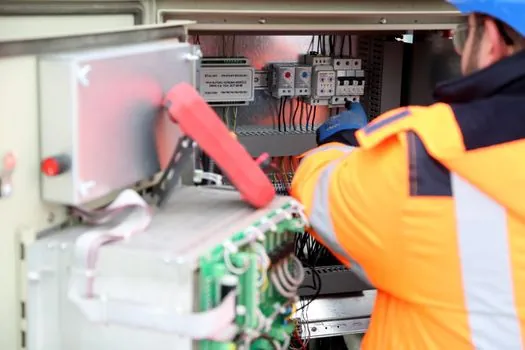
New HVAC control panels (BACnet/IP, modern DDC) use 24 V DC and read PNP sourcing or NPN sinking inputs, so a 10–30 V DC, 3-wire PNP NO sensor drops straight into a standard binary input [S1]. Retrofits on legacy electromechanical panels often run 120 V AC, and dedicated AC 2-wire proximity switches in standard or extended-range, shielded or unshielded bodies are stocked for that exact duty [S7].
Where multiple damper feedback points converge, a capacitive sensor sometimes replaces the inductive part when the target is plastic or fiber-reinforced composite, but for the typical metal cam or valve stem, an M12 PNP NO device at $8.99–$14.49 is the cost ceiling [S2]. For applications that also need valve-spindle travel beyond the 4–8 mm inductive sweet spot, a displacement sensor such as an LVDT gives continuous position rather than a single trip threshold [S1].
Comparing the Main HVAC-Ready Form Factors
For an HVAC-controls engineer choosing among the four common form factors, the practical comparison is: M8 (3 mm flush, IP67, 0.6–1.6 mm sensing) suits compact valve actuators where space is at a premium; M12 (4 mm flush, 8 mm non-flush, up to 8 kHz, IP67/IP68, stainless body) is the workhorse for damper feedback and is also stocked with high-pressure 200 bar (2900 psi) ratings for hot-water and chilled-water valve packages [S1].
M18 standard (5–8 mm flush, 12 mm non-flush, IP67) covers general rooftop AHU filter status; M18 extended range (12–18 mm, 120 V AC option) is the right pick when the target sits behind an insulating panel or insulation wrap [S1][S7]. Pricing on Amazon's current best-sellers list shows the LJ12A3-4-Z at $8.99 (4 mm, PNP NO, DC 6–36 V) and the SN04-N at $14.49 for a 4-pack, both rated for industrial 24 V DC panels [S2].
Manufacturer Tier and Sourcing Realities

The April 2026 manufacturer roundup names Balluff, IFM, Pepperl+Fuchs, Sick, and Turck as the European engineering tier, with Omron, Autonics, and the AutomationDirect ProSense line covering the U.S. value-engineered tier; AutomationDirect's catalog explicitly lists Contrinex, Koyo, and Micro Detectors alongside its own ProSense performance and AchieVe value lines [S3][S1].
For spec-driven jobs that require MTTF data, IO-Link diagnostics, or factor-1 constant-range behavior across ferrous and non-ferrous metals, the engineering tier is the right pull, with factor-1 sensors providing a constant sensing range without adjustment on all ferrous and non-ferrous metals [S1]. For commodity damper-position feedback where the BMS just needs a binary input, the Amazon-tier M12 is functionally adequate at one-tenth the unit cost, as long as the installer verifies IP rating and cable gland [S2].
Failure Modes and What Specs Actually Matter
The four real failure modes on HVAC jobs are: (1) target material derating (a 304 SS cam reads 40–60% of the rated range, so a 4 mm-rated sensor only fires at 1.6–2.4 mm in practice), (2) flush-mounting an extended-range sensor in a steel bracket and clipping the range to near zero, (3) NPN vs. PNP mismatch with the controller's binary-input polarity, and (4) cable gland failure letting condensate wick into the housing [S1][S4].
The 18 mm extended-range shielded units on AutomationDirect's catalog page are explicitly aimed at users who need more reach without a non-flush (protruding) nose, and the same page documents that flush-mounted sensors are embeddable (flush with mounting surface) while semi- and non-flush sensors allow longer sensing distances, with their sensing face required to protrude from or beyond the mounting surface [S1]. High-temperature 230°C-rated bodies, weld-slag PTFE coatings, and metal-chip-immune variants are overkill for an office AHU but worth specifying for plant-floor boiler rooms and welding-shop supply fans [S1].
Safety, IO-Link, and What to Verify Before Purchase

Fail-safe inductive sensors work with safety relays to trigger a safe state (such as stopping a machine) if the sensor fails, reducing the risk of injury to personnel or damage to equipment, which is the right architecture for any damper or fan feedback point that feeds a fire/smoke sequence [S1]. IO-Link versions of the same M12 and M18 bodies expose diagnostic, performance, and configuration data over a point-to-point digital channel, useful on larger BMS retrofits where the controls contractor wants remote health status from the sensor face [S1].
Before pulling the trigger, the installer should confirm: housing diameter and thread (M8/M12/M18), flush vs. non-flush mounting, output type (PNP NO most common for DC; 2-wire AC for 120 V legacy panels), rated sensing distance with a 1 mm margin to the target travel, IP67 or IP68 rating for wet duty, and whether the application calls for marine HVAC-grade stainless or a standard nickel-plated brass body [S1][S6]. A practical next node is the AutomationDirect catalog page for the 3–18 mm tubular and block-style sensors, where the application engineer can filter by diameter, output, IO-Link, and harsh-duty rating before requesting a quote, paired with a hard look at the U.S. controls-tier value-line pricing on the Amazon best-sellers list for comparison budgeting [S1][S2].
Background reading: Combustible Gas Detector Sizing and Selection: LEL, Sensor, and Placement Map.
