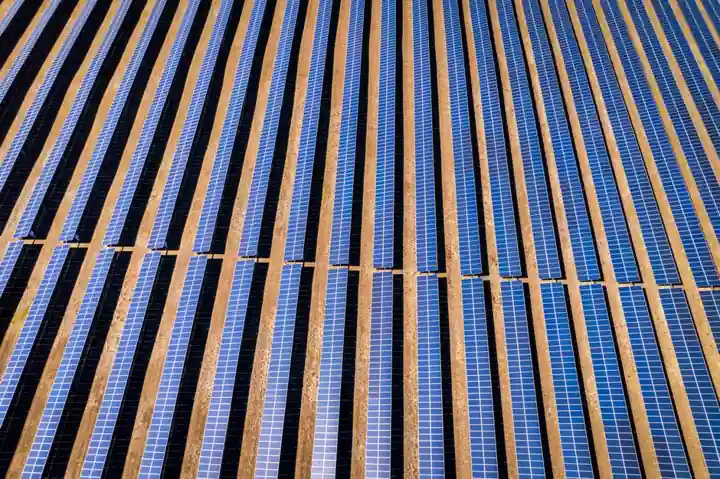
For utility-scale ground-mount solar, bifacial PV modules captured the dominant share of newly installed capacity in 2026, with market models placing the technology on a trajectory from 5% of installed power in 2017 to roughly 90% by 2033 [S5]. Most major module makers now ship at least one bifacial design as a stock SKU rather than a specialty line, and dual-glass bifacial construction alone accounted for 57.4% of 2026 module shipments by type [S1].
Engineers sizing a new plant should treat bifacial as the baseline and monofacial as the deviation. The technology produces incremental energy from the rear face via direct, diffuse, and ground-reflected irradiance, with reported bifacial gain ranging from 5% to over 20% depending on site conditions, and 8-15% being the typical band for utility-scale ground mounts [S4]. The procurement question in 2026 is no longer whether to specify bifacial, but which cell architecture, frame, and glass stack to lock into the bill of materials.
What 2026 shipment data actually shows
Three independent sizing sources converge on a single story: bifacial is no longer a niche SKU. Future Market Insights values the 2026 global bifacial solar module market at USD 220.37 billion with a 9.20% CAGR through 2036, and pegs 2 mm glass as the leading thickness at 41.6% share [S1]. Fortune Business Insights sizes the same year at USD 34.78 billion growing toward USD 65.69 billion, while DataM Intelligence reports a 2025 base of USD 9.65 billion scaling to USD 22.16 billion by 2033 at 11.85% CAGR [S2][S3]. The order-of-magnitude gap between FMI and the other two sources reflects different scope definitions (panel-level revenue versus full system value), not a contradiction in unit share.
By cell technology, monocrystalline and PERC remain the volume baseline, while TOPCon and heterojunction are the two architectures gaining the most share in 2026. By panel type, dual-glass construction dominates at 57.4% of 2026 module shipments, with framed products still ahead of frameless in most utility-scale procurements [S1][S3]. By power class, modules above 400 W now anchor most utility bids, and the residential segment is the slowest to convert because small rooftops cannot exploit the rear-side gain the way ground-mount arrays can.
Bifacial gain: the 8-15% working range
Bifacial gain, the percentage uplift in energy yield versus a monofacial module under identical conditions, is a function of ground albedo, mounting height, tilt, azimuth, row spacing, and rear-side shading from racking and wiring [S4][S5]. Reported real-world values span 5% to over 20%, with 8-15% being the band that most utility-scale designers plan against when writing performance estimates [S4].
Albedo is the single biggest variable: dry light-brown grass reflects more than deep-green grass, fresh snow pushes the upper end, and dark soil or bitumen pulls it down. Mounting height matters because the rear face needs an unobstructed view of the ground, and row spacing matters because inter-row shading on the rear face is just as punishing as front-face shading. Good weather data sets carry hourly step albedo so that snow days in cold climates get the higher rear-side contribution they actually produce, rather than a flat average [S5].
Decision criteria: when bifacial pays, and when it does not

Bifacial modules are the right call when the project has high ground albedo, fixed-tilt or single-axis tracking mounting that lifts modules well above the surface, and enough row spacing to keep rear-face shading low. Under those conditions the 8-15% energy uplift pays back the small cost premium within a few years of operation [S4][S5].
They are the wrong call when the array sits on dark roofing, when the roof tilt is shallow, when there is no realistic way to add rear-side clearance, or when the BoS cost premium cannot be amortized across a small nameplate. In those cases, monofacial modules remain the cost-correct answer, and the specifier should resist the temptation to bid bifacial just because it appears on a supplier's standard price list. The frame choice also matters: framed products are easier to handle and install but cast a small rear-face shadow, while frameless designs open the rear face but demand careful clamping and edge protection.
Cell technology comparison: PERC, TOPCon, HJT
For a 2026 utility-scale bid, the meaningful comparison is between three cell architectures. PERC is the legacy baseline: cheapest per watt, well-understood supply chain, and the architecture most of the existing fleet runs on. TOPCon is the mainstream 2026 upgrade, with higher bifaciality factor and a small efficiency lift over PERC at modest incremental cost. Heterojunction (HJT) delivers the highest bifaciality and the best temperature coefficient, but commands a clear price premium and needs tighter supply-chain qualification. [S4]
For most 2026 ground-mount utility-scale work, TOPCon is the default write-in: it preserves PERC-style processing maturity while opening the rear-side gain envelope. HJT is specified where land area is constrained, where hot-climate temperature coefficients bite hard, or where the developer is willing to pay a 5-10% module premium for a longer-term degradation curve. PERC remains the right answer when the bid is won on cents per watt and the site conditions only support modest bifacial gain anyway. The same logic that drives the bifacial share of installed power from 5% in 2017 to roughly 90% by 2033 [S5] is the logic pushing the cell-level mix toward TOPCon and HJT within that bifacial envelope.
Standards, sourcing, and the procurement checklist

Bifacial module procurement in 2026 is specification-driven, not commodity-driven. Buyers weight lifecycle cost models over upfront unit pricing, and supplier shortlists now require compliance certifications, vertical-integration evidence, and certified test reports as gate qualifiers [S1]. The fastest-growing regional markets are China at 12.40%, India at 11.50%, Germany at 10.60%, France at 9.70%, the UK at 8.70%, the USA at 7.80%, and Brazil at 6.90%, reflecting both greenfield utility build-out and the policy environments shaping it [S1].
Key players consolidating around these requirements include LONGi Green Energy Technology, 3Sun, Boviet Solar, Canadian Solar, First Solar, Hanwha Q CELLS, and JA Solar Technology, with M&A activity targeting complementary capabilities in glass, frames, and cell production rather than greenfield capacity alone [S1]. For specification work, the engineering deliverables that should travel with every 2026 bid include the bifaciality factor (typically 0.7-0.9 for PERC, 0.8-0.85 for TOPCon, and 0.85-0.95 for HJT), the temperature coefficient in %/C, the annual degradation curve, the mechanical load rating, and the IEC 61215 plus IEC 61730 certifications. For tracking systems, the same encoder feedback chain discipline that keeps row spacing consistent under wind load is the kind of BoS spec a bifacial project cannot afford to leave ambiguous.
Failure modes and limits engineers should price in
Bifacial modules are not a drop-in upgrade. They are sensitive to soiling on the rear face, where dust accumulation degrades gain in a way that front-face cleaning schedules will not catch, and they are more sensitive to row-to-row shading than monofacial modules because any obstruction on the rear face reduces a contribution that the rest of the plant design depends on [S4][S5]. They also carry a small BoS cost premium for taller racking and additional clearance, and they need clipping and grounding details that differ from monofacial layouts.
Edge cases worth flagging: bifacial performance estimates built on a single annual albedo value undercount winter snow contributions and overcount summer low-albedo periods, which biases the energy model [S5]. Sub-array mismatch is amplified on the rear side, so module-level power electronics or string-level optimizers earn their keep faster on a bifacial plant than on a monofacial one. And the rear-face PID (potential-induced degradation) pathway is not the same as the front-face pathway, so the PID mitigation strategy for the inverter and the grounding layout needs to be reviewed against the bifacial datasheet, not the monofacial one.
Signals to track over the next two quarters
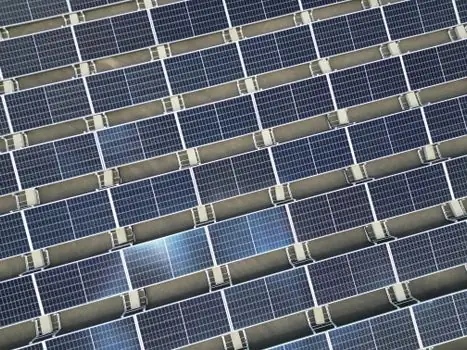
Two datapoints are worth watching as 2026 closes out. First, the IEA's 5,457-7,203 GW global solar capacity projection for 2030, in which bifacial technology is flagged as a meaningful contributor to the higher end of that range, will be revised in the next IEA Solar PV roadmap cycle [S3]. Second, the bifacial cell market is reported to be on track to reach 60% of global market share by 2029, with nearly every module provider now shipping at least one bifacial design, which sets a hard floor under the technology's procurement status in 2027 utility-scale bids [S6]. Watch TOPCon capacity utilization and HJT line commissioning announcements as the leading indicator of how quickly that 60% line gets pulled forward.
For procurement teams, the next-node spec to lock is the cell architecture: decide between PERC, TOPCon, and HJT based on the site's measured albedo, the developer's cents-per-watt ceiling, and the temperature coefficient the local climate actually requires. The bifacial decision is already made; the architecture decision is the one that still has real engineering content in it.
Component reference pages worth checking: relay module, and wireless module.
See also our earlier report, BeCu vs Phosphor Bronze Connector Strip: Spec, Cost, Supply.