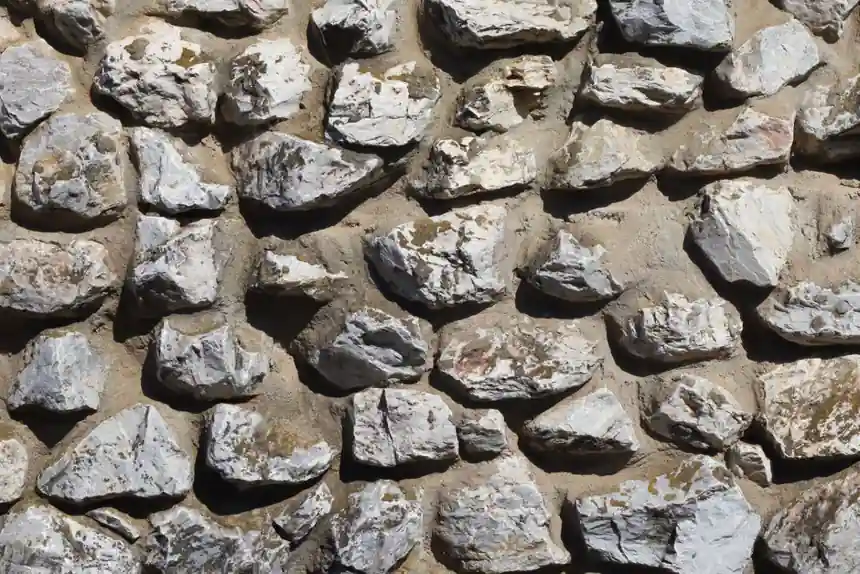
Granite, limestone, sandstone, and slate are the four natural stones most frequently specified for residential structural and cladding applications, with each family's mechanical and weathering behaviour mapped to a specific wall, floor, or foundation role [S2][S5].
For load-bearing residential walls, builders consistently use full-bed thickness building stone averaging 3 to 5 inches (75 to 125 mm), while non-structural faces use thin adhered veneer measured in square feet [S1]. Selecting between the two starts with whether the stone is part of the wall's gravity-load path or only its weather envelope.
Full-Bed Stone vs. Thin Veneer: How the Two Residential Formats Differ
Full-bed building stone averages 3 to 5 inches (75 to 125 mm) in thickness and is laid as a structural or semi-structural wythe in the wall assembly, so the wall's dead load and lateral stability depend directly on the stone's compressive strength and the bond pattern [S1]. Common residential formats in this class include squares-and-rectangles, split face, tumbled, weatheredge, and ledgerock, with limestone, granite, and sandstone blends accounting for the majority of stocked SKUs at typical North American suppliers [S1].
Thin veneer, by contrast, is a non-structural cladding typically under 1.5 inches (about 38 mm) thick, sold by the square foot for flats and by the linear foot for corners, and it relies on a substrate (CMU, wood sheathing, or a metal lath and scratch-coat system) to carry all structural loads [S1]. For most single-family residential projects, the spec question is not "stone versus no stone" but "which assembly the stone is bonded to," because that decision sets the tie spacing, drainage plane, and code path under the local masonry standard.
Decision Criteria: The Five Numbers That Drive Residential Stone Choice
Five measurable parameters separate a workable residential stone from one that fails within a decade: compressive strength, water absorption, density, modulus of rupture, and abrasion resistance [S5]. Granite's compressive strength sits at the top of the natural-stone range and its low water absorption makes it the default for foundation courses, steps, and high-traffic paving around a home [S3][S5].
Limestone and sandstone are easier to cut and shape on site, which is why they dominate the residential full-bed walls and fireplace surrounds sold by regional quarriers, but their higher water absorption means they need sealing for long-term exterior use in freeze-thaw climates [S5]. Marble is frequently specified for interior foyers, bathroom walls, and staircases, where the polished finish and unique veining are the selling point; the trade-off is that polished marble is slippery when wet and prone to acid etching, so exterior polished marble is a poor match for pool decks or wet-climate entryways [S5].
Quartzite occupies a middle ground: harder than limestone, more UV- and heat-resistant than sandstone, and frequently used for outdoor BBQ patios, walkways, and accent walls, with a price premium over standard sandstone [S3]. Slate's cleavage planes give it a natural cleft surface that is slip-resistant and dimensionally stable, which is why it appears in nearly every supplier's flagstone and stepping-stone catalog for residential garden paths [S2][S4].
Comparison Table: Four Primary Residential Stone Families
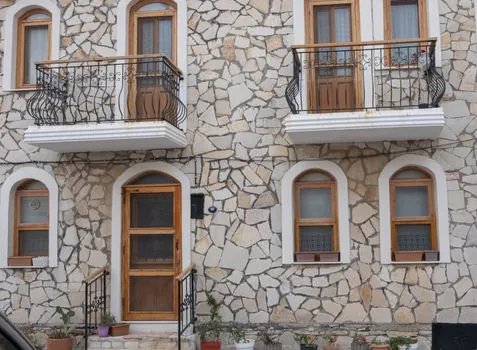
When sourcing for a single-family home, the choice is usually between granite, limestone, sandstone, and slate. The table below lines them up against the four criteria that most often determine a spec: compressive strength, water absorption, typical residential application, and installation complexity [S3][S5].
Granite rates highest on compressive strength and lowest on water absorption, which makes it the preferred material for foundations, exterior steps, and kitchen counters; the cost is weight and the need for skilled labour to cut and polish [S3][S5]. Limestone and sandstone score well on workability and cost, which is why they are the workhorses of full-bed residential walls and chimney cladding, but both need sealing in freeze-thaw exposure [S5]. Slate's slip resistance and natural cleavage make it the default for outdoor paving and pool surrounds, while marble is reserved almost exclusively for interior decorative work because of its acid sensitivity and polished-surface slipperiness [S2][S5]. For tooling context on cutting and finishing heavier residential stone, see construction tools and equipment and the stone, brick, and pipe hardware reference.
Use Cases by Residential Assembly
For a residential foundation and structural landscape wall, the dominant specification is full-bed limestone or granite at 3 to 5 inches, laid in a squares-and-rectangles or split-face pattern and bedded in mortar [S1]. For exterior cladding on a wood-framed home, the cost-effective assembly is thin adhered stone veneer over a drained WRB, with metal lath and a scratch coat where the substrate is open-stud [S1].
For a residential fireplace surround and chimney, limestone and sandstone are the typical choice because they tolerate the thermal cycling at the firebox opening and are easy to shape on site for the mantel and lintel transitions [S3][S5]. For patios, walkways, and pool decks, bluestone (a dense sandstone) and slate flagstone dominate, with granite specified where freeze-thaw cycling and de-icing salt exposure are severe [S4][S5]. Driveway cobbles and armour stone are typically granite or dense basalt, sold by the pallet or by the piece, and used as a heavy edging or accent rather than a continuous surface [S1][S4].
Limitations and Failure Modes Specifiers Should Catch Early

The three failure modes that most often show up in residential stonework are freeze-thaw spalling on absorbent stone, acid etching on limestone and marble, and salt damage on the wrong stone-family at the driveway transition [S5]. Limestone's low resistance to acids means that rainwater run-off from concrete coping or acid-cleaning of nearby masonry will etch the face over time; sealing and diverting run-off away from the stone are the standard mitigations [S5].
Sandstone's grainy surface is durable but variable: low-density sandstone absorbs more water and can spall in freeze-thaw cycles, so sourcing from a quarry that publishes absorption and density data, rather than buying on colour alone, is the safer spec path [S5]. Granite does not need sealing or polishing, which makes it a low-maintenance choice for exterior residential applications, but its weight means the foundation and any lintels supporting it must be sized for the additional dead load [S3][S5]. Polished marble and polished granite, while attractive, become slippery when wet, so a honed or textured finish is the safer spec for any residential floor that will see rain or pool water [S5].
Sourcing, Standards, and the Residential Supply Chain
Most residential building stone is sold through regional quarriers and landscape-yards that publish a blend name, a colour family, and the format (full bed, thin veneer, flagstone, or cut stone paver) rather than a single set of ASTM test results [S1][S4]. Specifiers who need test data for a code submittal should request the quarry's current absorption, density, and modulus-of-rupture values and confirm compliance with the locally adopted masonry standard, which in most of North America ties to ASTM C568 (limestone), C615 (granite), C616 (sandstone), or C629 (slate).
Beyond the structural stones, the residential supply chain also stocks basalt, laterite, gneiss, quartzite, trap stone, and a long tail of regional stones, used mostly for landscape accents, cobbles, and armour stone rather than the structural wall [S5]. For a residential project where the spec is performance-led rather than brand-led, the practical path is to pick the stone family on the dominant local climate and the wall assembly, then confirm the quarry's current test data and the format (full bed vs. thin veneer) before issuing a purchase order. For comparison context on the heavy-equipment and hardware side of residential stone installation, see the construction-machinery and equipment reference and the stone, brick, and pipe hardware catalog.
The next trackable signal is the autumn 2026 regional quarry price sheet: absorption and density values for full-bed limestone and sandstone blends, plus the format inventory for thin-vener corners at the dominant North American suppliers. The second signal is any update to the locally adopted ASTM C568 / C615 / C616 / C629 reference year, which is what most residential code submittals are tied to in the United States and Canada.
Related analysis: Taper Bush Selection for Textile Mills: Series, Material, and Drive-Side Specs.