For industrial facilities, building stone is no longer just cladding: it is a load-bearing, weather-exposed, chemical-resistant material that must meet documented compressive, porosity, and dimensional thresholds before the first pallet is unloaded.
Five rock families dominate the spec sheet: granite (igneous), limestone and sandstone (sedimentary), marble and slate (metamorphic). Each carries a different mineralogy, hardness, and porosity profile, and each interacts differently with plant effluents, freeze-thaw cycles, and oil splash, so the shortlist narrows fast once the service environment is fixed [S2].
What Counts as "Building Stone" for a Plant Envelope
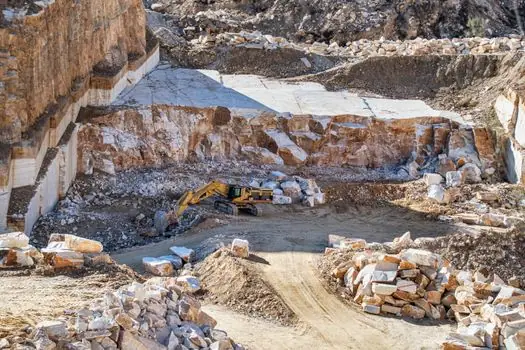
Building stone for industrial use is any naturally occurring quarried rock processed into load-bearing blocks, ashlar, or thin panels for walls, foundations, cladding, kerbs, and chemical-resistant lining. Only a small share of the earth's crust qualifies: quarry blocks must be solid enough to yield competent slabs, free of veins, microfractures, or mineralogical bands that would compromise structural integrity [S2]. Average quarry blocks run 15-20 tons and are sawn into slabs 0.5-4 inches thick before diamond-cut finishing [S2].
For post-1950s industrial buildings, the dominant format is a thin stone veneer (typically under 3 inches) anchored to a steel or concrete frame rather than the 6-inch-plus load-bearing masonry of pre-1900s construction. This shift moved the design responsibility from the mason to the engineer and geologist, who now run formal qualification testing on absorption, density, and strength before a stone is signed off [S2]. Industrial buyers should treat that qualification dossier as a contract deliverable, not paperwork. A formal building stone spec for a chemical plant, food processing line, or powerhouse envelope will list rock type, origin, finish, dimensional tolerance, absorption, and finishing standard in one document so the inspector can verify it on delivery.
Selection Criteria: The Four Numbers That Decide
Four measurable properties do almost all of the selection work in industrial-grade stone procurement. Compressive strength, the single most cited threshold, should fall between 60 and 200 N/mm² for any structural or load-bearing application; stone outside that band is either too soft for plant floors or uneconomical to cut [S4]. Water absorption must stay at 10% or lower, because stone that soaks up too much water will start to fail in cold, freezing weather, regardless of how dense or strong it appears on the spec sheet [S4].
Specific gravity is the second shortlist filter: a stronger, denser stone clusters in the 2.4-2.8 range, and material below 2.4 tends to underperform on abrasion and chemical resistance in service [S4]. Hardness on the Mohs scale is the third gate, with sandstone registering 6-7 and granite sitting higher; below 6, stone begins to mark under forklift and pallet-jack traffic typical of warehousing and production halls [S4]. Toughness, the fourth metric, is measured by impact test, and an index of 13 or higher is the typical plant-grade target for stones that will see vibration, mechanical impact, or crane swing loads [S4]. The take-away for any spec-first buyer: a single page quoting all four numbers with the test method is worth more than ten pages of supplier marketing.
Stone Type vs Industrial Service: A Criteria Comparison
Granite is the workhorse for high-traffic industrial floors, stair treads, and external kerbs thanks to its low porosity and high hardness, and it is the right call anywhere forklift traffic is expected [S1][S5]. Limestone, with its lower density and higher absorption, remains a practical choice for non-load-bearing cladding where modern sealants handle porosity, but it is the wrong call for acid splash zones without a protective treatment regime [S1][S4]. Marble's elegance makes it a frequent choice for administrative facades and interior lobby walls, but its lower toughness rules it out for production-floor or chemical-area cladding [S5].
Sandstone (Mohs 6-7) and travertine split the middle: travertine's strong mortar adhesion and weather resistance suit external facades, while sandstone's hardness and water-absorption profile (when ≤10%) make it a reliable choice for boundary walls, foundations, and landscape kerbing in plant yards [S4][S5]. Slate, the fifth common type, brings cleavage-plane versatility to roofing and external paving, but its anisotropic behaviour under impact means it is rarely the right call for high-load structural work [S2]. A practical rule of thumb: granite for floors and kerbs, sandstone or treated limestone for cladding, marble for interiors only, travertine for facades, slate for roofing and paving.
Environmental and Chemical Exposure: Where the Wrong Stone Fails
Environmental exposure is the dominant failure mode in plant service, and stone behaviour under that exposure is highly rock-type dependent. Climate, weather, and atmospheric pollutants all interact with porosity: high-absorption stone (above 10%) will fail in freeze-thaw zones within a few winters, and will stain or pit under acid rain even in temperate climates [S1][S4]. Limestone tolerates heat well, but its fire-resistance advantage disappears if moisture is allowed to soften the matrix, so any limestone spec for a boiler-house or furnace-adjacent wall must include a moisture-control detail [S4].
Quartz-rich stone, by contrast, loses its fire resistance rapidly under heat, and is a poor choice for any zone with sustained high-temperature exposure [S4]. Porosity and chemical reactivity are the joint gating factors in chemical-plant envelopes, and they are exactly why the industrial adhesive used to anchor stone veneer to a plant frame must be cross-checked against both the stone's absorption class and the chemical splash risk, otherwise the bond fails before the stone does. A defensible industrial spec for building stone will always pair the rock type, finish, absorption, and a defined chemical-exposure class in the same line, so the installer cannot substitute a more porous stone into a chemical-zone wall.
Quality Grading, Dimensional Tolerances, and Sourcing
Quality grading on the export market typically splits into three bands: Grade A (uniform colour, minimal defects, suitable for premium architectural and corporate-facade work), Grade B (economical with acceptable defects), and Export Grade (the highest standard in processing and finish) [S5]. For an industrial facility, Grade A is rarely necessary outside the visitor-facing envelope; Grade B or Export Grade is the cost-effective sweet spot for plant buildings, warehouses, and boundary walls. Processing and finishing quality are the second quality gate: precise cutting to standard dimensions, uniform thickness, smooth and even polishing, and clean edges without chipping separate a usable industrial pallet from a reject load [S5].
Dimensional tolerance is non-negotiable for machine-laid industrial walls. Commercial sawn-and-split cladding, for example, is often supplied to ±15 mm face tolerance on a 100 mm nominal bed depth, with module lengths 225/325/425 mm, and a course height of 65/140/215 mm, allowing 10 mm nominal joints and predictable coverage around 4-4.5 m² per bulk bag for non-coursed product [S3]. Bulk palletised thin-ledge stone for lighter industrial cladding typically runs 1-5 inch face height, 1.5-2.25 inch bed depth, 8-20 inch length, at 2200 lb (1.10 tons) per pallet covering roughly 100 sq ft, which gives the site team a verifiable yardstick for delivery acceptance [S6]. Machine-cut stone for tropical and equatorial industrial sites, where uniform block dimensions speed laying, is increasingly supplied to a tight 1-2 mm tolerance, with the supplier providing quarry traceability for every batch [S7].
Limitations and Failure Modes Industrial Specs Must Address
Building stone's biggest limitation is not strength, it is variability. Natural stone is anisotropic, direction-dependent, and never identical batch to batch, so the inspector must reject pallets with visible cracks, weak veins, rust stains, or salt deposits, all of which predict early failure in service [S5]. A second limitation is the seasoning window: many quarried stones retain internal moisture (loosely called sap) and need six to twelve months of rest before they are dimensionally stable enough to lay, and stone laid "green" will shrink and crack within the first heating season [S4].
A third limitation is finish-to-substrate compatibility. Rainscreen, hand-set, and stone-on-precast cladding systems each demand a different bedding detail, and the wrong anchor choice for a thin-veneer panel (under 3 inches) on a tall industrial facade is the single most common cause of stone fall incidents in plant envelope audits [S2][S3]. For any process building where vibration, washdown, or chemical splash is routine, the spec should also require impact-test documentation alongside compressive-strength data, because compressive strength alone does not predict behaviour under a dropped tool or a forklift nudge [S4][S5].
Standards, Sourcing Discipline, and the 2026 Procurement Checklist
The governing test framework for North American building stone is the ASTM durability suite for limestone and sandstone, which sets the published thresholds for absorption, density, and abrasion resistance used in the 60-200 N/mm² compressive band quoted above [S4]. European specifiers should require CE-marked stone with declared performance under EN 771-6 (natural stone masonry units) and a quarry-of-origin declaration for every batch, since stone from different beds of the same quarry can carry measurably different mechanical properties [S2]. A 2026 procurement checklist for industrial facilities should include, at minimum: rock type and origin, ASTM or EN test reports on compressive strength, absorption, specific gravity, and Mohs hardness, declared finish and face tolerance, pallet weight and coverage, quarry seasoning record, and a written chemical-exposure compatibility note for the intended service zone [S4][S5][S6].
Trackable signals for the next procurement cycle: bulk bag coverage tolerance (currently 4-4.5 m² per bag for non-coursed Forest Pennant sandstone, used as a benchmark), Export-Grade finishing availability per supplier, and lead time on made-to-order sawn-and-split cladding (the UK market now quotes this on a per-order basis, not from stock) [S3]. Process engineers specifying stone for new industrial builds in 2026 should also weigh engineered stone and porcelain alternatives only where the chemical-exposure data is equally well documented, not on aesthetics alone.
Spec-level background on the components involved: building pipe hardware.
Related analysis: Perimeter Alarm System Selection for Chemical Plants: Spec-First Map.