
Random Polypropylene (PPR, Type 3) pipe operates continuously at 70°C and 1.0 MPa with a published design life of 50+ years, and at 20°C its service life exceeds 100 years [S3]. For data center mechanical rooms distributing secondary chilled water, condenser water, and facility hot-water makeup, those service-life numbers align with the 15-25 year refresh cycles common in white-space retrofits.
The material density of 0.90 g/cm³, roughly 1/9 the weight of steel, and a thermal conductivity of 0.21 W/m·K, about 1/200 of steel, reduce both structural dead load on raised mechanical floors and standby heat gain into cold loops [S3]. Standard pressure classes available off the shelf are PN 10, PN 16, PN 20, and PN 25 (1.0, 1.6, 2.0, 2.5 MPa) in OD sizes from 16 mm to 160 mm, joined by socket fusion, electrofusion, or transition fittings [S1][S2].
Material baseline: what "PPR" actually means on a data center PO
PPR is Polypropylene Random Copolymer, produced by random copolymerization of propylene with 1-4% ethylene, which gives the resin its long-term hydrostatic strength and impact balance [S3]. The Minimum Required Strength (MRS) classification for pressure-rated PPR is 12.5 MPa, marketed as PPR 125, and this is the figure that drives the PN 10/16/20/25 wall-thickness series [S3].
Wall-thickness mapping from manufacturer data sheets is consistent across suppliers: at OD 110 mm, PN 10 wall is 10.0 mm, PN 16 is 12.3 mm, PN 20 is 15.1 mm, PN 25 is 18.3 mm; at OD 63 mm, PN 10/16/20/25 walls are 5.8 / 7.1 / 8.6 / 10.5 mm respectively [S1][S2][S4]. A specifying engineer should treat the supplier matrix as canonical, not a generic PPR table, because some catalogs list 75 mm PN 10 at 6.8 mm while others list 6.9 mm, a 0.1 mm variance that is real on small-bore fittings.
Operating envelope vs. data center fluid temperatures
Maximum sustained working temperature for PPR is 70°C with a maximum transient of 95°C, and the Vicat softening point is 131.5°C [S3]. Data center secondary chilled-water loops typically run 6-12°C supply / 12-18°C return; condenser-water loops run 25-35°C; and hot-water makeup for CRAC reheat or humidification rarely exceeds 60°C.
That puts every common data center hydronic loop well inside the long-term 70°C envelope, so derating for temperature is not the binding constraint. The binding constraint is pressure: at 63 mm OD, PN 16 (1.6 MPa) is the right class for 4-6 bar pump heads typical of chilled-water risers, while PN 20 (2.0 MPa) or PN 25 (2.5 MPa) is the conservative pick for high-rise mechanical risers or close-coupled pump-discharge runs [S2][S4].
Comparison: PPR vs. the realistic alternatives in a white-space pipe schedule
For open-loop hydronic service inside the data center envelope, the realistic alternatives are PPR, chlorinated PVC (CPVC), cross-linked polyethylene (PEX-A), and stainless steel 304/316. PPR is heavier-walled than PEX but does not require a heat-rework manifold and is not oxygen-permeable like PE-X without an EVOH barrier. [S3]
Against CPVC, PPR carries a higher maximum sustained temperature (70°C vs. ~93°C CPVC), but for cold-side data center work, both sit comfortably below their thermal limits. Against stainless steel 304, PPR thermal conductivity is roughly 1/200 that of steel, which directly cuts standby heat gain in cold loops and reduces insulation thickness on the same U-value target. Against stainless steel 316, PPR loses on maximum temperature and on UV tolerance, but wins on installed cost per meter for non-exposed mechanical-room pipe.
The decision criteria most often weighted in hyperscale builds are: 1) working pressure class matched to pump head, 2) operating temperature margin, 3) corrosion resistance to glycol-treated water and biocide, 4) fusion-joint integrity versus mechanical coupling, 5) installed cost per linear meter. PPR scores well on criteria 3, 4, and 5, and is acceptable on criteria 1 and 2 for any loop kept under 70°C.
Jointing, fittings, and what to put on the isometric
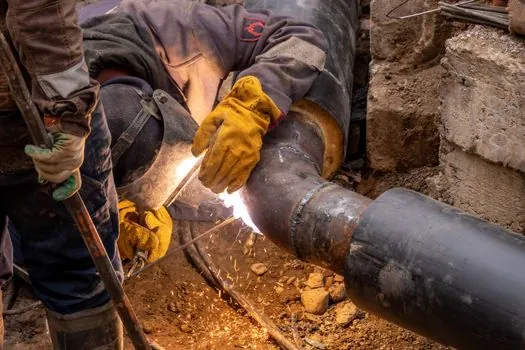
PPR is joined by socket fusion, electrofusion, or flanged transition, and the same resin is used for fittings, so a heat-fused joint is a homogeneous material joint rather than a mechanical seal [S1][S2]. On the isometric, that means the engineer can treat each weld as a lifetime joint, which removes the rework access footprint that threaded steel joints need.
Standard fittings carry PN 25 ratings across elbow, tee, reducer, and valve-port geometries [S4]. For data center work, the most common detail is a flanged transition at the equipment boundary (chiller, CDU, pump) so the OEM can isolate the asset, and socket-fused PPR everywhere else in the mechanical room. Avoid specifying PPR in exposed outdoor runs without UV-protective paint or conduit; the resin is not UV-stable in its natural grey or white form.
Standards, certifications, and what to demand on the MTR

The governing product standards for pressure-rated PPR pipe are ISO 15874 (international), DIN 8077/8078 (Germany), and GB/T 18742 (China), and the resin is typically third-party certified to NSF/ANSI 14 and FDA 21 CFR 177.1520 for potable contact [S3]. For European data center builds, BS 6920 WRAS approval is also commonly listed on the MTR for hot- and cold-water service [S2].
Factory quality systems to require on the data sheet: ISO 9001 for production, ISO 14001 for environmental management, and OHSAS 18001 (or ISO 45001) for occupational health and safety [S1]. The supplier MTR should report the MRS 12.5 MPa classification, the exact pressure class (PN 10/16/20/25), the OD and wall thickness to one decimal place, and the standard of manufacture; do not accept a "PPR pipe" line item without those four fields.
Failure modes and limits the spec must address
PPR's published failure mode in long-term hydrostatic service is creep rupture at elevated temperature and stress, with the 50-year design point at 70°C / 1.0 MPa baked into the MRS 12.5 MPa rating [S3]. In practice, this means the spec should derate working pressure as operating temperature rises, and any loop that could see 80-90°C transients (e.g., a steam-side preheat line) should not be PPR.
Other failure modes the data center spec should explicitly call out: UV degradation on outdoor runs, oxidative degradation in high-chloramine or high-free-chlorine water, and mechanical damage from impact during construction. PPR is not rated for fuel-line or compressed-air service, and it is not a fire-sprinkler pipe; do not substitute it into NFPA 13 or NFPA 75 listings.
Where PPR fits, and where it does not

PPR is a strong fit for: secondary chilled-water distribution inside the mechanical room, condenser-water loops kept under 70°C, hot-water makeup to CRAC units, radiant heating for back-up generator rooms, and plumbing risers for the data center admin wing. PPR is not a fit for: the primary chilled-water riser if it carries high-temperature heat-reject loops, fire suppression, fuel or gas service, or any outdoor run left unprotected from UV. [S3]
For a 10 MW hyperscale hall with N+1 chilled-water plants, a sensible pipe schedule is PN 16 PPR for all in-row CDU feeders up to 75 mm OD, PN 20 for the 90-110 mm mechanical-room headers, and PN 25 for the close-coupled pump-discharge nipples. Cross-reference the PPR pipe specification reference for the canonical wall-thickness matrix and the plastic pipe family overview for how PPR compares to PE, PEX, and CPVC in the same pressure class. The full pipe fitting and jointing detail reference covers fusion-joint geometry and the flanged-transition dimensions to expect at equipment boundaries.
Track for the next design cycle: any movement by hyperscale operators to publish an internal PPR standard equivalent to Uptime Institute's Tier-rated mechanical specifications, and any update to ISO 15874-2 that revises the derating curves for glycol-treated chilled water. Adjacent selections worth checking against the same spec-first method are covered in the mold temperature controller sizing and selection map and the plastic pallet spec map for cold chain, both of which use the same PN-class and material-grade discipline.