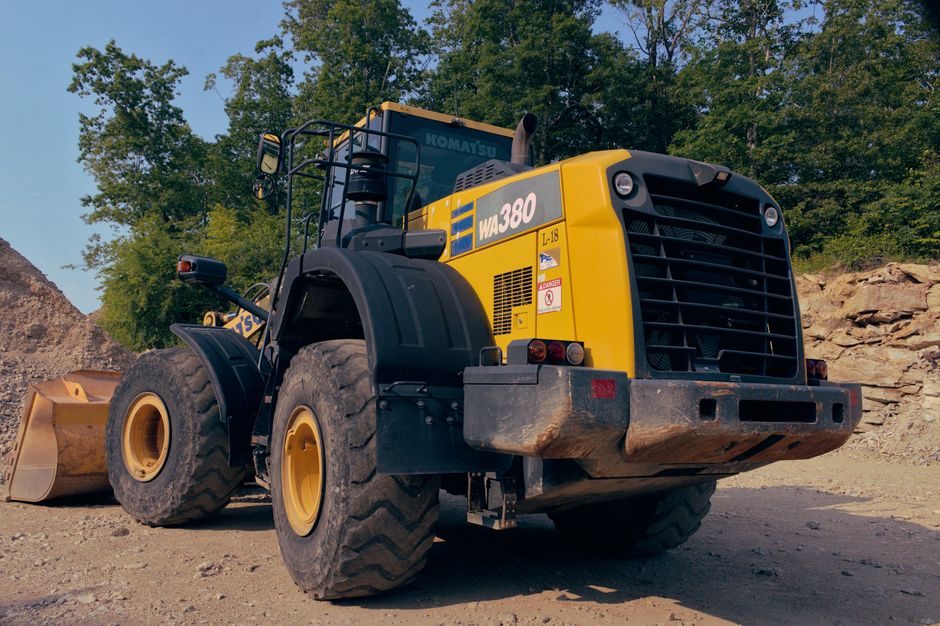
A mining-spec bulldozer in 2026 is almost always drawn from a narrow envelope: operating weight 30–60 t, engine output ≥ 400 HP, and a blade sized to the haul-truck dipper pass the dozer feeds [S3]. Buyers who anchor on those three numbers first, then layer cycle-time and ground-pressure constraints, eliminate roughly two-thirds of the catalog before reading a single brochure.
The class is split between crawler (tracked) dozers — the workhorse of bench building, ripping, and overburden pushing — and wheel dozers, which dominate long-haul road maintenance because tracked machines chew up rubber-tired truck rolling-resistance gains. Crawler units span roughly 10,000 lb utility machines to over 300,000 lb mining-class rigs, with the largest series-built unit being the Komatsu D575A-3 Super Dozer [S5][S6]. The procurement question is therefore not "which brand" but "which sub-class and which ground-pressure window."
Selection Criteria: Engine Power, Operating Weight, Blade Capacity
Engine power and operating weight are the two specifications that gate every other decision in a mining spec: bulldozers below 400 HP cannot sustain production-rate ripping in hard overburden, and machines outside the 30–60 t band either over-compact the bench or fail to anchor a coal-seam floor [S3]. Blade capacity is matched to the excavator or mining dump truck bucket pass: a semi-U or full-U blade in the 10–25 m³ range is the typical match for 100–400 t-class haul units [S3][S4].
For ripping and stripping on thin-cover deposits, dozing is more cost-effective than excavate-and-haul because the push distance is short; this is the use case where crawler dozers pull ahead of wheel dozers on TCO despite higher undercarriage wear [S4]. The procurement gate, in concrete terms: define the bench material UCS (kPa), push distance (m), and target production (m³/h), and the spec falls out of the OEM match-program.
Crawler Dozer vs. Wheel Dozer: When Each Wins
Crawler dozers win on ground pressure, drawbar pull, and ripping capability: tracked machines distribute 30–60 t across a track contact area that yields ground pressures in the 0.5–1.0 bar band, which is the only way to hold a blade load on soft floor without sinkage [S7]. Wheel dozers — the 350 HP class (XCMG DL350) and 560 HP class (XCMG DL560) are listed reference points at FOB $310,000–$350,000 for the 350 HP unit — win on speed, mobility, and haul-road maintenance, where a wheeled machine can sustain 15–25 km/h roadwork cycles that a tracked unit cannot match [S1].
Three decision criteria line the options up cleanly. <strong>Ground condition:</strong> crawler for soft floor, ripped rock, or muddy bench; wheel for graded hardpan. <strong>Primary task:</strong> crawler for stripping, ripping, and bench build; wheel for haul-road grading and dump-pad maintenance. <strong>Mobility vs. push:</strong> crawler wins drawbar pull per ton; wheel wins cycle time on the road network.
Total Cost of Ownership: Undercarriage, Fuel, and Match-Spec Discipline
Purchase price is the entry fee, not the cost. Undercarriage — tracks, rollers, idlers, and sprockets — is the single largest maintenance line on a mining crawler dozer, typically 30–50% of lifetime service cost over 10,000–15,000 hour service life; fuel scales roughly linearly with engine displacement, so a 560 HP wheel dozer burns close to 1.6× the fuel of a 350 HP unit at matched load factor [S5][S1].
The procurement discipline that prevents cost overruns: lock undercarriage spec to ground condition (heavy-duty sealed-and-lubricated track for abrasive rock, standard for coal and soft ore); specify ROPS/FOPS cab and fire suppression to site standard; and confirm parts commonality with existing fleet. Several mining spec guides also flag that bulldozer selection is a fleet decision — a single rogue model class doubles spares inventory.
Blade Types and Application Match
Three blade geometries carry roughly 90% of mining dozer work. <strong>Straight (S) blade:</strong> low-capacity, high-impact, used for fine grading and stockpile work. <strong>Semi-Universal (SU):</strong> the most common mining blade, mid-capacity, good penetration on stockpiles and light ripping. <strong>Full-U (FU):</strong> highest capacity, used for long-push overburden moves where the side wings retain load; blade capacities in the 10–25 m³ range match 100–400 t haul-truck pass volumes [S3].
Coal-seam floor protection and waste-dump spreading are the two applications where blade geometry choice directly affects production: an FU blade on a coal floor cuts and contaminates the seam, so SU is specified there even at the cost of push efficiency.
Open-Pit and Strip-Mining Use Cases
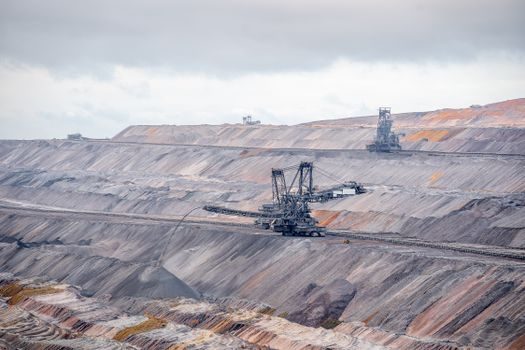
In open-pit mining the dozer's role is preparatory earthmoving that defines safe bench geometry and maintains the haul ramp conditions that control truck cycle times across the operation [S4]. Specific functions: primary overburden stripping on thin-cover deposits where pushing beats excavate-and-haul on unit cost; bench levelling to create excavator working platforms; haul road maintenance because road condition directly affects truck rolling resistance and therefore fuel burn per tonne-kilometer.
For dragline-assisted stripping on gently dipping coal seams, the dozer fleet is sized to support the dragline pad and spoil side, not to compete with dragline productivity on bulk overburden — a hybrid opencast/underground operation typically runs crawler dozers in the 40–60 t class as dragline support, with the dragline handling bulk stripping per the selection procedure documented in the surface-mining literature [S2].
Standards, Safety, and Specification Discipline
Mining-spec dozers are not generic construction machines: ROPS/FOPS cab structure to ISO 3471 / ISO 3449, fire suppression to site or MSHA-equivalent standard, and on-board machine-health telemetry are baseline. Buyers should also confirm compatibility with the site's dispatch system (Modular Mining / Wenco / Cat MineStar class) before order, since retrofit is painful. [S6]
For coal and oil-sand operations with combustible atmospheres, the procurement team also has to evaluate the engine platform: many underground-adjacent and gassy-surface pits now specify Tier 4 Final / EU Stage V aftercooled diesels with diesel particulate filters, while older Tier 2 units remain serviceable in open pits with verified ventilation. Buyers should note that the same general spec map used for industrial valve selection — define medium, pressure, and standard before model — applies to dozer selection: define ground, push, and production before horsepower.
What to Watch Between Now and the Next Procurement Cycle
Two trackable signals will move the 2026 spec map by year-end. First, the rollout of EU Stage V aftercooled platforms in the 400–560 HP band is reshaping wheel-dozer fuel curves in European and African operations, with XCMG-class Chinese OEMs listed at FOB $310,000–$350,000 for the 350 HP unit as a price benchmark [S1]. Second, autonomous and semi-autonomous dozer kits (Leica, Topcon, and OEM-native) are now reaching mining-spec TRL and will likely show up on 2027 tenders. The procurement discipline to copy from related heavy-equipment specs — for example the concrete admixture selection for prefabricated construction workflow — is the same: lock performance and standard first, then model.