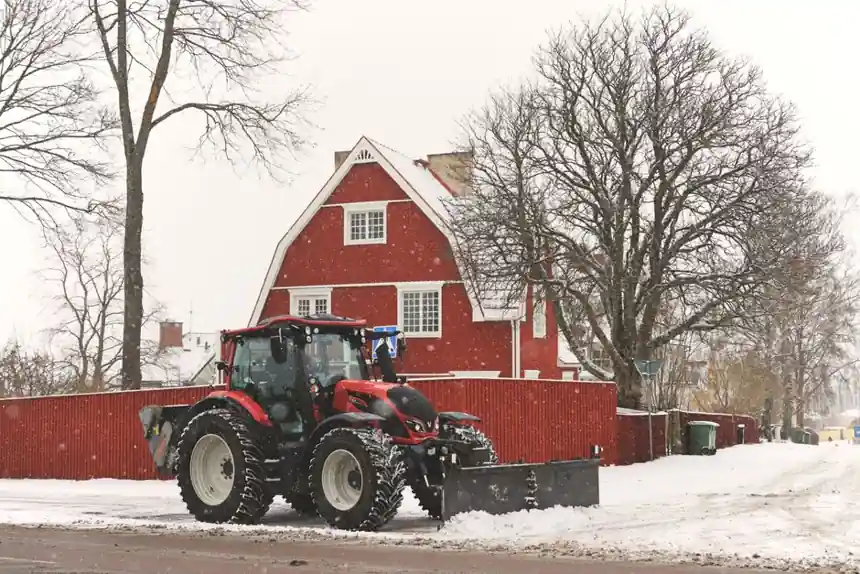
A bulldozer configured for winter work typically pairs a 3.0-4.5 m straight or semi-U blade with a track undercarriage sized for low ground pressure, giving the machine enough mass and tractive effort to push wet, packed snow that stalls wheeled units [S1][S3].
OEM guidance from Caterpillar and Bobcat groups snow attachments into five functional categories, and a standard moldboard, snow wing, V-plow, or straight blade can be specified on a dozer for highway and open-site clearing; in city lots and narrow access drives, compact machines are preferred [S3][S4].
Operating-Weight and Ground-Pressure Bands
For snow duty, a dozer's effective ground pressure is the spec that decides whether it floats on a fresh blanket or cuts into pavement and soft subgrade [S1].
Operating weights for small and mid-size dozers commonly sit in the 13-20 t class, with track shoes in the 510-610 mm range producing ground pressures near 50-55 kPa; larger 30-40 t dozers with 760-910 mm shoes drop to roughly 30-40 kPa, which is the band that protects asphalt and curb lines during repeated passes [S1][S3].
Industry guidance flags surface damage as a primary risk when full-size dozers run on paved lots, and recommends precision blade control and reduced speed at the curb line to limit gouging [S1].
Blade Geometry Choices and Where Each Excels
Caterpillar groups winter blades into four types, and the choice is driven by drift depth, road width, and how far the cleared windrow needs to travel [S3].
For open roads, a 3.5-4.5 m straight moldboard rolls snow cleanly to one side in moderate depths; a V-plow sections the drift and unloads it sideways, which is the standard answer for deep, windrowed snow above 600 mm; snow wings extend a 1.2-1.8 m folding panel to push the windrow further off the traveled lane, an arrangement that long-haul road authorities use on highway shoulders [S3]. For confined lots where a 14-20 t dozer is too heavy, a compact track loader running a 1.8-2.4 m snow blade or pusher is the common substitute, and a 3-point snowblower can be added behind a compact tractor where throwing distance matters more than push volume [S4][S5].
Hydraulics, Flow Demand, and Attachment Matching
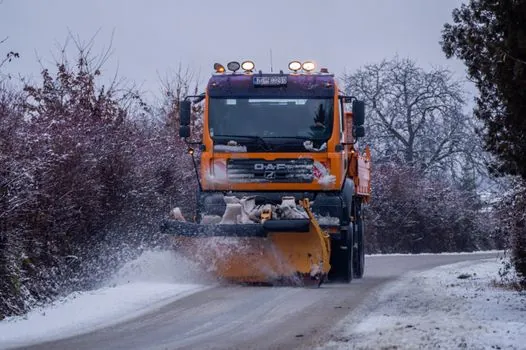
A snow blower on a compact track loader typically demands a high-flow hydraulic circuit, and matching flow to attachment is the most common spec mistake on winter conversions [S5].
Most skid-steer and compact track loader snow blowers specify 23-38 L/min at 180-210 bar, which is the high-flow kit range rather than the standard 14-18 L/min circuit; under-specced flow reduces throw distance and stalls the auger in wet, heavy snow [S5].
Attachment decision also hinges on machine compatibility, and dealers confirm that mounting pattern, hydraulic quick-coupler, and electrical connector must match before the unit is dispatched into the season's first storm [S4][S5].
Wheels vs. Tracks for Snow Substrates
Tracks spread machine weight over a larger contact patch, which is the reason compact track loaders are the default for fresh, unconsolidated snow, while wheeled skid steers stay competitive on packed lots where bite matters more than floatation [S5].
Compact track loaders use rubber belts 300-450 mm wide that produce ground pressures in the 25-40 kPa band, low enough to keep the machine on top of a 200-300 mm fresh layer without rutting; wheeled skid steers concentrate load through four small contact patches, which gives sharper turning on hardpack but causes spin-out in deeper, loose snow [S5].
For crews that already run both platforms, the common operating rule is to assign the tracked unit to drifts above 250 mm and the wheeled unit to cleanup passes and salt-yard work, an arrangement that also spreads engine hours across the fleet [S5].
Cold-Weather Operating Limits and Failure Modes
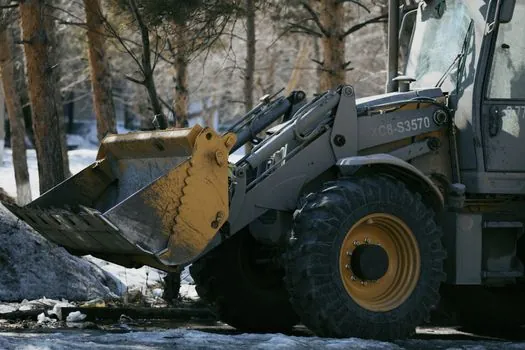
Cold-soak hydraulic fluid, frozen track pins, and reduced battery capacity are the three failure modes that winter operations report most often, and each ties back to a spec that should be set before the unit is deployed [S1][S5].
Diesel cold-start margin typically requires a block heater when ambient drops below about -15 C, and hydraulic reservoirs are commonly switched to an ISO VG 32 low-temp hydraulic oil to keep flow above 15 L/min at -20 C; battery capacity falls roughly 20% at -18 C versus 25 C, so a 1000 CCA minimum is a practical floor for dozers assigned to night shifts in northern latitudes [S1].
Visibility is the other operational ceiling, and the bulldozer cabs used on winter duty are typically specified with heated glass, LED work lights, and rear-view cameras so the operator can keep the blade aligned with curbs and buried obstacles, a configuration that field guides flag as the single largest safety upgrade on a winterized machine [S1][S3].
Selection Criteria and Decision Limits
The decision between a full-size dozer, compact track loader, skid steer, and compact tractor turns on five quantitative criteria, and the table below lines the four main options up against the criteria a fleet manager can score on [S1][S3][S4][S5].
On a 1-5 scale, a 14-20 t dozer scores high on push volume and drift depth but low on surface protection and maneuverability, which is why municipal fleets assign it to arterials and reserve compact track loaders for cul-de-sacs and commercial lots; skid steers and compact tractors cover the lower-volume, tighter-site band where initial cost and attachment flexibility dominate the decision [S3][S4][S5]. A related reference on how a single engine drives multiple hydraulic functions on similar iron is laid out in backhoe loader working principle and hydraulic flow, which shares the same blade-and-spool architecture that a winter-spec dozer relies on.
Standards, Sourcing, and Procurement Signals

Procurement specs for winterized earthmoving equipment reference SAE J1346 for net engine power, ISO 6747 for operator controls, and ISO 6014 for steering, with cold-start and hydraulic-fluid limits negotiated as contract clauses rather than catalog options [S1].
OEM industry pages published through 2025-10 confirm that standard moldboards, snow wings, V-plows, and straight blades remain the four factory-supported blade patterns for snow work, and that 3-point snowblowers, snow blades, buckets, and pushers are the four attachment families covering compact machines [S3][S4][S5].
Track candidate news/backhoe-loader-working-principle-hydraulic-flow-spool-valves-and-one-engine.html signal to watch into Q4 2026: OEM release notes adding electric and hybrid dozer platforms to municipal snow fleets, and any new high-flow hydraulic kit extending snow-blower compatibility to mid-size dozers rather than just compact track loaders [S3][S4][S5].
Spec-level background on the components involved: pressure transmitter, and flow meter.