
Wind blades past 100 m depend on pultruded CFRP spar caps with 50–60% fiber volume fraction, and a single tow-lot failure can paralyse a blade program because the qualified carbon-fiber supply for wind remains tight [S2][S7].
For blades beyond 70 m on 12 MW+ offshore turbines, spar-cap stiffness optimisation is bounded by 15–25% manufacturing-induced property losses, and the pultruded spar cap segment is forecast to grow at a 17.8% CAGR from USD 565 million in 2024 to USD 2144 million in 2031 [S2][S3].
Why Carbon Spar Caps, Not Glass, for Blades Past 100 m
Glass-fiber spar caps lose stiffness-to-weight headroom above 100 m blade length, and excessive tip deflection raises tower-strike risk while accelerating fatigue damage in the root [S2]. CFRP pultruded planks deliver higher specific stiffness at lower laminate thickness, enabling the 81.6 m reference blade used in 7 MW offshore aeroelastic models without proportional mass penalty [S4].
The structural argument is reinforced by a 2020 LCOE study (2020) showing that same-length GFRP and longer-length CFRP spar-cap retrofits both lower levelised cost of energy over a 25-year horizon, with longer CFRP retrofits outperforming GFRP [S9]. Process-wise, pultrusion gives consistent fibre alignment and reproducible fibre volume fraction, so plank-to-plank variability is much lower than for hand-laid or VARTM laminates [S4].
Pultrusion vs Resin-Infusion vs Prepreg: Decision Matrix
Pultruded CFRP planks win on cycle time, scrap rate, and cost per stiffness unit, which is why Vestas patented the architecture in 2007 and Zoltek scaled it for 60 m blades shortly after [S3]. For a side-by-side call against vacuum-infusion and prepreg, the decision criteria are cycle time, fibre-volume consistency, defect sensitivity, and tooling capex.
On cycle time, pultrusion runs continuously, so a single line can keep multiple blade-assembly cells fed; resin infusion is batch-bound and prepreg adds autoclave hours per blade. On fibre-volume consistency, pultruded planks hold 50–60% Vf with low void content; infusion drifts with resin flow and prepreg quality is autoclave-dependent. On defect sensitivity, thick-laminate defect detection limits still constrain stiffness optimisation, with 15–25% manufacturing-induced losses reported across processes [S2]. On tooling capex, pultrusion needs a die and creel room, infusion needs moulds and resin infrastructure, prepreg needs freezers and an autoclave line. LM Wind Power's earlier 88 m hybrid carbon/glass record blade took a resin-infused route, a data point that shows infusion still has a place when length pushes the limits of available pultrusion width [S6].
Supply-Side Risk: Precursor, Tow Lot, and Single-Source Failure

Wind-grade carbon fibre is a tight market, and a single tow lot failing inspection can freeze a blade program until a replacement batch is qualified, which is the second driver behind unbundled procurement strategies [S7]. Resin selection is the second pinch point: vinyl ester remains the dominant pultrusion matrix because it carries tensile load better than epoxy, but polyurethane is gaining traction in Europe for its higher interlaminar shear strength and lower-viscosity, faster reactivity that cuts pultrusion cycle cost [S3].
Logistics risk runs in parallel with chemistry risk. The relevant physical reference is a tapered bottom spar cap of roughly 0.014-in thickness at root falling to 0.007-in at the tip for a representative 3 m hobby-class wing, a tapering pattern scaled up rather than copied in modern utility blades [S5]. At utility scale, every plank still consumes a long, continuous tow run, so a creel break, precursor line trip, or PAN precursor shortage propagates straight into spar-cap delivery dates.
Quality, Defects, and the Detection Gap in Thick Laminates
The known in-service damage modes for pultruded CFRP planks are stress concentration from insufficient inter-plank bonding, voids, manufacturing defects, dielectric breakdown, and lightning flashover damage, each of which can lead to blade loss if unrepaired [S4]. NDT coverage is the weak link: thick-laminate defect detection limits still constrain how aggressively a designer can push stiffness optimisation, and 15–25% manufacturing-induced property losses are routinely observed even on well-controlled pultrusion lines [S2].
That gap matters because the same defect population drives the repair economics covered in the next section. Process control, not just material selection, sets the floor on achievable in-service fatigue life; the broader analogy is the discipline applied to carbon fiber tow spreading and creel tensioning, which directly controls Vf scatter and dry-spot formation. Buyers evaluating pultruded plank suppliers should therefore demand per-lot Vf, porosity, and interlaminar shear data, not just tensile coupons.
Repair Economics: Why Up-Tower CFRP Repair Is Now a Spec Line
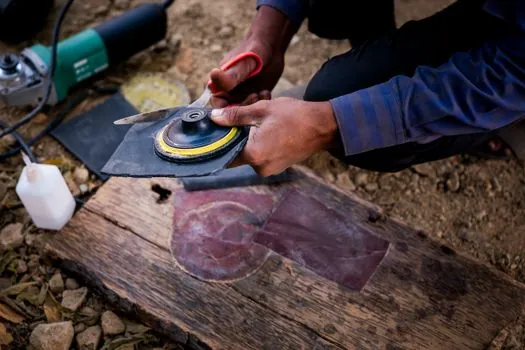
A 7 MW offshore blade with a damaged inboard CFRP plank currently requires removal from the tower, transport, and workshop repair, with the cost dominated by dismantling, transport, and revenue lost during downtime [S4]. Rosemeier et al. (2026) modelled an up-tower repair on an 81.6 m blade and showed that large repair zones can endanger structural stability unless temporary pretensioning and buckling-support structures are installed, with permissible wind speeds for repair work well below normal cut-out [S4].
For spec writers, this is no longer an R&D footnote: aeroelastic simulations now show turbulence-induced strain amplitudes during up-tower repair are manageable, but only with engineered support rigs. Procurement teams should therefore add up-tower repair feasibility, including access for inside-blade support structures, to spar-cap supplier RFQs alongside cycle time and cost data. The same down-tower-versus-up-tower tradeoff shows up in adjacent heavy-equipment decisions, for example the choice of low vs medium vs high carbon steel grades for the temporary support rigs themselves, where weldability and field toughness matter more than ultimate strength.
Sourcing Strategy: Dual-Sourcing, Unbundled Procurement, and Localisation
Three structural moves reduce spar-cap supply risk without redesigning the blade: dual-source pultrusion lines, unbundle the carbon fibre, resin, and pultrusion steps into separate contracts, and qualify a second creel room in a different region [S7]. Each move costs money in qualification testing and tooling duplicates, but the alternative is single-point exposure to a tow-lot failure that halts blade production [S7].
On regional balance, Asia-Pacific is the largest and fastest-growing pultruded spar cap region, while offshore wind is the faster-growing shore type globally, and CFRP is the dominant reinforcement over GFRP and hybrid laminates [S3]. For spec teams running European offshore programs, polyurethane-matrix pultrusion is worth tracking as a second resin pathway alongside the incumbent vinyl ester systems [S3]. Longer term, buyers evaluating a mould line for prototype blades can also review mold base selection for low-volume prototype tooling because the same pultrusion die qualification cycle drives both plank delivery and any coupon-level fatigue validation program.
Track two signals over the next two quarters: any second-source qualification announcement from a major blade OEM for 12 MW+ spar caps, and any peer-reviewed update to up-tower repair permissible wind-speed envelopes for 80+ m blades, which together will tell you whether supply risk is being absorbed at the procurement layer or pushed back into design.
Spec-level background on the components involved: carbon steel, and power supply.