
Carbon fiber sits inside a fiber-reinforced plastic (FRP) market sized at USD 172.20 billion by 2026, growing at a 4.2% CAGR over the 2026–2031 window, with Asia-Pacific retaining both the largest volume and the highest regional growth [S1]. Within that envelope, carbon fiber is the high-performance tier used where the matrix is epoxy or polyester resin — the dominant resin choices in pultrusion, vacuum infusion, filament winding, and compression-molded parts [S1].
The carbon-fiber-resin sub-market was estimated at USD 292.7 million in 2016 and tracked toward USD 532.7 million across the 2016–2021 forecast horizon, framing resin as the smaller but tightly coupled bottleneck to tow and fabric output [S5]. Process engineers evaluating new carbon fiber sourcing should treat PAN precursor, tow size (1K–24K), and sizing chemistry as inseparable from the resin system the laminate is cured against.
Supply chain nodes: precursor, tow, fabric, prepreg, part
The commercial chain runs PAN precursor → oxidation → carbonization → surface treatment/sizing → tow/fabric → prepreg or dry fabric → part, with autoclave, out-of-autoclave (OOA), and resin-transfer molding (RTM) as the conversion branches [S1]. Standard textile designations such as 3K 200 g/m² and 3K 240 g/m² are visible in 2026 Chinese fabric catalogs for architectural panel and motorsport-clas applications, confirming 3K tow continues as the workhorse weight for cosmetic and structural skins [S4].
China remains the upstream node of choice for woven and unidirectional fabrics in the 200–240 g/m² areal-weight band, with Chinese material sources explicitly listed for skateboard, surfboard, decorative wall-panel, and motorsport-clas carbon-fiber parts [S4]. The 4.2% FRP market CAGR through 2031 implies that even non-aerospace tonnage is growing in absolute kiloton terms, which keeps second-tier mills — and not just Toray/Syensqo tier-1 lines — relevant to procurement teams [S1][S2].
Resin system and manufacturing process selection
FRP manufacturing process options catalogued for 2026 sourcing include pultrusion, vacuum infusion, bladder molding, compression molding, thermoplastic extrusion, filament winding, and wet layup — each pairing to a different resin viscosity and fiber architecture [S1]. Epoxy and polyester resins dominate construction, transportation, and electrical/electronics use cases where the carbon-steel alternative is being displaced on a weight-or-corrosion basis [S1].
For high-volume automotive and wind-energy parts, thermoplastic extrusion and compression molding are the routes where cycle time beats autoclave economics, while pultrusion remains the structural-profile backbone for beams, columns, and slabs [S1]. Aerospace and defense still concentrate on prepreg + autoclave, but the wind-energy tier is moving toward dry fabric + infusion to keep pace with blade length growth.
Recycled carbon fiber (rCF) re-enters the matrix
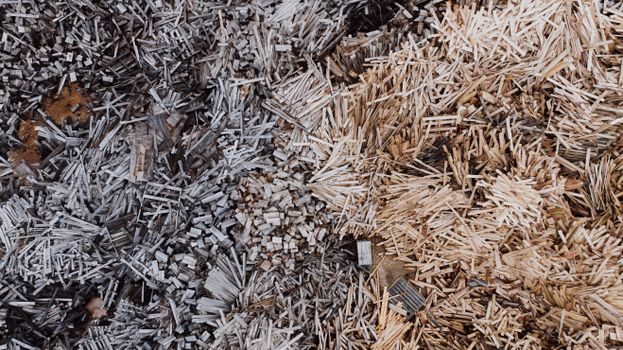
Pyrolysis-derived recycled carbon fiber, dosed at 0.25, 0.5, 0.75, and 1.0 vol.-% in fiber-reinforced concrete, lifted flexural strength by up to 31% versus plain concrete at 0.5 vol.-% loading, with O2 plasma treatment further improving elongation at break [S3]. That experimental result reframes rCF as a functional additive for civil/construction applications rather than a low-grade landfill diversion, which is the typical framing in 2026 supplier messaging [S3].
Pyrolysis is the dominant recovery route, with downstream use in new composites and concrete reinforcement documented in 2018–2019 literature and re-emphasized in 2026 procurement briefs [S3]. Aerospace scrap and end-of-life wind blades are the two largest rCF feedstocks, and the value spread between virgin PAN-based tow and rCF continues to drive recycled-feed interest in non-aerospace tiers.
Decision criteria: virgin tow vs. rCF, by application
For aerospace primary structure, virgin PAN-based carbon fiber remains the only qualified option; rCF is currently scoped to secondary structure, automotive non-safety, wind-energy internals, and concrete reinforcement where certification barriers are lower [S3]. Purity (residual char, surface oxygen content from anodisation), tow length, and modulus (standard vs. intermediate vs. high) are the three decision variables that determine whether rCF can substitute without re-qualification [S3][S6].
Anodisation with and without ultrasound produces different C1s carbon-oxygen ratios, which directly drive fiber-matrix adhesion in epoxy systems [S6]. Sourcing teams that ignore the surface-chemistry step end up with rCF lots that pass tensile screening but fail ILSS or short-beam shear, so the surface-treatment specification belongs in the purchase order, not just the supplier brochure [S6].
2026 industry calendar and procurement signals

Carbon Fiber 2026, presented by CompositesWorld, is scheduled for 10–12 November 2026 in Huntsville, Alabama, with Toray as Gold Sponsor and Syensqo sponsoring the Rayon Replacement pre-conference [S2]. The program scope is explicit: advanced design and automation processes to reduce manufacturing cost, plus the consumption outlook in markets with significant growth potential [S2].
Two trackable signals for the next 90 days are the call-for-papers close and the final sponsor/exhibitor list for Carbon Fiber 2026, both of which disclose which tier-1 lines, recyclers, and automation vendors are putting capital behind 2027 capacity [S2]. FRP demand-side, Asia-Pacific construction and automotive remain the regional growth anchor per the 4.2% CAGR forecast to 2031, so Chinese and Korean fabricators will continue to set the price floor on commodity 3K weaves [S1][S4].
Buyers specifying chain conveyor systems in CFRP-reinforced plants should note that process selection (pultrusion vs. filament winding) drives the laminate layup, and that decision ripples back to the tow and sizing quote — see also this Roller Chain Types and Classifications spec map for adjacent drivetrain context. Specifiers comparing composite-panel suppliers against Fiber Cement Board Price 2026 tier mapping will see the same Asia-Pacific capacity story driving both FRP and cement-board lead times. For a wider view of how upstream nodes feed industrial build-outs, the Vanadium Industry 2026 steel, VRFB storage, and supply map tracks the same Asia-Pacific feedstock pattern into a different downstream.