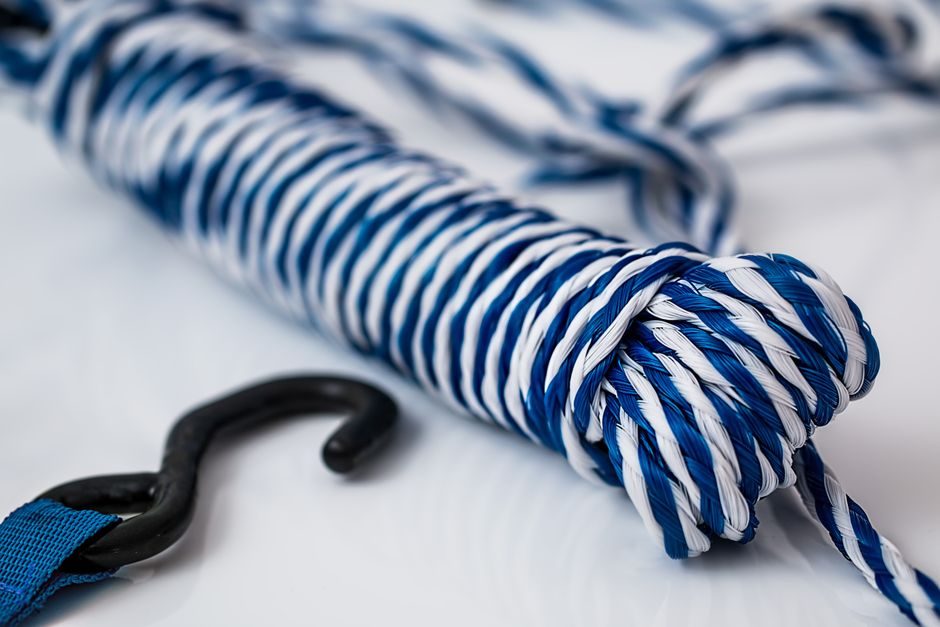
On 2026-06-23 wholesale listings, 1-9 mm high-carbon steel plate stock is quoted at US$450-650 per ton with a 25 t MOQ and ISO certification, while 12.7 mm 7-wire prestressing strand runs at separate per-ton rates against ASTM A416 and EN 10138 compliance [S2][S3].
Steel strand is a multi-wire rope product — typically 2-, 3- or 7-wire constructions spun helically with the same lay direction and lay length — used wherever long-length tensile capacity is needed, from post-tensioned concrete to guy wires and messenger cables [S1][S4]. For a baseline, see the steel strand reference page and the more specialised prestressing strand entry before you read further.
What you are actually buying: constructions, lay, and the 7-wire default
A steel strand is not a single wire — it is 2, 3, 7 (most common), or 19 individual cold-drawn wires helically laid with the same direction and identical lay length, then stress-relieved as a unit [S1]. The 7-wire construction, with six outer wires helically wrapped around a single king wire, dominates prestressed concrete and ground-anchor work; 2- and 3-wire strands are typically reserved for stay cables, small-diameter guy wires, and aluminium-clad steel (ACS) cores [S1][S4].
Common diameters sit at 9.3 mm, 11.0 mm, 12.5 mm, 12.7 mm, 15.2 mm and 15.7 mm — the 12.7 mm (0.5 in) and 15.2 mm (0.6 in) sizes are the workhorses for post-tensioned slab, bridge girder, and wind-turbine tower applications, both per ASTM A416 and EN 10138 [S3]. Helical lay (commonly right-lay) gives strand its characteristic flexibility but also creates a torsional tendency under tension that buyers should remember during anchorage design.
Price band by spec, June 2026
Quoted rates on B2B platforms in mid-2026 cluster in three bands. Bare high-carbon plate / wire-rod feedstock runs US$450-650/t at 25 t MOQ with ISO factory certification [S2]. Hot-rolled special-section C-channel (used in masts, forklifts, and structural fittings) lists at US$1,150-1,600/t at 5 t MOQ with CE / ISO 9001:2015 documentation [S2]. 12.7 mm 7-wire prestressing strand carries its own per-ton pricing, sized to ASTM A416 Grade 1860 (270 ksi) or EN 10138 relaxation-class 2 specifications, with a minimum break load of roughly 184 kN for the 12.7 mm class [S3].
Translated into per-metre terms for budgeting, a 12.7 mm 7-wire strand at ~1.101 kg/m times a mid-band raw-material cost of US$600/t lands near US$0.66/m of strand, with finished, stress-relieved, low-relaxation product typically running 2-3x that figure once drawing, stranding, stabilisation, and PE/HDPE sheathing (for unbonded strand) are added. Always request the per-ton rate, the per-metre rate, and the coil/reel weight together; coil weights for export reels commonly run 2-4 t for bare strand and 1-3 t for sheathed unbonded product.
Standards that move the price tag

Three specifications govern most purchasing decisions. ASTM A416 / A416M covers 7-wire uncoated and epoxy-coated prestressing strand in two strength grades: Grade 1725 (250 ksi) and Grade 1860 (270 ksi), with 12.7 mm and 15.2 mm the canonical diameters. EN 10138 is the European equivalent, harmonising relaxation classes (Class 1 = normal, Class 2 = low, Class 3 = very-low relaxation) and the Y1860S7 / Y1770S7 designation pattern. GB/T 5224 is the Chinese national standard, broadly aligned with A416 on dimensions and minimum breaking load but with its own relaxation testing protocol. [S1]
For unbonded post-tensioning, additional rules apply: ASTM A779 (epoxy-coated) and the ACI 423 / fib Bulletin 7 unbonded tendon guidelines govern grease weight, sheathing thickness (typically 0.5-1.0 mm HDPE over 12.7-15.2 mm strand), and anchorage set. For galvanised bridge stay and messenger-cable duty, ASTM A475 governs zinc coating mass in Class A / B / C weights (Class A ~230 g/m², Class B ~610 g/m² on 7-wire) [S4]. Specifying the wrong standard — for example, ordering A416 strand into a stay-cable application that requires A475 zinc coating class — is the most expensive way to lose a procurement week.
What moves the price: the seven real cost drivers
Raw wire rod is roughly 55-70% of finished strand cost, so the high-carbon steel 82B / SWRH82B feedstock quotation at your mill week is the dominant swing factor. Strength grade is next: Grade 1860 (270 ksi) strand sells at a premium over Grade 1725 (250 ksi) because of higher carbon content and more aggressive stress-relief thermal processing. [S2]
Relaxation class is a real cost item, not a marketing line: low-relaxation Class 2 strand requires stabilising heat treatment at ~400 °C under tension, adding process cost and line time versus normal-relaxation product. Coating is another step — galvanising per ASTM A475 adds zinc mass and process time, while epoxy coating per ASTM A779 adds a fusion-bonded layer and a handling cost. Sheathing for unbonded strand (PE / HDPE / PP / greased) adds material and a second production line. MOQ finally matters: the 25-tonne plate-stock MOQ in the Alibaba listing is a baseline; specialty strand at 1-3 t MOQ typically carries a 10-20% small-lot surcharge [S2].
Comparison: strand type vs decision criteria
Four main strand types line up against four decision criteria for typical buyers. Plain 7-wire prestressing strand (ASTM A416 Grade 1860) is the cheapest at roughly baseline per-ton rates and suits post-tensioned slab, beam, and ground anchor work where corrosion protection comes from grout. Galvanised steel strand is commonly used for messenger wire, guy wire, and as core/strength wire in applications requiring corrosion resistance. Epoxy-coated 7-wire strand (ASTM A779) sits between galvanised and unbonded on cost and is preferred for segmental bridge tendons and any tendon where grout cover is uncertain. [S3]
For real procurement context, the Alloy Steel Buying Guide 2026 explains how mill source and MTC discipline feed upstream into wire-rod quality, and the Stainless Steel Buying Guide 2026 covers the austenitic vs duplex trade-offs that may apply if your project later pivots to stainless strand for highly corrosive environments.
Who this fits, and who it does not
Steel strand is the right call when you need a flexible, high-tensile, long-length tendon with a proven, codified minimum break load — post-tensioned concrete, ground anchors, rock bolts, suspension and stay cables, conveyor belt carcass, prestressed railway sleepers. It is the wrong call for applications needing high axial stiffness (use a solid bar), high corrosion resistance in chloride exposure (consider stainless or CFRP), low elongation under dynamic load (consider wire rope with steel core), or any short-length application where the anchorage cost swamps the strand cost. [S4]
Buyers who do best are procurement engineers who can name the diameter, the strength grade, the relaxation class, the standard, the coating, the reel weight, and the delivery port on the first RFQ; the rest of the cost conversation follows. Specifiers should be wary of generic "PC strand" enquiries — every missing field is a 5-10% pricing fudge room that suppliers will fill whichever way benefits them.
Limitations, failure modes, and what to ask the mill
Stress-corrosion cracking (SCC) and hydrogen embrittlement are the two failure modes that drive the most strand field failures, especially in humid, chloride-rich, or galvanically coupled environments — this is why galvanised, epoxy-coated, and greased sheathed options exist [S4]. Relaxation losses over service life typically sit at 2-3% for low-relaxation Class 2 strand at 70% GUTS initial load, versus 6-8% for normal-relaxation product; the cost premium is amortised back over decades of tendon life.
Reject any shipment without a clear standard designation printed on the coil label; the cost of mis-labelled strand in a post-tensioned slab far exceeds any per-tonne saving.
Sourcing channels and lead-time reality
Three sourcing channels dominate in mid-2026. Chinese mill-direct platforms (Alibaba, Made-in-China) carry the widest spec range and the most aggressive FOB prices, with mill lead times of 15-30 days plus 25-40 days sea transit to most non-Asian ports; Okorder-style B2B hubs aggregate the same mills with slightly slower quoting cycles but bundled logistics [S1][S2][S3]. Regional steel service centres in Europe and North America hold common diameters (12.7 mm and 15.2 mm) in stock for same-week pickup at a 10-25% premium over mill-direct.
For project tonnage above ~200 t, a mill visit or third-party inspection (SGS, BV, TUV) is worth the 0.3-0.8% of contract value — most strand quality disputes trace back to skipped inspection at loading. For smaller spot buys, request a mill test certificate and a recent reference project of comparable tonnage before wiring the deposit.
Cost-control checklist before you issue the PO
Lock the standard (ASTM A416 / EN 10138 / GB/T 5224 / ASTM A475 / ASTM A779), the diameter, the strength grade, the relaxation class, the coating or sheathing, the reel weight, and the delivery incoterm in writing before price comparison. Request per-tonne AND per-metre quotes, with separate line items for raw strand, coating, sheathing, and freight; this is the only way to benchmark like-for-like when mills quote in different units. [S5]
For multi-diameter or multi-strength orders, a single-mill blanket call-off contract typically beats spot buying by 5-12% on average once volume rebates and freight consolidation are factored in.
Two trackable signals to watch through the rest of 2026: high-carbon wire-rod 82B mill offers in Shandong and Hebei, which have been the marginal-price setter for global strand since 2024; and any new ASTM A416 revision activity, since relaxation testing and zinc-coating compatibility rules have been under periodic review. For related procurement context, the Storage Rack Price & Cost Guide 2026 covers downstream tonnage-driven steel buying in a different application class.
For component-level specifications, see linear guide.