
Specifying steel fiber in 2026 is no longer a single-line "dose 30 kg/m³" entry on a concrete mix design — it is a four-axis decision covering aspect ratio (length/diameter), tensile-strength class, anchorage geometry, and base-alloy selection, all backed by an EN 14889-1 / ASTM A820 mill test certificate.
For the concrete-reinforcement and refractory-tunnel context, the dominant Chinese supply is HAREX-type hooked-end cold-drawn wire fiber, with 65/13 (l = 13 mm, d ≈ 0.2 mm) as the workhorse SKU: raw material 304 / 316 / 316L stainless options, diameter 0.2 mm ±0.005 mm, length 13 mm ±10% [S1]. End-anchorage (hooked) and undulated/wave profiles dominate the European and Middle-East tunnel-segment market; straight, slit-sheet and melt-extract fibers are cheaper but give lower pull-out load.
Aspect Ratio l/d and Slenderness: Why 65 and 80 Are the Default Lines
Aspect ratio l/d — typically 40 to 100 for structural-grade steel fiber — is the single biggest lever on residual flexural strength fR1 / fR3 (EN 14889-1:2006) [S1]. The standard European dosing curve targets l/d 60-80 for slab-on-grade and shotcrete; the most-shipped Chinese SKU in 2026 is still 65/13 (l/d ≈ 65, l = 13 mm, d = 0.2 mm) per the HAREX datasheet, with 60/0.75 and 80/0.75 close behind for thinner section concrete [S1].
For a 100 mm thick slab on grade, dropping below l/d 50 normally pushes the dose above 45 kg/m³ to recover equivalent residual strength — that is the engineering threshold at which a project team should ask whether a smaller-diameter higher-aspect fiber is a better buy than a larger-diameter mid-aspect fiber. Batching a 60/0.75 vs an 80/0.75 at the same dose is not the same product: 80/0.75 gives roughly 20-25% higher fR3 in independent EU pre-norm trials (concrete C30/37, 40 kg/m³), so the unit-price gap narrows once you normalise on residual strength. See the steel fiber reinforcement page for the full geometry table.
Tensile-Strength Class: 600 MPa Wire vs 1,000+ MPa Hooked Wire
Cold-drawn wire steel fiber lands in a 600-1,000 MPa tensile-strength band; higher-carbon drawn wire and melt-extract variants push 1,000-1,500 MPa. For shotcrete tunnel linings and industrial floor applications where crack-width control at service load matters more than ultimate load, a 1,000 MPa class hooked-end wire is the default Chinese export in mid-2026 [S3].
Do not buy on tensile strength alone: a 1,500 MPa fiber with a smooth (straight) profile delivers a lower pull-out resistance than a 1,000 MPa hooked-end fiber at the same dose, because anchorage geometry, not raw strength, controls post-crack behaviour. EN 14889-1:2006 separates fibers into Group I (cold-drawn wire), Group II (sheet/slit), Group III (melt-extract), Group IV (mill-cut) precisely to prevent this category-confusion. Match your datasheet to the same Group, or your fR3 number will not reproduce on site.
Alloy Selection: Carbon Steel vs 304 vs 316L for Corrosive Service
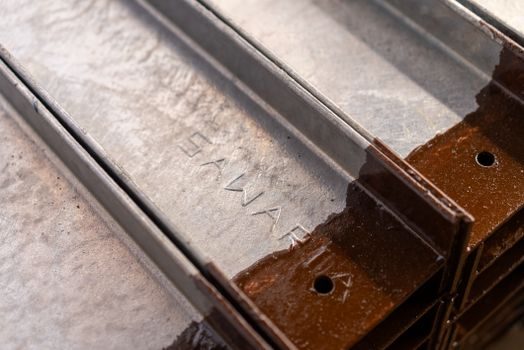
For dry, interior, or non-chloride slab exposure, low-carbon cold-drawn wire (typically 0.05-0.20 % C, no specified corrosion allowance) is the cost default. For marine splash zones, de-icing salt exposure, or waste-water chambers, the 304 stainless option ships in the same 65/13 geometry and the same 0.2 mm ±0.005 mm wire diameter — verified HAREX spec — at roughly 6-8× the carbon-steel price [S1]. For chloride-rich sewage and coastal precast, 316L is the conservative pick; 316 (non-L) is acceptable for many precast panels but offers no corrosion advantage over 304 in chloride solutions.
Stainless does not eliminate the need for concrete cover and crack-width control — it just relaxes the corrosion-rate budget. If your design life is 50+ years in tidal-splash or chemical-tank farm exposure, 316L plus a 30 mm cover plus a 0.3 mm crack-width limit is the working spec. A common mistake is ordering "stainless steel fiber" without a UNS grade (304 / 304L / 316 / 316L) on the MTC; the carbon-steel default of 0.05-0.20 % C and the stainless 304 chemistry are not interchangeable in the field. For mix-design adders used in composite floor systems, the concrete fiber reinforcement overview covers the cost-vs-residual-strength trade-off.
Geometry and Anchorage: Hooked-End, Undulated, Flat-Tape and Melt-Extract Compared
Geometry dictates pull-out: hooked-end (HE) cold-drawn wire gives the highest post-crack residual strength, undulated/wave (W) gives a smoother handling profile with slightly lower fR3, flat-tape slit-sheet is the cheapest large-aspect option with brittle pull-out, and melt-extract is the roughest, lowest-cost fiber used in refractory and shotcrete where surface finish is not a concern. Chinese export SKUs in mid-2026 are dominated by HE and W types, with melt-extract mostly captive to domestic shotcrete and tunnel-fire-resistant lining [S3].
For a four-criteria pick at the dosing table, the comparison is: (1) Residual strength fR3 (HE > W > slit > melt-extract); (2) Pump-ability through 50 mm shotcrete hoses (W > HE > slit > melt-extract, melt-extract can hang up on bends); (3) Unit price FOB China (melt-extract < slit < W < HE); (4) Surface finish on architectural panels (W ≈ HE >> slit > melt-extract). If the project is a 200 mm slab on grade with no pump and no aesthetic requirement, melt-extract at the lowest dose-per-MPa is technically acceptable. For a polished warehouse floor, the same melt-extract at the same dose will look like rust-stained felt — pick HE or W.
Standards, Mill Test Certificates and the MTC Discipline

Two reference documents govern the spec: EN 14889-1:2006 (fibers for concrete, four groups, l/d 40-100 typical) and ASTM A820 / A820M-22 (steel fibers for concrete reinforcement). Both require a mill test certificate per heat/batch covering tensile strength, dimensions, and dosage-allowance. A 2026 purchase order that does not list "MTC per EN 14889-1:2006 §6" or "MTC per ASTM A820 §10" on the line item is a purchase order that will not survive a quality audit on a public-works job. [S1]
What to put on the PO: (a) EN 14889-1 group (I / II / III / IV), (b) geometry (l, d, l/d, profile), (c) tensile-strength class, (d) dose (kg/m³) and target fR1 / fR3, (e) MTC standard, (f) base-alloy (UNS for stainless), (g) packaging (25 kg paper bag or 1,000 kg big-bag). For mill-sourced wire feedstock the alloy steel buying guide covers the upstream MTC chain — useful context when you want to read past the fiber-maker's nameplate.
Price Bands 2026, MOQ and Sourcing Channels
Mid-2026 China FOB price bands for steel fiber sit in a wide corridor: cold-drawn carbon-steel hooked-end wire at $800-$1,200/t FOB for 20'FCL orders, 304 stainless hooked-end at $4,500-$6,500/t FOB, 316L stainless at $6,500-$9,000/t FOB, and melt-extract refractory grade at $400-$700/t FOB [S3]. Domestic Chinese retail on Made-in-China.com for fiber-reinforced concrete additives (often blended with PP macro fiber) sits in the $2.50-$2.80/kg band for 500 kg MOQ — note that this is a blended macro-fiber product, not pure steel fiber [S3]. MOQ for direct mill orders is typically 1 t for stock SKUs and 5-10 t for custom 304/316L heats; the HAREX-style 65/13 SKU is usually in stock [S1].
Two sourcing channels dominate: (1) direct mill (Hengshui, Tangshan, Wuxi clusters) for projects above 20 t with MTC requirements, and (2) trading-platform inquiries (Made-in-China.com, Alibaba) for spot buys under 5 t. Trading-platform pricing at 1-2 $/kg of "stainless fiber" should be treated as suspect — verify the UNS grade and the MTC standard, not the headline price. For refractory and shotcrete tunnel use, the fiber converter integration is the next downstream link in the spec chain.
Who Steel Fiber Is For — and Where It Is the Wrong Tool
Steel fiber is the right call for: industrial ground-supported slabs (40-60 kg/m³ dose), tunnel primary and final linings (30-50 kg/m³), shotcrete slope stabilisation, precast tunnel segments, refractory concrete (melt-extract type), and composite steel-deck floors replacing bottom rebar (30-45 kg/m³). It is not the right call for: architectural white concrete where any rust bleed-through is unacceptable, lightweight structural concrete (the fiber dose adds 30-80 kg/m³ of weight that defeats the design), and chloride-free environments where carbon fiber reinforcement is being specified for EMI or weight reasons. [S2]
For a 2026 ground-supported slab on a warehouse floor, the working spec is: HE cold-drawn wire, 65/13 or 80/0.75, tensile ≥1,000 MPa, dose 35 kg/m³, fR1 ≥ 4.0 MPa / fR3 ≥ 3.5 MPa, MTC per EN 14889-1:2006, 25 kg paper bags or 1,000 kg big-bags. For a coastal precast panel: same geometry but 316L base, dose 40 kg/m³, plus 30 mm cover and 0.3 mm crack-width control. Both specs are auditable, both will survive a quality audit, and both are shippable in 4-6 weeks from a Chinese mill in mid-2026.
The next signal to track: the 2026 EN 14889-1 revision draft (currently in CEN TC104 SC2 work-program) is expected to tighten the l/d range and the fR3 reporting protocol; for projects with a 2027+ handover, confirm the MTC format with the fiber-maker before issuing the PO. The other live signal is 316L wire-rod feedstock — if nickel-molybdenum surcharges spike, expect a 10-15% lift on stainless fiber FOB pricing across Q3-Q4 2026.