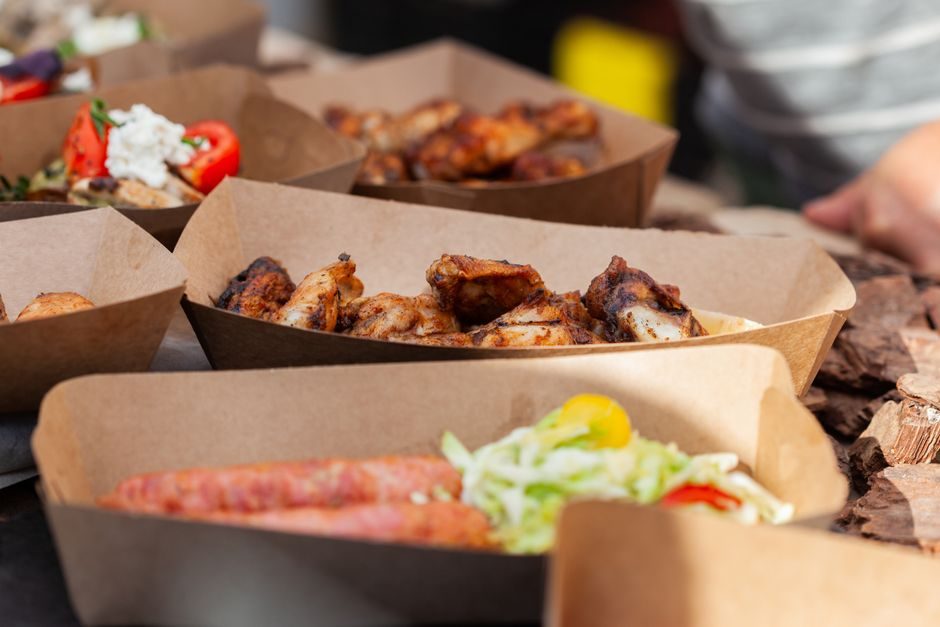
Carton erecting machines are classified primarily by station count, drive architecture, and forming method, with single-station compact units rated 30–50 pcs/min and double-station full-servo lines reaching 180 pcs/min on 210–400 g/m² paper stock, according to OEM data published 2026-07-22 [S1].
Three structural classes dominate the 2026 packaging-machinery market: compact single-station thermoformers for new entrants, double-station servo-driven erectors for mid-volume food packaging, and inline carton erecting modules integrated into corrugated converting lines. Selection pivots on throughput target, paper grammage range, available footprint, and whether the finished carton box ships to a regulated jurisdiction such as the EU [S1][S2].
Single-Station Class: Compact Thermoforming for Low-Volume Entry
Single-station carton erectors are designed for startups and small food-packaging lines, with the ZX-550 model measuring 1900×1000×2200 mm and weighing 900 kg, drawing 6 kW at 380 V, and supporting 50/60 Hz grids, per Zhejiang Zhixin specifications dated 2026-07-22 [S1].
Output on this class runs 30–50 pieces per minute, paper grammage spans 210–400 g/m², and footprint stays under 2 m² — a deliberate trade for buyers who prioritise low site-rental cost over throughput. The forming principle is pulp/paper thermoforming against a heated mould, typically producing boat-shaped trays, fried-chicken containers, and burger boxes. Mold changeover is a manual operation taking minutes rather than hours, which is the central economic argument for this class. Optional upgrades include 2- or 4-gun hot-melt glue sprayers for improved box-seal tightness [S1].
Double-Station Class: Servo-Driven High-Output Erectors
Double-station full-servo carton erecting machines deliver higher throughput than single-station units, and ZX-series double-station models hold CE certification for EU-bound packaging, per Zhixin product documentation updated 2026-07-22 [S1].
The defining engineering difference versus single-station is drive architecture: full-servo control replaces mechanical cam timing, which the OEM states reduces forming errors, material waste, and unplanned downtime. In practice this means smoother continuous run cycles and faster changeover between box styles, because servo axes can be re-referenced electronically rather than re-set mechanically. The ZX-1600 and ZX-2000 sit at the top of this class, aimed at small-to-mid packaging factories, fast-food chains, and takeaway businesses that need to scale output without expanding floor space [S1].
Inline Carton Erecting on Corrugated Converting Lines
Inline carton erecting is integrated as one stage within broader corrugated converting lines, where 2/3/5/7-layer corrugated cardboard production lines run at 60–300 m/min across web widths of 1400–3200 mm, per DESSION catalog data published 2026-06-20 [S2].
This class does not stand alone — the erector feeds from a flexo printer slotter folder gluer upstream and delivers erected carton box blanks downstream toward a coding machine or filling machine station. Configuration options for the upstream end include vacuum-adsorption flexo printing, high-speed HD models, and full-automatic models; the erector itself is selected to match line cadence. DESSION's catalog, reflecting 18+ years of Cangzhou-based carton machinery manufacturing, exports to 50+ countries with agents in 10+, indicating that this class is the dominant format for industrial-scale converters [S2].
Drive Architecture Comparison: Servo vs Mechanical
Comparing the three classes against four decision criteria clarifies when each pays back: the table below maps station count, drive type, output range, and best-fit application [S1][S2].
Single-station mechanical-thermoform suits sub-50 pcs/min runs on light paper (210–400 g/m²) for new food-packaging entrants with constrained floor space. Double-station full-servo units target 50–180 pcs/min on similar grammage for established food and takeaway lines needing CE compliance. Inline erectors on corrugated converting lines handle the highest cadence — effectively the line's rated m/min converted to erected box count — for industrial packaging producers running 2/3/5/7-ply board. The servo vs mechanical split matters most at the changeover: servo axes let an operator switch box styles without mechanical re-set, while mechanical units require physical timing adjustments. Selection threshold is roughly 60 pcs/min sustained output — below that, mechanical single-station economics dominate; above it, servo control pays back the capex premium in reduced scrap and downtime [S1][S2].
Standards, Certification, and Regulatory Fit

Carton erecting machines destined for EU food-contact packaging lines must hold CE certification, and ZX-series double-station models are explicitly documented as CE-compliant for cross-border shipment, per Zhixin product pages 2026-07-22 [S1].
For food-contact end use, paper stock selection still flows from the food-contact material regulations of the destination market — EU Framework Regulation (EC) 1935/2004 and US FDA 21 CFR §176.170 for paperboard are the typical baselines, though the erector itself is not the regulated article. Domestic Chinese manufacturers including Cangzhou Xiaoyuan, Yiding Carton Machinery, and DESSION supply both domestic and export markets, with main export regions across Southeast Asia, Africa, and the Middle East [S4][S5]. Buyers specifying for pharmaceutical or coding-marked lines should also confirm compatibility with downstream coding machine integration, since ink adhesion on freshly erected surfaces differs from stock paperboard [S3].
Manufacturer Landscape and Sourcing Signals
Carton erecting machines are concentrated in Cangzhou, Hebei, where manufacturers including DESSION (18+ years operating, exports to 50+ countries) and Cangzhou Xiaoyuan anchor the supply base, per vendor profile data 2026-06-20 and 2026-06-05 [S2][S4].
Zhejiang Zhixin in Zhejiang province specialises in the carton erecting and thermoforming sub-segment rather than full corrugated lines, signalling a vertical focus on food-packaging end use. Yiding Carton Machinery in the same Hebei cluster also supplies single-facer units, used carton machinery, and two-color printing/slotting machines — the latter relevant to buyers retrofitting an erector into an existing cutting machine and print line rather than starting greenfield [S5]. Used and refurbished erecting equipment remains a viable sourcing channel for budget-constrained Asian and African buyers, with Yiding explicitly listing "used carton machine" as a main product line [S5].
Selection Criteria: Matching Machine Class to Operating Reality
Specifying a carton erecting machine starts with three quantitatives: target pieces/min, paper grammage range, and available workshop dimensions, then layers in drive architecture and certification requirements. [S1]
For sub-50 pcs/min on light food-grade paper with a sub-2 m² footprint, a single-station mechanical thermoformer is the economic choice. For 50–180 pcs/min on the same grammage with EU export as a downstream requirement, a double-station full-servo CE-certified unit is the correct class. For industrial-scale converters already running a corrugated line, an inline erector matched to the line's m/min cadence is the only coherent option. Buyers should also verify the PLC program control architecture and request documented changeover time between box styles, since this is where single-station mechanical units lose most of their day to a mechanical re-set, and where servo units justify their price premium. Total cost of ownership math follows the same packaging-line retrofit logic applied to any capex-heavy industrial line.
Trackable signals to watch: servo-drive price compression as Chinese servo-motor volumes scale through 2026, and any CE-notified-body clarification on whether inline erected boxes for food contact require additional migration testing beyond the paperboard itself. Buyers commissioning lines in 2026 H2 should confirm mold-change tooling lead time with the OEM before placing the PO, since this is the single most common source of install-to-production slip.