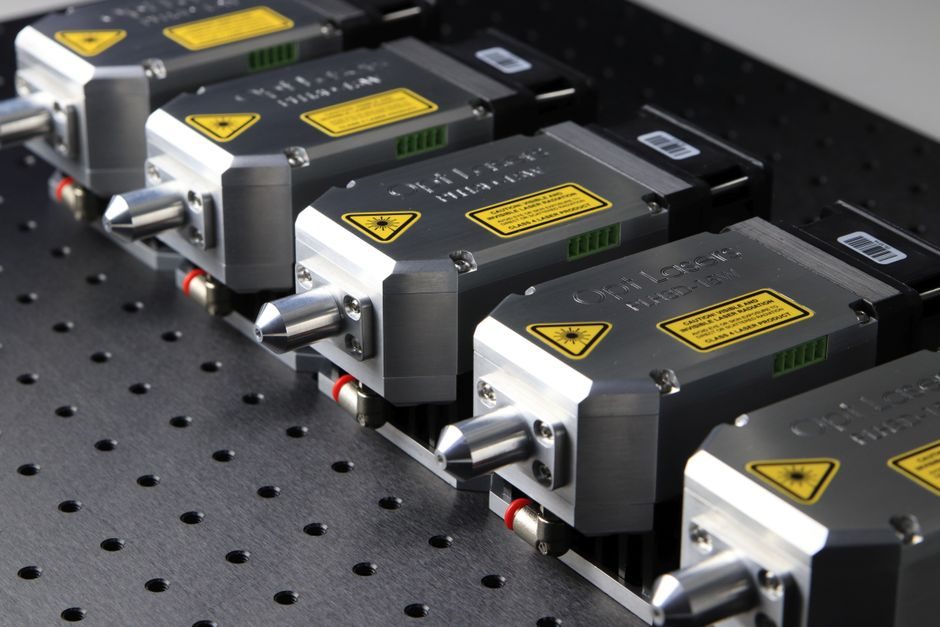
A 2026 line layout almost always combines both assets: a carton erecting machine builds the case from flat blanks at typical throughputs of 15-60 cartons per minute, after which a labeling machine applies shipping, retail, or variable-data marks to the sealed pack at 30-200 pieces per minute depending on configuration [S1][S3].
They occupy different stations on the same packaging line, accept different infeed formats, and fail for different reasons — so direct apples-to-apples cost comparisons mislead. What matters is matching the erector's box-range, glue system, and changeover time against the labeler's substrate handling, accuracy tolerance, and integration with upstream coding.
Core Function and Line-Position Differences
A carton erecting machine takes flat corrugated or paperboard blanks — usually Regular Slotted Containers (RSC) or Half Slotted Containers (HSC) — and forms them into squared, glued, or glued-and-taped cases ready for product loading [S3][S6]. Bench-top and entry-level erectors from Chinese OEMs such as Zhejiang Feida and Wenzhou Hongshuo (ISO 9001-certified, Pingyang) typically run at 15-25 cpm on small RSCs, while servo-driven inline units push 40-60 cpm on standard 200-600 mm box ranges [S3][S4].
A labeling machine sits downstream of the case sealer and prints or applies pre-printed labels — paper, PE, BOPP, clear film — to one or multiple faces of the finished pack [S1]. DirectIndustry's 2026 industrial-manufacturer index lists 34 vendors offering 53 distinct carton-labeling products, including wrap-around, two-side, top, and corner-wrap configurations, confirming how fragmented the labeling sub-segment is relative to the erector market [S1].
Selection Criteria: Mechanical vs Adhesive-Aplication
For erectors, the binding specs are: blank magazine capacity, glue type (hot-melt vs cold), box dimensional range, changeover time, and servo vs cam-driven indexer architecture. Wenzhou Hongshuo, a Made-in-China-listed manufacturer running an ISO 9001 quality system, advertises carton erectors alongside full-servo glueless paper-straw and KFC popcorn-box machinery, indicating the breadth of format support Chinese OEMs offer [S4]. DirectIndustry's erector listings also show that high-end units increasingly integrate automatic tape sealing — collapsing the erector-sealer boundary.
For labelers, the binding specs are: label-substrate width, application accuracy (commonly ±1 mm for wrap-around, ±0.5 mm for precision tamp), throughput in pieces per minute, and the type of label feed (servo stepper vs pneumatic). DirectIndustry's 34-vendor carton-labeler index shows application categories clustered around wrap-around, two-side front-and-back, and top labeling — and many OEM labelers integrate thermal-transfer or ink-jet coders upstream for batch/lot/expiry marks [S1].
Who Each Asset Is For — and Who It Is Not
A carton erecting machine is the right pick when a plant runs medium-to-high SKU counts on corrugated cases, ships 5,000+ cases per shift, or needs consistent case squareness for robotic pick-and-place. It is the wrong pick for low-volume hand-pack lines (under ~3,000 cases per shift) where manual erection is cheaper, or for thermoformed retail-ready packs that do not use RSC geometry [S3].
A labeling machine is the right pick when regulatory marks (batch, lot, expiry, barcodes) must be applied to a sealed case, when retail-ready labels must appear on multiple faces, or when variable-data printing is needed inline. It is the wrong pick when pre-printed corrugated is already inbound and the line does not need variable data — printing the corrugator saves the labeler capital cost. Plants using direct thermal-transfer or ink-jet on the corrugator (companies like Royo Machinery resell converting/finishing lines on this principle) may not need a dedicated case labeler at all [S2].
Throughput, Changeover, and Cost Bands
Comparing the two on equal terms produces a useful table for line planners. Erectors and labelers do not substitute for each other, but they are typically specced in pairs and share the upstream conveyor: [S1]
Carton erecting machine: 15-25 cpm (entry/semi-auto) to 40-60 cpm (servo inline); 3-15 minute changeover for box size; capex band US$8,000-60,000 per OEM listings on Made-in-China, with high-end servo units exceeding US$100,000 [S3][S4][S5][S6].
Carton labeling machine: 30-60 ppm (single-side) to 100-200 ppm (wrap-around, dual-head); 5-30 minute changeover for label roll and guide-rail; capex band US$3,000-30,000 for Chinese-built units, US$40,000-150,000 for European brands such as Novexx Solutions, LOGOPAK, and Marchesini Group [S1].
Used and rebuilt converting machinery — the core of what Royo Machinery brokers in North America — typically halves new pricing for both categories, but lead time drops to 2-4 weeks versus 8-16 weeks for a new Chinese OEM unit [S2]. For more on this cost-spec trade-off, see the Shrink Wrapping Machine 2026 Price & Cost Guide for adjacent spec-tier thinking that applies to case-pack equipment too.
Integration and Failure-Mode Constraints
Integration friction between an erector and a labeler usually appears at the case sealer, not at the label applicator. If the erector outputs a case that is skewed, over-glued, or undersquared, the downstream labeler cannot hold ±1 mm placement accuracy and the coder's OCR verification station will reject the pack [S1][S3].
Common failure modes: hot-melt glue stringing in cold plants (erector-side), label mis-feed from low-tack acrylic adhesive on dusty corrugated (labeler-side), and servo indexer drift on erectors running 24/7 at max cpm.
Vendor and Sourcing Landscape (2026)
The erector market is heavily Chinese-OEM dominated: Zhejiang Feida, Wenzhou Hongshuo, and a long tail of Made-in-China and Alibaba-listed factories run 1 Set MOQs at US$4,800-30,000 entry pricing [S3][S4][S5][S6]. A complementary category — carton box blank supply and case packers from Zhengzhou/Henan — rounds out the upstream side at US$4,800-30,000 per set with 15-day fast delivery.
The labeler market is more transnational: DirectIndustry's index shows European brand presence (Novexx, LOGOPAK France, Marchesini) alongside Chinese and Indian OEMs (NEOSTARPACK, JDA Progress, LC Printing, Beijing Acctrue), reflecting the higher accuracy and validation requirements — pharma and food lines must validate label placement under FDA 21 CFR Part 11 or EU GMP Annex 11 [S1]. The carton erecting machine 2026 buying guide covers box-range, speed, and integration detail that complements this comparison.
Decision Signals to Track
Two trackable signals for the next 6-12 months: (1) Chinese OEM erector suppliers adding integrated print-and-apply modules — a 2026 listing on Made-in-China already shows Blister Packing Machine vendors cross-selling automatic labeling, suggesting erector-labeler single-vendor sourcing will accelerate; (2) servo-driven glueless erector technology spreading from paper-straw OEMs (Wenzhou Hongshuo advertises glueless paper-straw machinery alongside erectors) into RSC/HSC case formats, which would lower adhesive OPEX and shift erector-labeler cost ratios [S4].