
Automatic carton erecting machines on the 2026 China-supplier market cluster into two distinct speed bands: 15-40 cartons/min for entry-level case erectors aimed at e-commerce and short-run packing lines, and 80-180 pcs/min for high-output PLC-controlled lines such as the Zhixin ZX-1200 food-container system [S1][S5]. The wider specification envelope — cardboard thickness, blank size, robot-arm versus mechanical-sucker pick, and inline sealing — is what separates a US$3,500 case former from a US$60,000+ robotic top-load case packer [S5].
For a process engineer writing a 2026 capex spec, the buying decision is dominated by three levers: the carton size envelope (length × width × height in mm), the throughput in cartons per minute that matches the upstream filler and downstream sealer, and the level of integration with conveyors, hot-melt glue units or robotic pick-and-place. Zhejiang-based manufacturers (Zhixin, Land River, Wenzhou Xingpai) dominate the supplier pool on Made-in-China.com and Made-in-China, and a typical enquiry in 2026 returns 1-6 verified CE-certified factories per search query [S1][S2][S4][S5].
Output Speed Bands and What They Actually Mean on the Line
The 15-40 cpm tier covers the automatic case erectors listed at US$3,500-6,000 FOB on Made-in-China, including robot-arm packer erectors with 1-piece MOQ from Shandong Unity Robotics [S5]. The 80-180 cpm tier is occupied by PLC-controlled full-corrugated lines such as the Zhixin ZX-1200 food-container box maker, where the whole line runs on a PLC program and the speed ceiling is 180 pieces/min [S1]. For an engineer sizing a line, the practical rule is to spec the erector at roughly 1.3× the net downstream case-packer throughput, so the erector is never the bottleneck during recovery from a downstream micro-stop.
For comparison with adjacent packaging automation, the shrink wrapping machine spec tier guide breaks a similar packaging line into throughput bands, and the vacuum packaging vs capping-sealing spec cut is a useful reference when the carton erector sits between a form-fill-seal and a palletiser.
Carton Size, Board Grade and Blank Type Constraints
Most 2026 Chinese automatic carton erecting machines accept corrugated board in B-flute (3 mm) and C-flute (4 mm) as standard, with E-flute (1.5 mm) and double-wall BC-flute (6-7 mm) as configurable options on the higher-tier machines. Carton size envelope for the entry-tier sits around L 200-500 mm × W 150-400 mm × H 100-400 mm; the high-output tier extends to L 600 mm × W 500 mm × H 500 mm, and lock-style or 4-corner-glue food boxes sit in a separate machine family that overlaps with carton box die-cutting and folder-gluer lines [S1][S3].
Hot-melt adhesive versus cold glue is the second material lever. The hot-melt path is dominant above 30 cpm because open-time on a PVA cold-glue bond drops below 1 second on fast conveyors, while EVA hot-melt at 160-180 °C gives 3-5 seconds of tack for 4-corner carton closing. Specifying the wrong glue system is the most common cause of poor carton-square formation and downstream case-packer mis-picks; the hot-melt tank capacity (typically 4-8 kg on entry machines, 15-25 kg on high-output lines) and the number of glue guns (4-6 on a standard 4-corner closer, 8-10 on a 6-corner with handle-attachment) should be written into the RFQ. The carton erecting machine category on the spec encyclopedia indexes the machine types against these board and glue permutations.
Integration Scope: Standalone Erector Versus Robotic Case Packer Line
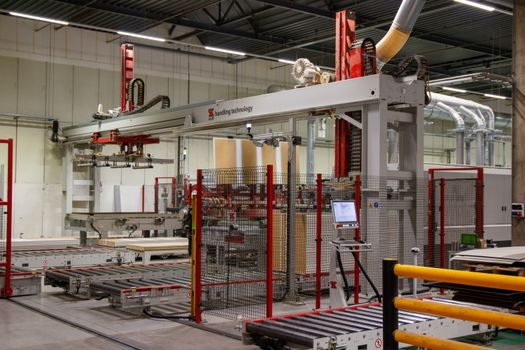
Integration scope is where the 2026 quote list fragments most aggressively. A standalone automatic carton erector (US$3,500-6,000 FOB) covers blank magazine, erecting, bottom-flap folding, hot-melt sealing and discharge onto a short outfeed conveyor [S5]. Adding a robotic pick-and-place arm to load product into the erected carton (Shandong Unity-style robot-arm packer erectors) typically pushes the line price into the US$18,000-45,000 band, and a fully integrated top-load case packer with vision-guided product collating, flap closing and case sealing runs US$60,000-150,000 installed.
PLC versus PC-based control is a sub-decision inside integration. Entry-tier machines use a dedicated PLC (Delta, Siemens S7-200, or Mitsubishi FX) with a 7-inch HMI; high-output lines such as the ZX-1200 run the full line from a single PLC program with servo-driven blank feed, glue temperature closed-loop control, and rejection of malformed cartons via a vision check before discharge [S1]. Servo count is a quick proxy for control sophistication: 2-3 servos on the entry tier, 5-8 on the high-output tier, and 10+ on a fully robotic case-packer line. For plants that already standardise on one PLC family, matching the erector PLC to the line PLC removes an integration tax on Ethernet/IP or Profinet commissioning.
Certifications, CE Status and What Buyers Should Verify
CE marking under the Machinery Directive 2006/42/EC and electromagnetic compatibility compliance are baseline for any 2026 automatic carton erecting machine entering the EU, and the Made-in-China listings explicitly carry CE certification dates — for example, Shandong Unity's CE certificate for the automatic case erector is dated 2026-01-26 and is valid from that issue date [S5]. Buyers should request the CE declaration of conformity, the Notified Body four-digit identification number, and the most recent audit date; suppliers in Zhejiang (Wenzhou Xingpai, Ruian City) and Shandong dominate the verified-CE pool in 2026 [S4][S5].
For North American-bound lines, UL 508A on the control panel and NFPA 79 electrical safety for industrial machinery are the parallel requirements, and CSA C22.2 No. 14 applies in Canada. Food-contact applications such as the ZX-1200 food-container box line should additionally be specified against FDA 21 CFR 176.170 (paperboard in contact with aqueous and fatty foods) and EU Framework Regulation 1935/2004 for the EU, with the food-grade statement documented per shipment [S1]. For explosive-dust environments (flour, sugar, starch lines), ATEX zone classification 21/22 for the erector frame and any vacuum pump is a separate engineering check, not a CE-line item.
Total Cost of Ownership: Power, Air, Spare Parts and Operator Skill
Entry-tier 15-40 cpm carton erectors draw 2-4 kW of three-phase power and 6-8 bar compressed air at 100-200 L/min for the vacuum suckers and glue gun pneumatics. High-output 80-180 cpm lines draw 8-15 kW and 300-500 L/min of air; the Zhixin ZX-1200 sits in this upper band and the spec sheet calls out PLC-controlled energy management as a way to flatten idle draw [S1]. Air quality matters: ISO 8573-1 class 7.4.4 (40 µm filtration, -20 °C pressure dew point, 5 mg/m³ oil) is the practical floor for hot-melt and vacuum-sucker reliability.
Spare-parts stocking for a year of two-shift running should include hot-melt gun modules (1-2 spares per gun), vacuum-sucker silicone cups (4-6 spares, replaced quarterly), timing belts on the blank feed (1 spare set), PLC backup battery, and one full set of photocells and proximity switches. Operator skill: a single trained operator can run one or two entry-tier erectors, while a high-output PLC line typically needs a line-leading operator plus a mechanic-on-call within 10 minutes, which is a labour assumption that should be priced into the TCO before the machine is signed off.
Supplier Pool and Lead Times in 2026
As of 2026-06-30, the active China-side supplier pool for automatic carton erecting machines clusters in three regions: Wenzhou/Ruian in Zhejiang (Zhixin, Wenzhou Xingpai, and the broader Ruian packaging-machinery cluster), Qingdao in Shandong (Shandong Unity Robotics), and the Guangdong Pearl River Delta [S1][S2][S4][S5]. Land River Group's carton machinery line out of Qingdao sits alongside its offset-printer and refrigerant-filling lines, and is representative of the multi-category Chinese machinery exporter that consolidates a buyer's RFQ across several packaging SKUs [S2].
Lead times in mid-2026 run 30-45 days for the entry-tier case erectors (1-piece MOQ) and 60-90 days for the high-output PLC lines, with sea freight from Ningbo or Qingdao adding 25-35 days to North America and 30-40 days to the EU. Hot-die-cutting and folder-gluer attachments are commonly quoted from the same supplier base on Alibaba, and the carton erecting machine category on the spec encyclopedia links to the adjacent coding machine and carton box references for the downstream ink-jet and outer-carton SKUs that share a packing line with the erector.
For a 2026 capex decision, the practical first gate is the carton size envelope and the cpm number from the upstream filler; the second gate is the integration scope (standalone, robotic-arm, or full top-load case packer); the third gate is the PLC family match to the existing line and the CE/UL paperwork. If those three line up, the US$3,500-6,000 FOB entry-tier quote from a verified-CE Shandong or Zhejiang factory is a defensible spec, and the high-output PLC line at US$25,000-80,000 is justified only when the real OEE demand sits above 60 cpm sustained [S1][S5]. Track for the rest of 2026: the Made-in-China CE-certificate refresh dates per supplier, and any shift toward servo-driven blank feed on the entry tier, which would compress the price gap between the 15-40 cpm and 80-180 cpm speed bands.