A casting ladle is a steel-shelled, refractory-lined vessel that holds, moves, and pours molten metal between furnace and mold; capacity ranges from ~20 kg in a hand shank to 300 t in a steel-mill teeming ladle, all at 1,350–1,650 °C [S2].
The functional split is transfer, casting (pouring), and treatment — each vessel is optimized for a different job in the melt flow, and lifting, tilting, and lining all change with role and capacity [S2][S6].
Three Functional Classes: Transfer, Pouring, Treatment
Transfer ladles move large batches between process steps — typically from a melting furnace to a holding furnace or an automatic pouring unit — so they are sized for capacity, insulation, and low heat loss rather than fine pour control [S2][S6]. Casting (pouring) ladles deliver metal into molds and are optimized for a controlled, predictable stream; treatment ladles host a reaction inside the vessel — ductile-iron nodularization, desulfurization, or argon stirring — so geometry, cover design, and refractory choice all change to contain the reaction and keep alloy yield high [S2][S6].
The same physical shell can take on different roles: a 50 t vessel in a steel works often functions as a transfer/treatment ladle during ladle-furnace (LF) refining and as a teeming ladle on the caster, so the "type" follows the metallurgical step, not the hardware [S2].
Capacity Bands and Lifting Method Drive Geometry
Hand shanks (single- or two-worker carry) cover roughly 20 kg and are the bench-scale end of the family. Bull ladles and small geared crane ladles serve the iron-foundry mid-range from a few hundred kilograms to several tonnes; steel-mill teeming ladles reach 300 t, and drum-type transfer ladles in integrated steel works frequently exceed 100 t [S2].
Geometry tracks capacity: small foundry ladles use a slightly tapered truncated cone shell for stiffness; very large steel-mill ladles move to a cylindrical or drum profile because a cone that size would waste refractory volume and add headroom demand on the crane. Crane-lifted vessels are anchored on trunnions sized to OSHA 1910.179 and ASME B30.2 for overhead crane and trolley service [S2].
Pour Mechanisms: Lip-Pour, Bottom-Pour, Slide Gate, Stopper Rod

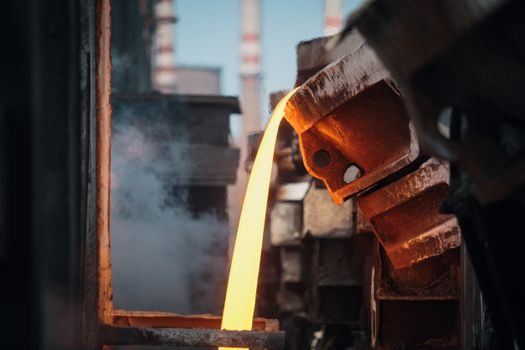
Lip-pour (teeming) is the oldest and simplest: the ladle tilts on its trunnions and metal leaves over a spout. It is cheap and robust, but stream rate and stream shape are operator-controlled, and slag control depends on a well-designed spout and freeboard. Bottom-pour uses a nozzle in the ladle bottom; combined with a stopper rod or a slide gate, it gives a much tighter stream and is the standard for steel teeming and for many iron-foundry automatic pouring cells [S2][S4].
Slide-gate systems are dominant on modern steel teeming ladles because the refractory slide plate is changed from outside the ladle between heats, and the operator can throttle or shut the stream without going near the metal. Stopper-rod systems (a refractory-coated steel rod raising and lowering a nozzle plug) are still common in iron and smaller steel ladles; their weakness is that the rod wears in service, and a worn nozzle-rod interface leaks [S2]. For bench and small-floor work, hand-bottom-pour dippers like the Rowell pattern (2-1/4" bowl, 9" handle) are still in production for non-ferrous shops pouring aluminum and zinc alloys [S4].
Refractory Lining Systems and Consumable Campaigns
Every casting ladle has three refractory layers: a working lining against the metal (the consumable), a safety/permanent lining that protects the steel shell from melt-through if the working lining fails, and an insulation layer to cut heat loss. Steel-mill steel-casting-ladle datasheets typically specify magnesia-carbon (MgO-C), dolomite, dolomite-MgO-C, and alumina-MgO-C working linings plus a bottom castable, gunning mixes for hot repair, and a dedicated safety lining mix [S3].
Working lining selection tracks the metal and the process step. MgO-C gives the best resistance to basic steelmaking slags and is the steel teeming ladle default; dolomite and dolomite-MgO-C are specified where low-sulfur and low-phosphorus residuals matter because dolomite is carbon-free and avoids carbon pickup into ultra-low-carbon grades; alumina-MgO-C sits in between and is used on iron and some lower-temperature steel duties. For molten aluminum, hand-pouring ladles are commonly built in mild steel, stainless steel, or composite ceramic — Pyrotek's RFM (reinforced fiberglass composite) is non-wetting in liquid aluminum and gives substantially higher insulation than a steel shell of the same wall thickness [S7].
Selection Criteria: Match Vessel to Metal, Capacity, and Pour
The decision flow is functional role → capacity → metal and temperature → pour mechanism → refractory → lifting. A ductile-iron foundry pouring 1–3 t into green-sand molds usually specifies a geared crane ladle with a stopper-rod bottom-pour and an alumina-based working lining; the same shop doing in-ladle nodularization needs a treatment ladle with a cover, a reaction pocket, and a denser MgO-based lining to hold the magnesium treatment. A steel works tapping 80–300 t from an EAF into a ladle furnace and on to a continuous caster runs a slide-gate teeming ladle with MgO-C working lining and a gunning-repair routine between heats [S2][S3].
Quick comparison of the main options on four decision criteria:
Hand shank / bull ladle — capacity 20 kg to ~500 kg, pour mechanism lip-pour or hand bottom-pour, typical metal aluminum / zinc / lead, lining steel or RFM shell. Geared crane ladle — capacity ~0.5–10 t, pour mechanism geared lip-pour or stopper-rod bottom-pour, typical metal cast iron / ductile iron, lining alumina or alumina-MgO-C. Slide-gate teeming ladle — capacity 50–300 t, pour mechanism slide gate, typical metal carbon / low-alloy steel, lining MgO-C with gunning repair. Treatment ladle (LF / wire-feed) — capacity 30–300 t, pour mechanism slide gate + cover + gas purging, typical metal steel + alloy trim, lining MgO-C or dolomite-MgO-C [S2][S3][S4][S7].
Engineers specifying a new ladle should also cross-check upstream and downstream stations: a melting furnace installation sets the tap weight, the mold line sets the required stream rate and freeboard, and the die-casting machine cell has its own ladle-auxiliary interface if the foundry is mixed-mode. The casting ladle encyclopedia entry covers the full sizing sequence; the related die-casting die and sand casting mold pages are the right references when the pour target is a sand or die system rather than a continuous caster.
Common Failure Modes and Sourcing Signals
The four most common in-service failures are: nozzle erosion (visible as stream bias or drip between actuations, accelerated by Mn-rich or FeO-rich slags), slide-gate plate wear (sudden stream changes at the start of a heat), working-lining wear-through caught only by the safety-lining thermocouples, and trunnion-bearing failure on ladles that are not lifted on a level crane. The first two are refractory and metallurgy problems; the last two are mechanical and inspection problems. OEM and refractory supplier datasheets — including the [S3] steel-casting-ladle datasheet set covering MgO-C, dolomite, and dolomite-MgO-C bricks plus bottom castables and gunning mixes — are the public spec reference engineers should pin to the maintenance plan, because lining life is what sets the reline interval and the campaign length.
Two trackable signals to watch over the next quarter: refractory supplier datasheet revisions (MgO-C resin-bond grades keep shifting toward lower-carbon and nano-oxide bonded variants to cut carbon pickup into IF and ULC steel), and patent activity around composite ladle shells and compound pony-ladle designs in the secondary-aluminum segment [S5]. Both signals move the spec sheet before the marketing does.