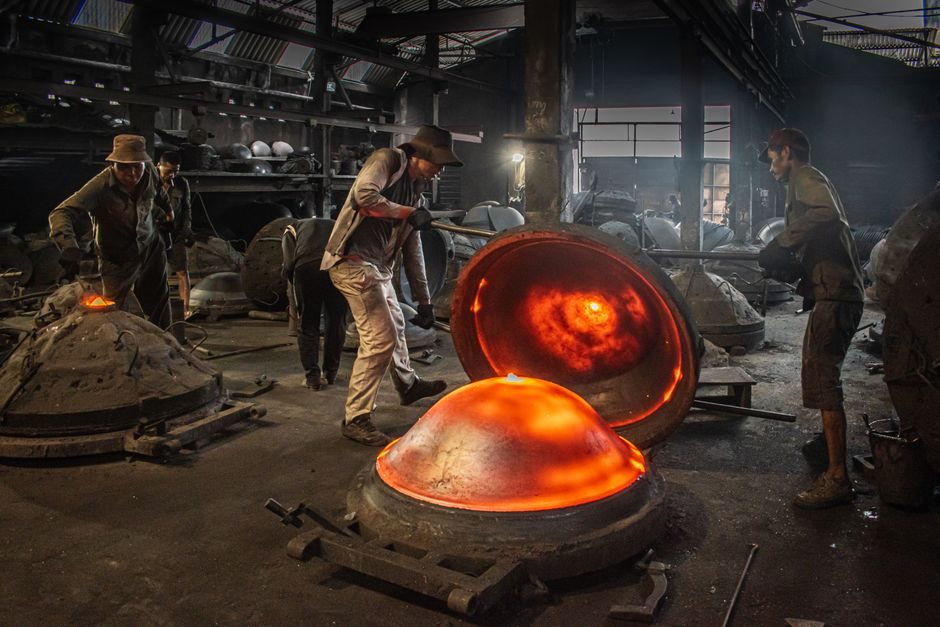
An induction furnace's sticker price is the smallest line on a serious total-cost-of-ownership (TCO) worksheet; over a 10-15 year service life, medium-frequency coreless and channel-type units typically spend 60-80% of lifetime cash on electrical energy, with refractory relining, water-cooled copper coil repair, and power-factor-correction capacitor replacement making up most of the rest [S3][S5].
The cost drivers that move the final number are also the same ones a process engineer can actually influence: melt throughput per shift, specific energy consumption in kWh/tonne, refractory campaign length, and the cooling-water chemistry that decides whether a copper induction coil lasts two years or ten. Procurement teams that benchmark only the invoice line routinely see lifetime spend come in 2-3x the capex figure once those four operating variables are modelled honestly [S1][S7].
The five cost lines that decide induction furnace TCO
Purchase and installation is line one, and on a 1-5 ton medium-frequency coreless furnace it usually lands in the low-to-mid six figures USD before freight, foundation work, and the medium-voltage transformer or harmonic filter required for a clean bus [S4]. Line two is electrical energy, the dominant spend for almost every induction melting site; specific consumption for steel scrap typically runs 500-600 kWh/tonne at the melt, with copper alloys at roughly 350-450 kWh/tonne and aluminum near 600-700 kWh/tonne, and that figure is the single biggest multiplier in the lifetime model [S3]. Line three is the refractory campaign: a silica or alumina-magnesia lining on a coreless unit is rated in number of heats, not months, and replacement costs scale with furnace capacity because the whole shell has to come down [S5].
Line four is the water-cooled copper induction coil and its associated buswork; line five is the capacitor bank that corrects power factor and tunes the resonant tank. Together, lines four and five tend to deliver the most avoidable spend on a well-run furnace, because water quality, flow rate, and the choice between fixed and automatic capacitor switching decide how often the coil has to be re-brazed or re-turned [S1][S6].
Coreless vs channel: how topology changes each cost line
Coreless medium-frequency furnaces and channel (submerged-arc-channel or "induction channel") furnaces sit on the same TCO spreadsheet but weight the five lines very differently. Coreless units have a higher specific energy consumption per tonne, shorter refractory campaigns, and easier cold-start behaviour, while channel furnaces hold metal in a vertical channel inductor that stays full between shifts, giving lower specific energy and a much longer inductor refractory life measured in years rather than heats [S3][S5].
The trade shows up in the maintenance column: coreless furnace refractory relining on a 3 t unit is a multi-day, multi-personnel job, and the coil itself typically requires inspection every 6-12 months in continuous-duty steel foundries, whereas a channel furnace's holding inductor is rebuilt on a longer cycle but with a heavier single-event cost when it does come due [S7]. Engineers specifying new equipment should treat throughput profile as the deciding variable: a foundry that melts cold charges every shift on a coreless furnace will see energy dominate, while a casting line fed from a holding furnace sees channel-furnace efficiency and refractory life dominate instead.
Energy: the line item that sets the lifetime ratio
For any induction melting furnace, the lifetime energy bill is set by specific consumption (kWh/tonne), annual tonnage, electricity tariff, and the number of operating hours per year [S3]. A 2 t medium-frequency coreless furnace melting steel at 550 kWh/tonne for 8 hours/day, 250 days/year, draws roughly 1.1 GWh/year, and at an industrial tariff of $0.08-0.12/kWh that single line item reaches $88,000-132,000 in year one, before any maintenance, labor, or capex amortisation [S1]. Over a 12-year service life that exceeds $1M of energy spend on a unit whose purchase price often sits in the $150,000-300,000 band.
The two engineering levers that move this line the most are power-factor correction (penalty clauses for PF below 0.90 are common in industrial tariffs) and melt-cycle efficiency through charge preheating, ladle scheduling, and avoiding cold-hold soaking losses. Sites that benchmark power factor, kWh/tonne, and kWh/heat every month consistently report lower TCO than sites that only look at $/ton melted, because the $/ton figure hides poor electrical housekeeping behind higher tonnage [S4][S6].
Refractory and coil: the maintenance lines that punish neglect
Refractory life in a coreless induction furnace is rated in number of heats, and the working lining of a 1-5 t steel-melting unit typically runs 200-500 heats before relining is required; for ductile iron and high-temperature alloys the campaign can drop below 150 heats if slag chemistry is not controlled [S3]. Each reline is a multi-day outage with consumable, labor, and lost-production cost, so refractory life per dollar of lining material is the metric to track, not purchase price per kilo.
The water-cooled copper induction coil is the second punishing maintenance line. Closed-loop cooling with deionized water at controlled conductivity (typically below 5 µS/cm) and flow rates that meet the OEM's minimum L/min per kW of coil power is the difference between a coil that runs 5-8 years and one that fails in 18 months from internal pitting or scaling [S5][S7]. Capacitor banks for the resonant tank have their own failure mode: dielectric aging, contactor wear, and the need for periodic re-tuning, and they typically need partial replacement every 5-8 years on continuous-duty units, which is a measurable line that is often missed in the original TCO worksheet [S1].
Installation, downtime, and the hidden cost lines
Installation cost on a new medium-voltage induction furnace is rarely the line item procurement budgets for: civil foundation work, a dedicated transformer (or an upgraded MV feed), harmonic filtering to meet IEEE 519 limits, busbar runs, closed-loop cooling skid, and stack exhaust for dust and fume are all separate packages that can add 20-40% to the delivered-equipment price [S4][S6]. On a brownfield site, the engineering effort to integrate the new melting furnace into existing ladle handling and power distribution is the variable that often decides whether the project lands on schedule, and downtime cost during installation is itself a TCO line that should be modelled before the order is signed [S3].
Downtime during the operating life is the second hidden line, and it cuts both ways: scheduled refractory relines and coil inspections can be planned, but unplanned water leaks, capacitor failures, and bus faults on medium-voltage equipment routinely cost a foundry more in lost production than the spare part itself. The PTFE TCO reference shows the same pattern for sealing components: planned maintenance is cheap, emergency repair is not, and the same logic applies to induction furnace TCO [S5].
Selection criteria, 10-15 year view, and the signals to track next
For buyers comparing options, the decision criteria that actually move the TCO are: specific energy consumption in kWh/tonne at the rated throughput, refractory campaign length in heats, copper coil design and OEM-published service interval, harmonic compliance with IEEE 519, and the OEM's published MTBF for the capacitor bank [S4][S6]. A 1-2 t channel-type induction furnace is for sites with a continuous holding duty and a stable melt schedule, while a 2-10 t medium-frequency coreless unit is for jobbing foundries that need flexibility in alloy and charge weight. The rebar cutter TCO breakdown follows the same line-item discipline, and the same five-line framework applies to induction furnace procurement [S3][S5].
The two trackable signals that will move induction furnace TCO numbers over the next reporting cycle are industrial electricity tariffs (a 10% tariff change shifts lifetime spend more than any capex negotiation) and refractory material pricing, where magnesia and alumina-grade supply has been the swing variable on a number of recent reline contracts. Buyers who model those two variables alongside a rolling 12-month kWh/tonne figure will see their induction furnace TCO line up with actual spend, rather than with the original crucible furnace spec sheet.