Epsilon CAM plans to commission a 20,000 t/yr LFP cathode plant by 2028 at its Moosburg, Germany site, while Lopal Tech's Changzhou Lithium Source (LBM) is scaling an Indonesian facility to 240,000 t/yr of LFP cathode output by 2028 under a three-year, $4.3 billion supply deal with LG Energy Solution (LGES) [S1].
These announcements sit inside a cathode market sized at $55.00 billion in 2026, growing to $193.41 billion by 2036 at a 13.4% CAGR, with global EV battery cell capacity under construction exceeding 5 TWh and cathode materials representing 40% to 50% of cell-level material costs [S3].
Capacity Pipeline and the 5 TWh Demand Floor
Fact.MR's March 2026 outlook values the lithium-ion battery cathode market at $48.50 billion in 2025, lifting to $55.00 billion in 2026 and a 2036 forecast of $193.41 billion, a 13.4% CAGR creating a $138.41 billion incremental opportunity [S3].
More than 5 TWh of EV battery cell production capacity is currently under construction globally, and precursor metal supply plus regional processing capacity have replaced cell engineering as the gating constraints for new gigafactory site selection [S3]. NMC and high-nickel chemistries lead the chemistry mix with a 49.0% share in 2026, and EV batteries dominate application share at 73.0%, with the U.S. (14.6%) and Mexico (13.6%) the fastest-growing national markets [S3].
Capacity matching on the cell line is the first-order constraint: the anode must be sized to accept every lithium ion the cathode can deliver with margin to avoid lithium plating, so cathode ramp schedules dictate downstream anode, electrolyte, and formation line build-out [S6]. The planning question is no longer "where to put the gigafactory" but "where the cathode precursor arrives from and at what landed cost."
LFP Capacity Anchors: Epsilon CAM, Lopal-LBM, IBU-tec
Epsilon CAM's Gen 3.0 LFP cathode is in global customer validation with cell manufacturers across Asia-Pacific, Europe, and the U.S., posting a discharge capacity of 159 mAh/g and an electrode density above 2.51 g/cc, levels that the company positions against Chinese suppliers [S1].
The 20,000 t/yr Moosburg target for 2028 is small relative to LBM's planned 240,000 t/yr Indonesian LFP line for 2028, but the Epsilon site is designed to qualify Western cell OEMs that need a non-China second source for IRA-compliant material [S1]. IBU-tec, a Germany-based developer with over 10 years of battery-materials experience, runs a portfolio of IBUvolt LFP, NMO, and LMFP powders qualified for both wet and dry coating processes, supporting European automotive and stationary storage customers that need regional material alternatives [S2].
Spec sourcing detail for LFP should always pin the discharge capacity window (Epsilon Gen 3.0: 159 mAh/g; general LFP band 155 to 165 mAh/g), the thermal runaway onset around 270 degrees C, and the flat 3.2 V voltage plateau, all of which set the floor for cell-level pack design versus NCM and NCA chemistries [S4].
Material Handling and Thermal Processing at Cathode Scale
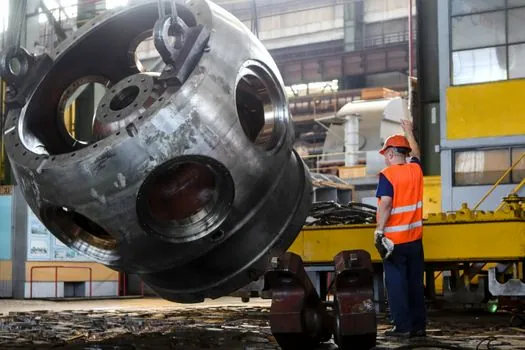
AUMUND and Versa Materials Technology published a joint engineering study in July 2026 covering conveying and thermal processing architectures for scalable cathode material production, a packaging line that becomes the bottleneck once reaction outputs cross roughly 5,000 t/yr per train [S7].
For high-nickel NMC811, NCMA, and single-crystal cathode grades, the kiln and post-calcination handling train sets both capex per ton and achievable yield; for LFP, the carbon-coating and milling steps dominate yield loss rather than the sintering furnace [S4]. Plant designers planning 100,000+ t/yr single-site capacity typically need two parallel processing trains to maintain campaign flexibility between LFP and high-nickel SKUs.
A 2026 Science Direct study by Lassila also demonstrated a low-temperature direct recycling route for LFP production scraps, an approach that can recover cathode-grade lithium iron phosphate from cell-manufacturing waste streams and lower the effective precursor bill on a new LFP line [S8].
Comparison: LFP vs NCM vs NCA vs LMFP vs LCO on Planning Inputs
The five commercial cathode families diverge on the four planning inputs that actually drive gigafactory site decisions: energy density, voltage plateau, cost per kWh, and safety margin [S4].
For a planner, the matrix reduces to: pick LFP when cost and cycle life dominate (ESS, entry EVs, commercial vehicles), pick high-nickel NCM or NCA when energy density per liter dominates (long-range passenger EVs), and pick LMFP when a small voltage bump over LFP is needed without leaving the olivine family [S4].
CSIS's May 2026 report states that China accounts for about 85 to 90 percent of all global cathode and anode active material manufacturing capacity, and that several U.S. midstream projects were cancelled in 2025, leaving the U.S. downstream assembly and cell segments growing faster than midstream materials [S5].
That concentration is the single largest planning risk for non-Chinese cell OEMs: any new U.S. or European gigafactory line must either qualify a non-China cathode source (Epsilon, IBU-tec, planned LBM-Indonesia material, or Korean/Japanese suppliers) or accept exposure to Chinese export-control or tariff shifts [S5]. The 11.9% CAGR recorded for the Rest of Asia-Pacific cathode market in the MarketsandMarkets May 2025 base report is the regional growth signal that planners watch as a proxy for the buildout of non-China but Asia-based capacity [S9].
Selection Criteria for a New Cathode Supply Contract
Four criteria tend to dominate a 2026 cathode sourcing decision, in order of typical weight: regional content (for IRA, EU Critical Raw Materials Act, and similar policy gates), precursor security (lithium, nickel, manganese, iron, phosphate), validated cell-level performance (discharge capacity and electrode density versus the target cell spec), and $/kWh landed cost inclusive of tariffs and logistics [S3][S5].
Epsilon CAM's Gen 3.0 LFP at 159 mAh/g and 2.51 g/cc electrode density is targeted at cell makers that need Western-qualified material with Chinese-comparable performance, while Lopal-LBM's 240,000 t/yr Indonesian line is targeted at scale, with the LBM site supplying LGES for North American ESS packs [S1].
On cost structure, the cathode represents 40% to 50% of cell-level material costs and is the largest single procurement category by value, so even a 5% landed-cost delta on cathode translates into a larger swing on the bill of materials than a 20% delta on separator or electrolyte cost [S3]. Procurement teams that anchor RFPs on $/kWh without pinning a regional-content clause end up re-bidding within 12 to 18 months once the IRA or EU CRM filing window moves.
Process Equipment, Scrap Recovery, and the New Planning Floor

Process engineers planning a new cathode line should treat the following as the 2026 spec floor: precursor co-precipitation reactors sized for 10,000 to 50,000 t/yr per train, continuous rotary or pusher kilns for high-nickel calcination, and a carbon-coating plus jet-mill finishing section that holds electrode density above 2.50 g/cc for premium LFP grades [S4][S7].
Scrap and off-spec recovery is now a first-line economic input: Lassila's 2026 direct recycling study showed that LFP manufacturing scrap can be re-introduced into the precursor stream at sub-virgin cost, which compresses the effective precursor bill and improves project IRR for a 100,000 t/yr LFP line by an amount that depends on scrap yield [S8].
Trackable near-term signals: (1) the 2028 commissioning of the 20,000 t/yr Epsilon CAM Moosburg line and the 240,000 t/yr LBM Indonesia line, (2) any disclosure of additional non-China LFP precursor capacity in Europe or North America, and (3) updated Fact.MR or CSIS data points on the U.S. midstream share through 2027, since downstream cell capacity is already outpacing midstream materials [S1][S3][S5]. For related BESS procurement decision logic, see this BESS procurement decision map, and for process-side measurement and control on a cathode line, the solid-state battery process control spec stack is the closest adjacent reference.
The underlying component specifications are covered under advanced material, chemical material, and copper material.