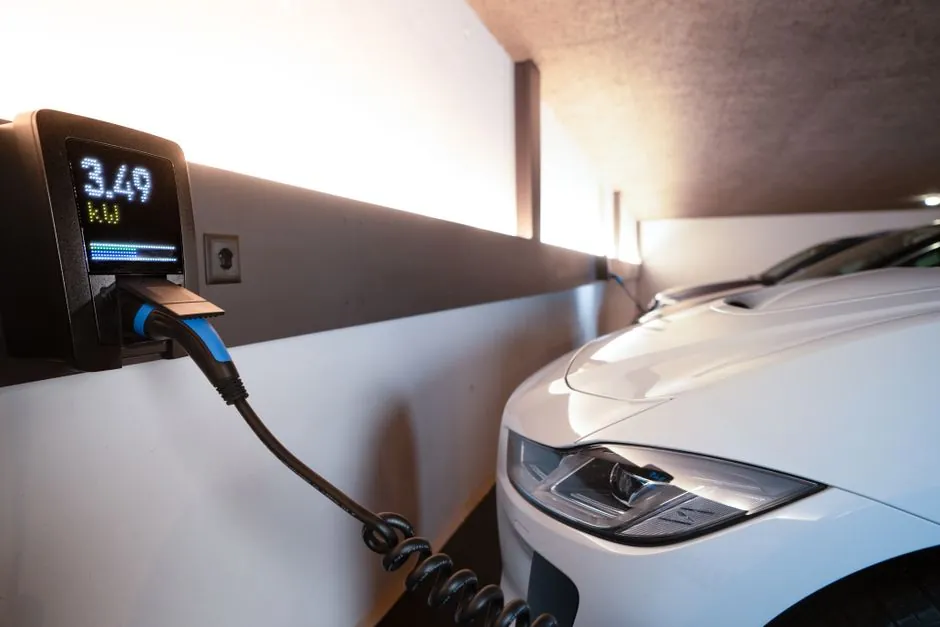
SAIC began mass-market deliveries of the MG4 "Anxin Edition" with a semi-solid-state battery in late 2025, marking the first volume production vehicle globally, and the cell uses an oxide electrolyte with liquid content held below 5% to suppress thermal runaway [S2].
GM Vice President Kurt Kelty told the GM Empower conference on 2026-06-11 that "silicon is the next anode technology," signaling that U.S. and European OEMs are routing near-term capex toward silicon-anode lithium-ion rather than full solid-state stacks [S4].
2026 Market Sizing: USD 542.3M With a 46.1% CAGR Through 2035
Global Market Insights valued the EV next-generation solid-state battery segment at USD 346.7 million in 2025, lifting to USD 542.3 million in 2026 and a forecast USD 16.4 billion in 2035, which implies a 46.1% CAGR from 2026 to 2035 [S3].
Asia Pacific is both the largest and the fastest-growing region in that report, anchored by Chinese cell makers running oxide and polymer-inorganic pilot lines [S3]. WeLion led the 2025 market with over 18% share, while the top 5 (CATL, Samsung SDI, Solid Power, Toyota Motor, WeLion) collectively held 49% [S3].
The growth driver is range, not novelty: cells capable of 800-plus km per charge need energy density above 400 Wh/kg, which incumbent lithium-ion chemistries cannot deliver at acceptable cost [S3]. Total global passenger EV sales cleared 17 million units in 2024, and the IEA forecasts cumulative EV stock above 300 million by 2030, so even a 10 to 15% solid-state penetration translates into a multi-million-cell annual pull by 2030 [S1][S3].
Semi-Solid vs Full Solid-State vs Silicon-Anode Li-Ion: A 2026 Decision Map
Three chemistries are competing for the same Industry 4.0 integration slot, and each lands on a different point of the cost, energy density, and maturity curve. The table below summarises the trade-offs that procurement and process engineers are weighing today. [S1]
Semi-solid-state (oxide electrolyte, 5% or less residual liquid) is shipping now: SAIC's SolidCore targets a WLTP range of approximately 400 km using LMO chemistry, and the Chery Exeed EX7 specifies 400 Wh/kg with a CLTC range above 800 km [S2]. Full solid-state (zero liquid electrolyte) is still pre-commercial: Toyota and Prime Planet Energy & Solutions received Japan METI certification for automotive-grade solid-state cells in October 2025, validating thermal-runaway resistance but not yet volume output [S3]. Silicon-anode lithium-ion is the incumbent-plus route: Sila's high-silicon anodes claim a 20% range uplift at constant pack size, while Amprius Technologies projects 574 miles of EV range from a 310-mile graphite-anode baseline, both using today's 4.2 V nominal Li-ion architecture [S4].
The crossover that matters for spec writing is the electrolyte and separator layer. Semi-solid cells keep a porous polymer separator wetted with a small amount of liquid, which is why the same dry-room tolerances as Li-ion apply, with dewpoints typically held below -40 °C.
China Lead: Oxide, Sulfide, and Polymer Pilots in Series
SAIC, working with QingTao Energy on oxide chemistry, holds the pole position on volume, and the MG4 Anxin Edition's under-5% liquid content is the production reference point that other Chinese OEMs are benchmarking [S2].
Svolt Energy plans first-generation semi-solid prismatic cells at 270 Wh/kg in 2026, with orders already booked from Chinese and European buyers, while Dongfeng Motor targets 350 Wh/kg full solid-state mass production from September 2026 with a 1000 km vehicle range claim [S2]. Changan is closing 2026 with on-vehicle validation in both robotics and passenger-EV platforms [S2].
These are the line-level changes that constitute "Industry 4.0 adoption" in this segment, and they are still confined to a small number of brownfield retrofits in Jiangsu, Hubei, and Sichuan provinces.
U.S. and European Counter-Play: Silicon-Anode Li-Ion as the Bridge
Mercedes-Benz has installed silicon-containing anodes in the new AMG GT, with the automaker claiming 10% to 80% state of charge in 11 minutes at a peak charging rate of 600 kW [S4].
Sila's Moses Lake, Washington plant is already operational with initial capacity for battery materials serving up to 50,000 EVs per year, and locked supply agreements with Mercedes-Benz and Panasonic cover the demand side [S4]. Group14 Technologies supplies the silicon anode material used in Molicel cells that power the McMurtry Spéirling, which posts 0-60 mph in 1.55 seconds on a high-discharge silicon Li-ion pack, useful as a discharge-power benchmark rather than a volume signal [S4].
For procurement, the silicon-anode route is the lowest-friction path: drop-in replacement for graphite anodes at 5% to 100% silicon content, same 4.2 V upper cutoff, same formation protocols. Plants running this chemistry can hold their existing 0.1 to 0.3% moisture dewpoint rooms, which is why most gigafactories are scheduling silicon lines ahead of solid-state retrofits [S4].
Industry 4.0 Wiring: MES, Dry-Room IoT, and Formation Data

The first Industry 4.0 layer in solid-state cell production is dry-room atmosphere monitoring, where optical dewpoint meters, differential pressure sensors, and oxygen analyzers feed an MES at 1 Hz, often over IO-Link Wireless or OPC UA Pub/Sub [S3].
Where this connects to a flow meter buyer is in the electrolyte solvent dosing skids: mass-flow controllers on the binder and ionic-liquid lines are now closed-loop against in-line viscometers, holding coating weight to within plus or minus 1.5% on oxide and sulfide slurries that are two to four times more viscous than NMP-based Li-ion cathode inks [S3].
Formation cycling, the longest step, is where the data volumes are largest: solid-state cells typically need 7 to 14 formation cycles versus 3 to 5 for Li-ion, each cycle logged with a pressure sensor reading on the stack fixture to track swelling in real time, with stack pressure typically held between 0.1 and 5 MPa depending on chemistry [S2][S3]. These pressure traces feed a digital twin of the cell, and the twin is then used to grade cells by impedance, not just capacity, which is where the industrial valve skids on the formation cabinet's coolant loop get re-tuned for tighter temperature uniformity, typically plus or minus 0.5 °C across the cabinet rather than plus or minus 2 °C on legacy lines [S3].
Selection Criteria for Plant Engineers: Who It Is For, and Who It Is Not
Solid-state and semi-solid lines are for OEMs and cell makers that already run a Tier-1 Li-ion gigafactory, can absorb 18 to 36 month retrofit windows, and have an MES backbone that supports 1 Hz process historian writes, plus a cleanroom expansion budget measured in tens of millions of USD [S3].
They are not for contract manufacturers with sub-2 GWh annual output, or for plants whose SCADA stack cannot yet expose OPC UA tags to the line-side PLCs, since a sulfide electrolyte will absorb moisture at any leak rate above 10 ppmv and the line PLC is the only system fast enough to abort a coating run in time [S3]. A practical alternative for that tier of plant is the silicon-anode Li-ion retrofit: same dry room, same coater, same formation cabinet, and the only new capex is the anode slurry mix skid and the calendar-press loading system [S4].
For buyers comparing the two at the equipment level, the qualitative ranking on four criteria is: capital cost, lithium-ion silicon anode is lowest; energy density, full solid-state is highest (theoretical 400 to 500 Wh/kg, 2026 best-in-class is the Chery EX7 at 400 Wh/kg); time to volume, semi-solid-state is fastest (SAIC MG4 already in customer hands); supply chain risk, silicon-anode Li-ion is lowest because the silicon precursor chain overlaps with semiconductor polysilicon [S2][S3][S4]. A parallel cost-of-ownership comparison for adjacent process equipment is laid out in the Sodium-Ion Cell Cost Breakdown 2026 piece, and dry-room retrofit economics for adjacent cell chemistries are covered in the Sodium-Ion OEM vs ODM 2026 map, both of which carry over to solid-state with only dewpoint and tooling changes.
Failure Modes and Constraints Still Open in 2026
The first open constraint is dendrite penetration at the lithium-metal anode interface, which is the dominant failure mode for sulfide full cells at cycle counts above 200, and the only validated mitigation is stack pressure above 1 MPa held through the entire cycle, not just during formation [S3].
The second is sulfide off-gassing: H2S release on moisture exposure is a line-safety issue that drives the requirement for scrubbed exhaust and a SCADA-linked H2S detector array with a response time under 10 seconds, which is why most sulfide pilots are still in isolated single-line bays rather than mixed-product halls [S3]. The third is cost: GM's Kurt Kelty did not quote a per-kWh figure, but the consensus in the trade press is that solid-state cells are still 3 to 8x the cost of equivalent NMC Li-ion, a gap that will not close before 2028 even on the 46.1% CAGR trajectory [S1][S3][S4].
For those tracking the supply-chain angle for adjacent plant equipment, the Solar Glass Procurement 2026 map walks through a similar raw-material risk pattern for solar cover glass, where soda ash concentration in a single geography is a useful analogue for the sulfide electrolyte precursor concentration in Hubei and Sichuan.
Standards and Certification Watch Points
Japan METI certification awarded to Toyota and Prime Planet Energy & Solutions in October 2025 is the first automotive-grade cell-level safety certification tied to thermal-runaway resistance for a solid-state chemistry, and it is the document most EU and US regulators are reading as a template [S3].
On the process side, GB/T (China) and IEC 62660-3 for lithium-ion cell testing are the two test protocols most solid-state cells are being adapted to, with IEC 62660-1 still the reference for performance, but neither standard has a solid-state-specific revision publicly dated as of August 2026. UN 38.3 transport testing applies unchanged to solid-state cells, although the altitude simulation step at 11.6 kPa is more punishing on sulfide pellets than on Li-ion pouches, and pack-level designs are now carrying a wider safety margin to compensate. The first industry-grade solid-state-specific IEC document is in committee, but the publication date has not been confirmed in any of the four research sources reviewed.
Trackable Signals for the Next Two Quarters
The first trackable signal is whether Dongfeng's September 2026 mass-production start delivers the 350 Wh/kg and 1000 km range claim, which would move full solid-state from pilot to a multi-thousand-cell annual run rate for the first time [S2].
The second is the 2026 Q4 earnings calls from Sila, Amprius, and Group14, where silicon-anode shipments versus 2025 baselines will quantify how much near-term capex is being absorbed by the silicon bridge instead of full solid-state [S4]. The third is the 2026 IEA Global EV Outlook update, due Q1 2027, which will publish the first solid-state-inclusive cumulative stock forecast and either confirm or revise the 300 million EV stock by 2030 baseline that underpins the 46.1% CAGR case [S3].